
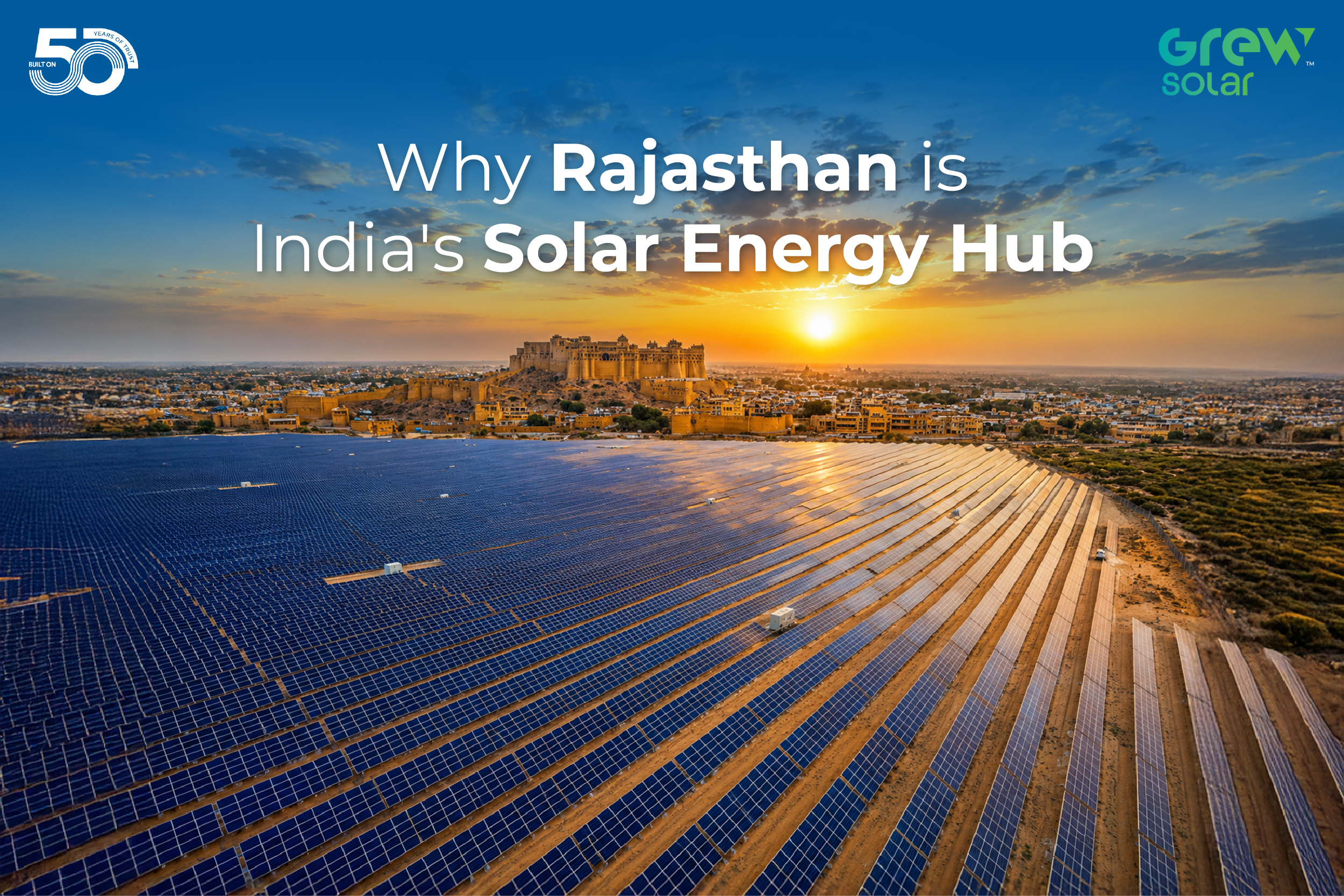
India has committed to reaching 500 GW of non-fossil fuel capacity by 2030, one of the most ambitious clean energy targets in the world. Achieving it will need ground level execution besides policy initiatives. It demands the right geography, the right scale, and consistent execution. On all three counts, one state stands apart more than any other, i.e., Rajasthan.
The Geography Makes the Case
Solar energy is, at its core, a geography-driven industry. Rajasthan’s natural conditions are perfect for it.
The state receives 6 to 7 kWh of solar radiation per square metre each day, with over 325 sunny days annually. In the western areas of the Thar Desert, rainfall occurs on as few as 10 to 20 days per year. Rajasthan has the highest total solar generation potential among all Indian states, assessed at 142 GW by the Ministry of New and Renewable Energy (MNRE).
Other than the sunlight factor, the state also has a significant land advantage. The Thar Desert covers nearly two-thirds of Rajasthan, offering vast stretches of flat, largely uninhabited terrain with barely any agricultural or urban use. For utility-scale solar infrastructure, this means fewer land conflicts, lower acquisition costs, and faster project clearances; most Indian states cannot match these conditions.
Together, these two factors, i.e., high solar irradiation and abundant usable land form the foundation on which everything else in Rajasthan’s solar story is built.
The Scale of What’s Already in Place
Rajasthan’s solar credentials are already well-established.
The state is home to the Bhadla Solar Park in Jodhpur which spans over 14,000 acres and has 2,245 MW of installed capacity. It is the world’s largest fully operational solar park. Bhadla is an example of how seriously Rajasthan has translated their solar potential into reality.
There are other numbers that reinforce this. According to data from the Global Energy Monitor, Rajasthan accounted for around 31% of India’s non-hydro renewable energy installations between 2020 and March 2024. In Q1 2025, Rajasthan generated 13.1 billion units of solar power, outpacing all other states and registering an 11.1% growth over the last quarter, as per Mercom India’s analysis of data from the Central Electricity Authority (CEA) and Ministry of New and Renewable Energy (MNRE).
Rajasthan has also crossed a milestone that no other Indian state has reached, i.e., more than 50% of its total installed power capacity is solar. This reflects where the state stands today.
A Policy Environment Built for Investment
Rajasthan’s solar scale has been consistently backed by its natural advantages with structured, long-term policy.
The Rajasthan Renewable Energy Policy 2023 had a target of 90 GW renewable energy by 2030, out of which 65 GW was to be solar. The following year, the Integrated Clean Energy Policy 2024 upped the target to 125 GW renewable energy by 2029-30, of which 90 GW was to be solar.
To attract private capital, the Rajasthan Investment Promotion Programme 2024 provides 100 per cent exemption on electricity duty for seven years for renewable energy projects, and big waivers on stamp duty and land conversion charges. For capital-intensive projects where tariff margins are closely managed, these incentives have a huge impact on project economics.
The response from industry has been equally significant. GREW Solar, backed by the Chiripal Group’s 52-year manufacturing legacy and established in 2022 chose Dudu, Rajasthan as the location for its solar PV module manufacturing facility. The plant is now one of India’s largest, with 6.5 GW of operational capacity and an ongoing expansion to 11.0 GW in 2026.
The decision by a solar panel company of this scale to root itself in Rajasthan reflects what the state’s policy environment has made possible across the full solar value chain.
What the Next Phase Needs to Solve
Rajasthan’s scale is real and so is the infrastructure work required to sustain it.
Solar generation capacity in the state has grown faster than the grid’s ability to move that power. An 18-month delay in a critical transmission strengthening programme created evacuation bottlenecks for 8.1 GW of renewable capacity, as documented in Grid-India’s official Operational Feedback on Transmission Constraints report for April-June 2025.
Between March and August 2025, curtailment rates climbed from 8.5% to 51.5% during peak solar hours. The Central Transmission Utility of India has identified connectivity challenges for approximately 60 GW of renewable capacity in the state. These are problems that come with moving fast and Rajasthan is moving to address them.
A 1,000 MW/2,000 MWh battery energy storage project is currently underway, with an additional 4,000 MWh allocated under the PSDF scheme. Demand-side flexibility regulations are set to take effect from April 2026 to better integrate variable solar generation into the grid.
The investment in storage and transmission infrastructure is what will allow Rajasthan to convert its generation capacity into delivered, usable power at the scale the state is clearly capable of.
The Bigger Picture
No other Indian state brings together Rajasthan’s combination of solar irradiation, land availability, installed capacity, and policy infrastructure. That ecosystem is now attracting not just project developers, but manufacturers and the broader solar value chain.
For any solar panel company looking to grow within India’s energy transition, Rajasthan is not to be overlooked. The foundations are proven, the ambition is clear, the only thing that remains is closing the gap between what the state can generate and what its grid can carry.
That is the defining challenge and opportunity of Rajasthan’s next phase.

