
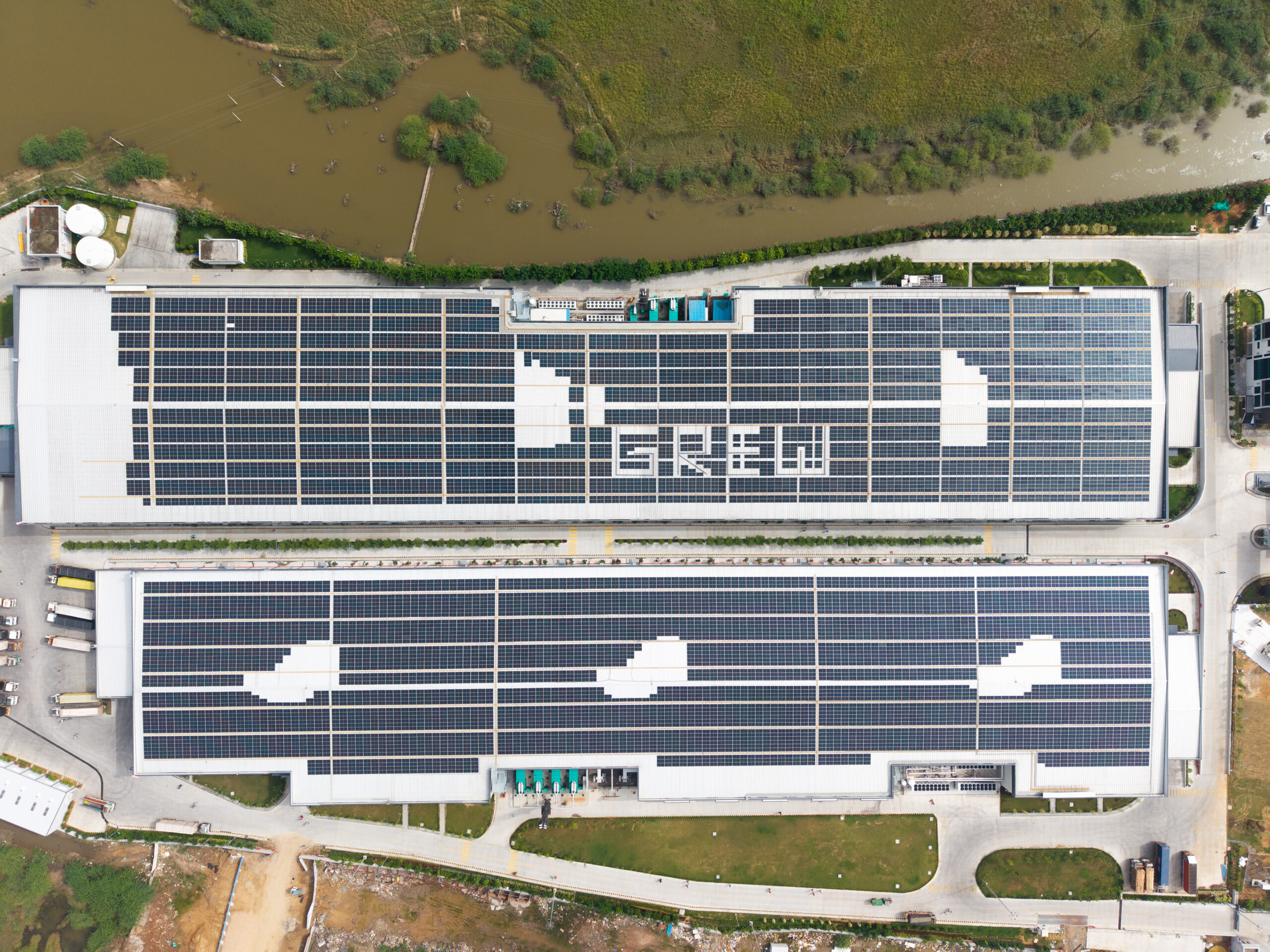
Bifacial modules have moved from a niche specification to the expected choice on most large solar projects. The IEA’s PVPS programme notes that bifacial cells, modules and systems are quickly taking market share from monofacial technology. With adoption largely settled, the harder question for developers and EPCs is how much extra energy a particular site will actually produce.
The range of possible answers is wide. In a study of five Indian climate zones published in Next Energy and reported by pv magazine in September 2026, modelled bifacial gain ranged from 8.36% to 27.10% depending on location and ground surface. IEA PVPS defines bifacial gain as the additional share of total energy a bifacial system produces compared with a monofacial system of the same size and orientation. Most of what determines that number is decided before a module is ever procured.
The Ground Under the Array Sets the Ceiling
The rear face of a bifacial module works mostly with light reflected from the surface beneath it. The reflectivity of that surface, its albedo, caps what the rear side can contribute. IEA PVPS identifies albedo as one of the most important site characteristics for bifacial performance, and reports that single-axis tracker plants over typical natural ground, with albedo between 0.2 and 0.3, generally see gains below 10%.
The Indian study puts a number on the relationship. Its authors found gain rising roughly in step with albedo, with every 0.10 increase adding about 2.6 percentage points. The surfaces they modelled ranged from concrete at an albedo of 0.30 to white paint at 0.90. High-reflectance surfaces such as white paint and aluminium raised annual generation by around 13% to 16% compared with concrete.
Most Indian ground-mount sites sit well below the top of that range, and the spread within a single state can be wide. For a solar plant company in Gujarat developing on dry, pale soil in one district and on cropped farmland in another, the same module and structure can produce noticeably different rear-side yields. Albedo also shifts through the year as dust settles and vegetation returns after the rains. A yield model built on one survey reading is likely to be optimistic for part of the year. Seasonal measurements, or a conservative assumption where none exist, give a more defensible number.
Height, Spacing and Tilt Decide How Much Light Reaches the Back
A reflective surface only helps if the light it returns can reach the modules. Beyond albedo, IEA PVPS lists diffuse fraction, array height, row spacing and the gaps between modules as factors that raise bifacial gain. Of those, height and spacing are the ones a designer actually controls.
NREL’s sensitivity study found that height above ground and albedo both directly affect bifacial performance. It also flagged a gap between test arrays and real plants. At an albedo of 21%, the centre module in a large array produced up to 7% less energy than a single bifacial module, because neighbouring rows block the horizon and shade a larger area of ground. This matters when reading published gains. The Indian study, for instance, modelled a 6 kW system mounted 1.5 m high with 5 m row spacing, a far more open layout than a densely packed multi-megawatt block.
Trackers add another layer. Research from the Solar Energy Research Institute of Singapore, published in Joule and reported by PV Tech, found that bifacial modules on single-axis trackers produced the lowest levelised cost of electricity across 93.1% of the land area analysed. The same study excluded land costs and assumed developers could afford enough row spacing to limit shading. Where land is expensive and rows are tight, part of that advantage is lost.
The mounting structure also takes its share. Researchers at the Technical University of Madrid, in field measurements reported by pv magazine, found that the tracker structure cut rear-side irradiance by 10.0% on one-in-portrait trackers. Rear shading from racking is easy to leave out of an early model and expensive to discover after commissioning.
Reading Bifaciality Off a Datasheet
Bifaciality is the ratio of a module’s rear-side efficiency to its front-side efficiency under equal light. N-type TOPCon cells generally carry higher bifaciality than older PERC designs, which is one reason TOPCon has become the default for bifacial projects.
Many datasheets also publish a bifacial nameplate rating, and this is where yield assumptions can drift. GREW Solar’s G12R DCR, an N-type bifacial TOPCon module with 2 mm glass on both faces, defines its BNPI test condition as 1,000 W/m² on the front and 135 W/m² on the rear, with a stated bifaciality of 80±5%. Working from those two manufacturer-stated values, the rear side adds output roughly equivalent to 108 W/m² of extra front-side light at that test point.
When comparing quotes from solar panel suppliers in Gujarat or anywhere else, the useful question is whether the yield estimate assumes that test-point rear irradiance or a figure modelled for the actual site. Dual-glass bifacial construction also brings rear-surface reliability questions of its own. PV Tech has reported that bifacial PERC+ modules, which lack full rear metallisation, are exposed to rear-side potential-induced degradation.
Where the Gain Mostly Disappears
Some installations leave the rear side with very little to work with. Modules mounted flush or close to a dark industrial roof sit over a low-albedo surface with almost no clearance, and the rear contribution shrinks accordingly. Low fixed-tilt structures and tightly packed rows on expensive land face a similar limit.
Comparing options on solar panel price in India alone misses where much of the value sits. In the Indian study, favourable high-albedo configurations reduced the levelised cost of electricity by 4% to 7%, a gain that came from site design rather than module selection. Whether extra height, wider spacing or a lighter ground surface pays back on a given project is a site-by-site calculation.
As bifacial becomes the standard specification across Indian projects, the module itself stops being what separates one plant from another. That difference will increasingly be decided at the layout stage, by the teams that model the rear side as carefully as the front.

