
Categories
Grew Solar Industrial Solar Solutions Rajasthan Solar Solar Company Solar Energy Company Solar Panel Manufacturer

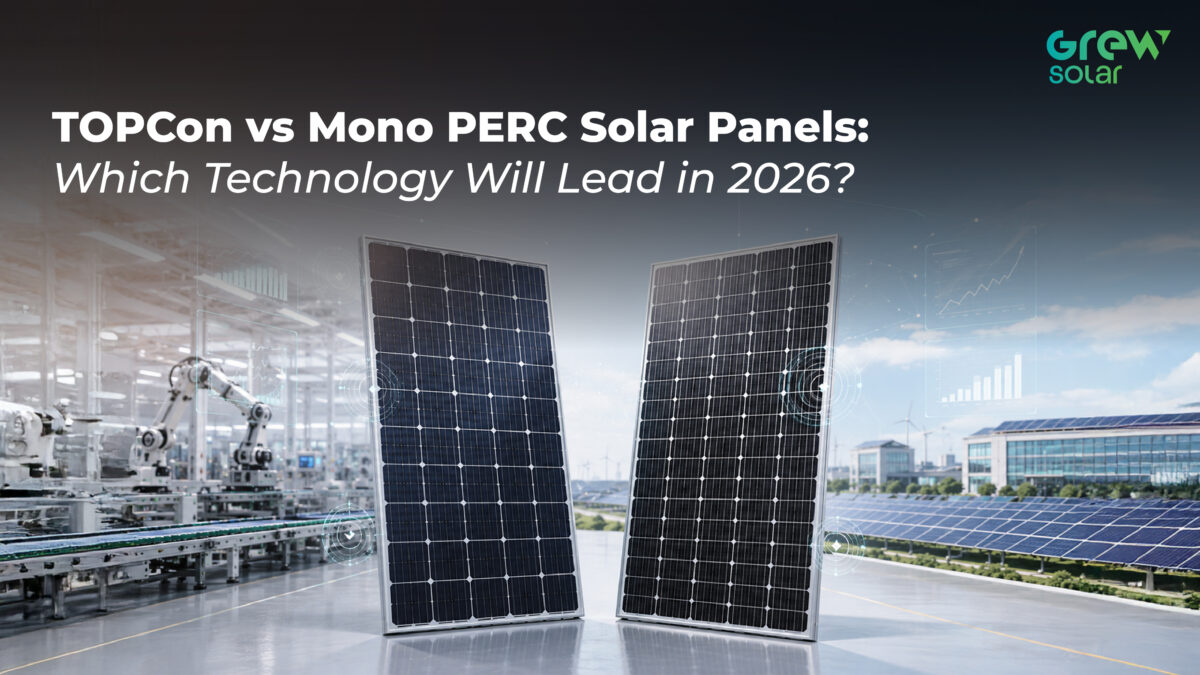
TOPCon vs Mono PERC Solar Panels: Which Technology Will Lead in 2026?

Mono PERC dominated the Indian solar market for the better part of a decade. It was efficient enough, affordable enough, and backed by a manufacturing ecosystem mature enough to supply projects at any scale. For a long time, it was the obvious default.

That default is changing and faster than most people expected.

According to the Fraunhofer ISE Photovoltaics Report 2025, TOPCon technology accounted for approximately 65% of global silicon solar cell production in 2024, up from roughly 20% in 2022. Over the same period, PERC’s share fell from 80% to under 25%. That isn’t a gradual shift. It’s a technology transition already well underway and the reasons behind it have direct implications for anyone making procurement decisions in 2026.

What Makes These Technologies Different

Both Mono PERC and TOPCon are built on monocrystalline silicon, so the fundamental starting point is the same. The difference is in how each handles the physics of energy conversion.

Mono PERC adds a passivation layer to the rear of the cell, reducing electron recombination and improving light absorption. It was a meaningful efficiency leap over earlier polycrystalline technology, and it remains a reliable, well-understood option.

TOPCon goes further. It deposits an ultra-thin tunnel oxide layer and a doped polysilicon film on the cell’s rear surface, reducing recombination losses more aggressively and improving open-circuit voltage. Also, TOPCon uses N-type silicon rather than P-type which means it has no sensitivity to Light-Induced Degradation (LID) or Light and Elevated Temperature Induced Degradation (LeTID), both of which affect PERC panels to varying degrees.

The result is a technology that starts higher on efficiency and holds that efficiency longer over time.

What the Performance Data Shows

Efficiency and degradation are the two figures that determine long-term project economics and on both, the gap between TOPCon and Mono PERC is measurable.

Mono PERC modules currently operate at 20.5-22% efficiency. TOPCon modules reach 22-23.5% in mass production formats. For large-scale commercial and industrial projects, even that 1-2% difference matters because fewer modules per project means lower balance-of-system costs, reduced land use, and simpler installation logistics.

On degradation, manufacturer warranties place Mono PERC at 0.55% annual degradation and TOPCon at 0.40%. The gap looks small in year one. Over 25 years, it represents a meaningful difference in total energy output and therefore in return on investment.

TOPCon also handles heat better than Mono PERC. For commercial solar installation Gujarat projects where panels operate under sustained high temperatures for much of the year, that performance difference shows up in actual annual yield, not just datasheet specifications.

Upfront Cost vs. Lifetime Value

TOPCon modules currently carry a 5-15% price premium over Mono PERC. That premium is real though it has been narrowing steadily as TOPCon manufacturing scale increases and production processes mature.

The relevant question isn’t whether TOPCon costs more upfront. It’s whether the cost per unit of energy generated over the project’s lifetime justifies the investment. For utility-scale and large industrial projects where a module’s 25-year yield is the core financial variable, the answer is increasingly yes.

For businesses evaluating industrial solar solutions Gujarat and similarly scaled deployments, procurement decisions made on upfront module cost alone without accounting for degradation trajectory and lifetime yield tend to look worse as the asset ages. For cost-sensitive residential installations where upfront budget is the primary constraint, Mono PERC still holds a practical case.

What Investment Patterns Are Saying

Market transitions are often announced before they’ve happened. In this case, manufacturing investment confirms what procurement trends suggest.

Across India, solar panel manufacturers in India have been redirecting capital expenditure toward TOPCon production lines rather than expanding PERC capacity. This reflects where order books and technology roadmaps are pointing, and where buyer specifications for new utility-scale and industrial projects are landing.

GREW Solar, a solar company in Gujarat headquartered in Ahmedabad and backed by the Chiripal Group, is among the manufacturers that have built their strategy around N-type TOPCon technology. Its facility in Dudu, Rajasthan, manufactures N-type bifacial TOPCon modules at 6.5 GW of capacity, expanding to 11.0 GW with solar PV cell manufacturing in Narmadapuram, Madhya Pradesh providing upstream integration. That commitment reflects a manufacturing view of where the market is heading, one supported by the global production data.

Does Mono PERC Still Have a Future?

Mono PERC still has a defensible position in residential rooftop projects where upfront cost is the dominant consideration, in weight-constrained installations, and in repowering of existing PERC-based systems. The technology is mature, the supply chain is established, and for standard applications it continues to perform reliably.


But the trajectory is clear. For new utility-scale procurement, for industrial projects where long-term yield drives ROI, and for any application where sustained output over 25 years is the primary measure of value, TOPCon is increasingly the specification of choice, not the premium alternative.


The debate between the two technologies has largely been settled by the market. The more useful question in 2026 is which manufacturer’s TOPCon modules are built with the process control and supply chain integration to deliver on what the technology is actually capable of consistently, across a full project lifetime.
Categories
Grew Solar Industrial Solar Solutions Rajasthan Solar Solar Company Solar Energy Company Solar Panel Manufacturer

How India is Reducing Dependence on Chinese Solar Imports

For years, the conversation around India’s solar industry has been built on Chinese imports. That picture has started to shift, and the numbers behind the shift are worth looking at closely.

Between March 2021 and August 2025, India’s solar module manufacturing capacity scaled twelvefold, from 8.2 GW to 100 GW, according to a CEEW analysis published in November 2025. Over the same broad period, the value of India’s solar module imports fell from $4,353 million in FY2024 to $2,151 million in FY2025.

That’s a real shift, not a policy talking point. 

The Gap That Remains

Module manufacturing capacity isn’t the same as cell manufacturing capacity. The difference between the two is where India’s import picture gets more complicated.

As of October 2025, ALMM List-I enlisted module manufacturing capacity stood at 119.8 GW, per CEEW. Domestic cell manufacturing capacity, however, falls well short of what that module capacity actually requires. CEEW’s analysis puts the shortfall at 59.66 GW. That means nearly half of India’s enlisted module manufacturing capacity currently depends on cells sourced from outside the country to keep running. Closing that gap will require roughly $4.18 billion (₹35,500 crore) in new cell manufacturing investment, by CEEW’s estimate.

This is the part of the story that headline capacity figures tend to skip over. India has built an enormous amount of module assembly capability. It has not yet built the cell manufacturing base to fully supply it. Until that changes, a meaningful share of what goes into an “Indian-made” module still starts as an imported cell.

The Policy Fix Already in Motion

The government’s response to this gap is direct, and it’s arriving on a fixed timeline.

From June 1, 2026, the Ministry of New and Renewable Energy’s ALMM List-II comes into effect. It requires all ALMM List-I module manufacturers to source their cells exclusively from approved domestic suppliers, rather than importing them. Manufacturers who don’t comply risk being delisted from List-I altogether, per official MNRE communication reported by PV Tech.

This sits alongside trade measures already in place. Basic customs duties on solar cells and modules have been imposed since April 2022, increasing the landed cost of imported equipment. In September 2025, India’s Ministry of Commerce and Industry issued a final ruling recommending anti-dumping duties of 23 to 30 percent on solar cells and modules originating from China, depending on the manufacturer. The duties are set to remain in place for three years.

Taken together, these measures are designed to make domestic cell manufacturing the default.

Why This Will Keep Moving Upstream

Closing the cell gap will just shift it one layer further up the supply chain.

The same domestic sourcing logic the government is applying to cells is already scheduled to extend to wafers and ingots. ALMM List-III, introduced for solar ingots and wafers, comes into effect from June 1, 2028. Bids submitted under competitive bidding routes after that date will need to use ALMM List-III compliant wafers, with grandfathering provisions in place for projects already underway.

India’s larger manufacturers have read this trajectory clearly and are moving accordingly. Reliance, Adani, Tata Power, Waaree, Avaada, ReNew, and GREW Solar are among the companies that have begun backward integration into the upstream solar value chain. Tata Power Renewable Energy, for instance, has committed ₹6,500 crore toward developing 10 GW of ingot-wafer manufacturing capacity across two phases.

The pattern is consistent. Every time India closes a gap at one stage of the supply chain, the next stage upstream becomes the new constraint. That isn’t a flaw in the approach. Building a fully integrated manufacturing base happens in stages, not all at once, and this is what that process actually looks like.

Where This Leaves India

The honest assessment sits somewhere between the two extremes. India hasn’t yet achieved full independence from Chinese solar imports as the cell-level dependency gap will take several years of sustained investment to close, with wafers and polysilicon still further out on the horizon.

But the direction of movement is unmistakable. Module manufacturing capacity has scaled dramatically. Policy mechanisms to close the cell gap have firm enforcement dates and the manufacturers driving India’s solar industry forward are investing in upstream capability.

That shift is visible across the country’s manufacturing base, including in states like Gujarat, which has become one of India’s most active hubs for solar manufacturing investment. Companies positioning themselves as a serious solar panel manufacturer in Gujarat are increasingly building toward this same backward-integrated model, recognising that long-term competitiveness depends on owning more of the value chain, not less.

For businesses and developers evaluating what industrial solar solutions Gujarat based manufacturers can offer, that distinction is becoming a meaningful one. The companies investing in cell and upstream capacity today are the ones positioned to be less exposed to import dependency as ALMM requirements tighten further over the next several years.

India’s solar import story is no longer just a story about cheaper Chinese modules. It’s a story about how much of the supply chain India is prepared to build for itself, one stage at a time.

Categories
Grew Solar Industrial Solar Solutions Rajasthan Solar Solar Company Solar Energy Company Solar Panel Manufacturer

Adani vs Tata Solar Panels 2026: Detailed Comparison

Search for solar panels in India today, and two names dominate the results almost immediately i.e., Adani Solar and Tata Power Solar. Both carry significant market presence, and both are counted among the leading solar panel manufacturers in India.

But scale alone doesn’t answer the question that actually matters: which one fits what you’re building?

A residential rooftop system, a commercial facility in Gujarat’s industrial belt, and a utility-scale solar park have very different requirements. The right manufacturer for one isn’t necessarily the right manufacturer for another and in 2026, that distinction is sharper than it used to be.

Tata Power Solar: Legacy Built on Two Decades of Manufacturing

Tata Power Solar’s Bengaluru facility has been operational since 1992, it’s manufacturing history that predates most of India’s current solar industry. That facility produces 682 MW of modules and 530 MW of cells annually.

The bigger story is more recent. In 2025, Tata Power commissioned a 4.3 GW solar cell and module manufacturing plant in Tirunelveli, Tamil Nadu which is India’s largest single-location facility of its kind, built on a ₹4,300 crore investment. The plant runs on TOPCon and Mono PERC technology, and is notable for an 80% women workforce, a detail Tata Power has actively highlighted as part of its operational identity.

Combined, the two facilities give Tata Power Solar 4.9 GW of manufacturing capacity. In the first nine months of FY26 alone, the company produced 2.9 GW of modules and 2.8 GW of cells.

For buyers prioritising brand history and rooftop solar experience, particularly residential and smaller commercial installations, Tata’s manufacturing pedigree carries real weight.

Adani Solar: Scale Through Integration

Adani Solar has taken a different route to the same conversation building scale through vertical integration rather than legacy alone.

Operating out of the Mundra Special Economic Zone in Gujarat, Adani Solar currently runs 4 GW of integrated cell and module capacity, alongside 2 GW of ingot-wafer capacity. That capacity is expanding fast: the company has accelerated its timeline to reach 10 GW of integrated cell and module manufacturing by mid-2026, ahead of its original 2027 target.

What sets Adani Solar apart is the depth of that integration, with its polysilicon through to the finished module, under one roof. It’s a model few Indian manufacturers have replicated at this scale, and it’s part of why Adani Solar ranks 6th globally on Wood Mackenzie’s 2026 list of module manufacturers, the only non-Chinese company in the top six.

For businesses researching commercial solar installation Gujarat options, or evaluating large industrial projects elsewhere, that integration matters. It typically translates into tighter supply chain control and more consistent component quality,  factors that become more visible the larger the project gets.

Why Manufacturing Depth Matters More in 2026

A few years ago, most buyers compared solar panels on price, wattage, and warranty length. That comparison has gotten more sophisticated.

For buyers exploring industrial solar solutions Gujarat and other large-scale deployments, the questions buyers are asking now go deeper: 

  • How consistent is module performance across a production batch? 
  • What does the degradation curve actually look like after year eight or ten? 
  • Is the manufacturer sourcing cells from a third party, or producing them in-house under controlled conditions?

These questions matter because two modules with near-identical datasheet specifications can perform very differently a decade into their operational life. That difference is usually traceable back to the manufacturing process itself.

Both Adani Solar and Tata Power Solar have moved decisively toward TOPCon technology, which offers better low-light performance and lower degradation rates than older Mono PERC modules. For commercial and industrial buyers, higher module efficiency also means fewer modules per project which reduces land use, balance-of-system costs, and installation complexity.

Which One Should You Choose?

There’s no universal answer, it depends on what you’re building.

  • Tata Power Solar tends to be the stronger fit for residential rooftops and smaller commercial projects, where brand familiarity, service reliability, and Tata’s long operating history carry weight with buyers.
  • Adani Solar tends to be the stronger fit for utility-scale deployment and large industrial projects, where integrated supply chain control and high-volume procurement capacity matter more than legacy alone.

Price is part of the equation, but it shouldn’t be the deciding factor. A lower upfront module cost means little if faster degradation or inconsistent quality erodes 25-year generation output. For large-scale projects, the more relevant calculation is lifecycle generation and operational stability, not just the price on day one.

A Market That’s Bigger Than Two Names

What’s worth noting is that India’s solar manufacturing landscape is no longer a two-player conversation. The market is shifting toward manufacturers who combine integrated production, rigorous quality testing, and long-term scalability and that shift is creating room for newer players to compete seriously.

GREW Solar, a solar company in Gujarat headquartered in Ahmedabad and backed by the Chiripal Group, is one example. The company operates a 6.5 GW solar PV module manufacturing facility in Dudu, Rajasthan which is expanding to 11 GW alongside a 3.5 GW solar PV cell manufacturing facility in Narmadapuram, Madhya Pradesh, set to expand to 8.0 GW in 2026. GREW Solar is one of only 11 companies in India to receive a PLI allocation for fully integrated solar manufacturing, and its modules are ALMM certified.

It’s a reminder that India’s manufacturing base is broadening, and that the comparison worth having in 2026 does not stay limited to two names for long.

The Real Decision Factor

Adani Solar and Tata Power Solar represent two different paths to scale in India’s solar manufacturing industry. Tata brings legacy, service reliability, and a strong rooftop track record. Adani brings integrated manufacturing depth and utility-scale capacity, expanding faster than almost any other Indian manufacturer right now.

The right choice depends on your project’s scale, its timeline, and how much weight you place on manufacturing integration versus brand familiarity. 

Either way, the decision is no longer just about price. It’s about which manufacturer’s capabilities actually match what you’re building.

Categories
Industrial Solar Solutions Rajasthan Solar Solar Company Solar Energy Company Solar Panel Manufacturer

Why Industrial Manufacturers in India Are Switching to Solar in 2026

For most of the last decade, the conversation around solar adoption in the Indian industry centred on cost. Modules got cheaper, tariffs fell, and the financial case became harder to argue against. That argument is largely settled now.

What’s driving the current wave of solar adoption among industrial manufacturers is different and more urgent. It’s about risk.

Energy Is No Longer Just an Overhead

India’s power demand is growing faster than the grid can comfortably handle. Peak demand hit 270 GW in summer 2025, up from 250 GW the year before, per the NLDC report with baseload capacity failing to keep pace. 

For industrial manufacturers, that gap doesn’t show up as an abstract policy problem. It shows up as production downtime.

Research published by CEPR on electricity shortages and Indian manufacturing puts it plainly: for plants without backup generation, a grid outage functions like an infinite input tax on electricity production stops entirely. For plants that do have generators, every hour of outage becomes a cost premium on power consumption. Neither outcome is acceptable for manufacturers running tight margins and tighter delivery timelines.

The energy cost structure has also shifted. The Time of Day tariff has been made compulsory for all C&I consumers in India with demand above 10kW from April 2024 onwards, as per the amendments made by the Ministry of Power to the Electricity (Rights of Consumers) Rules. 

The mandated delta between peak and off-peak rates is a minimum of 40%. For energy-intensive manufacturing operations that run through peak hours which most do, this has introduced a new layer of cost volatility that grid dependency alone cannot solve.

Energy shortages and supply unreliability already cost India an estimated 1.9% of GDP annually in lost industrial output and diesel backup costs, per Energy Tracker Asia. Solar, particularly through open access procurement, directly addresses the exposure. It substitutes a variable, grid-dependent cost with a predictable, largely fixed one and for high-load operations like steel, cement, and large-scale manufacturing running at 80% or more plant load factor, open access solar delivers payback periods in the range of 3 to 5 years.

India’s C&I sector has recognised this. Cumulative open access solar capacity reached 27.9 GW by September 2025, after adding 6.1 GW in the first nine months of the year alone, a 13% year-on-year increase, per PV Magazine citing industry estimates. Demand for renewable energy from C&I consumers outstripped supply by approximately 10 GW in 2024. The shift is no longer early-stage.

The Compliance Pressure

Alongside the operational case, a second driver has hardened considerably and it’s one that manufacturers exporting to global markets can no longer treat as optional.

C&I consumers account for nearly half of India’s total electricity demand and 18% of its CO2 emissions as of 2022-23. In 2024, over 200 Indian companies were part of the global Science Based Targets initiative, committing to verified emissions reduction pathways. India was the second largest market globally for renewable energy procurement contracts in 2022. The direction of corporate intent has been clear for some time.

What’s changed is the regulatory pressure reinforcing that intent. The EU’s Carbon Border Adjustment Mechanism entered its definitive phase in January 2026, covering carbon-intensive sectors including steel, aluminium, cement, fertilisers, and hydrogen. Scope 2 emissions, those from purchased electricity are directly counted under CBAM. For Indian manufacturers exporting to Europe, the carbon intensity of their grid power is no longer an internal metric. It’s a cost that shows up at the border.

India’s own Carbon Credit Trading Scheme is expected to be implemented in 2026, adding domestic regulatory pressure alongside the international. The top 250 listed companies by market capitalization in India are now required to disclose Scope 3 GHG emissions from FY2024-25 under the BRSR Core Circular, with further expansion of value chain ESG reporting from FY2025-26.

Open access solar procurement directly reduces Scope 2 emissions. For manufacturers whose export competitiveness, institutional financing access, and supply chain relationships increasingly depend on demonstrable ESG performance, switching to solar is no longer a sustainability initiative. It’s a commercial necessity.

Choosing the Right Manufacturing Partner

The operational and compliance case for solar is established. What follows is an execution question and it starts with module selection.

For industrial-scale installations, the math is straightforward: higher efficiency per module reduces land use and installation complexity, longer warranties reduce lifecycle risk, and manufacturer credibility determines whether the system performs as modelled over a 25-year asset life. 

This is where working with a solar panel company that has a fully integrated manufacturing capability matters. Modules produced through integrated supply chains where cells, not just assembly, are manufactured domestically offer greater consistency, traceability, and quality control than those assembled from imported components. For C&I buyers making a procurement decision that will sit on their balance sheet for two decades, that distinction is not academic.

GREW Solar’s 6.5 GW module manufacturing facility in Dudu, Rajasthan, and 3.5 GW solar PV cell manufacturing facility in Narmadapuram, Madhya Pradesh, both part of a deliberate backward integration strategy are built around exactly this kind of supply chain depth. 

ALMM certified, PLI allocated, and backed by in-house testing infrastructure, the company’s manufacturing model is designed to support the reliability requirements that industrial procurement demands. 

Where the Industry Is Headed

India’s industrial manufacturers aren’t waiting for the grid to catch up or for compliance deadlines to arrive. The open access solar market, the volume of corporate RE procurement commitments, and the pace of C&I capacity additions all point in the same direction.

The question for most industrial manufacturers in 2026 is no longer whether to switch, it’s how quickly, and with whom.