Categories
solar home Grew Solar

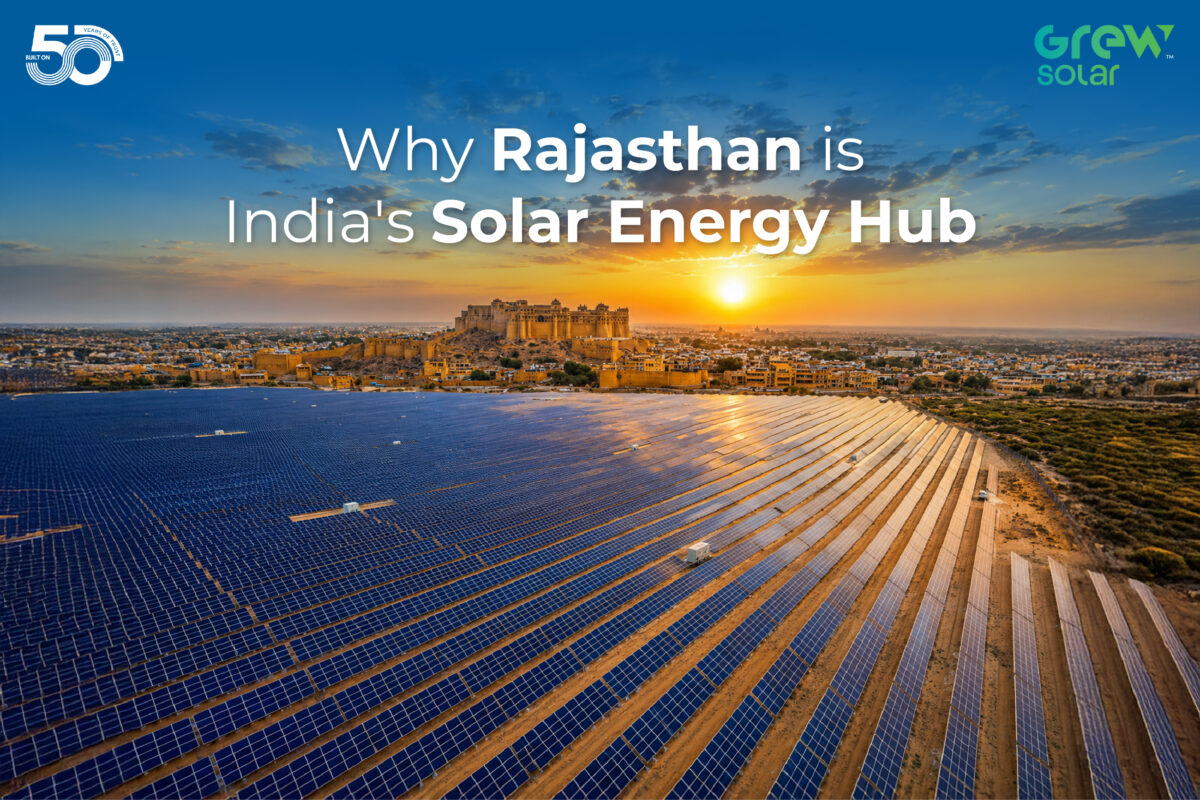
Why Rajasthan is India’s Solar Energy Hub

India has committed to reaching 500 GW of non-fossil fuel capacity by 2030, one of the most ambitious clean energy targets in the world. Achieving it will need ground level execution besides policy initiatives. It demands the right geography, the right scale, and consistent execution. On all three counts, one state stands apart more than any other, i.e., Rajasthan.

The Geography Makes the Case

Solar energy is, at its core, a geography-driven industry. Rajasthan’s natural conditions are perfect for it.

The state receives 6 to 7 kWh of solar radiation per square metre each day, with over 325 sunny days annually. In the western areas of the Thar Desert, rainfall occurs on as few as 10 to 20 days per year. Rajasthan has the highest total solar generation potential among all Indian states, assessed at 142 GW by the Ministry of New and Renewable Energy (MNRE).

Other than the sunlight factor, the state also has a significant land advantage. The Thar Desert covers nearly two-thirds of Rajasthan, offering vast stretches of flat, largely uninhabited terrain with barely any agricultural or urban use. For utility-scale solar infrastructure, this means fewer land conflicts, lower acquisition costs, and faster project clearances; most Indian states cannot match these conditions.

Together, these two factors, i.e., high solar irradiation and abundant usable land form the foundation on which everything else in Rajasthan’s solar story is built.

The Scale of What’s Already in Place

Rajasthan’s solar credentials are already well-established.

The state is home to the Bhadla Solar Park in Jodhpur which spans over 14,000 acres and has 2,245 MW of installed capacity. It is the world’s largest fully operational solar park. Bhadla is an example of how seriously Rajasthan has translated their solar potential into reality.

There are other numbers that reinforce this. According to data from the Global Energy Monitor, Rajasthan accounted for around 31% of India’s non-hydro renewable energy installations between 2020 and March 2024. In Q1 2025, Rajasthan generated 13.1 billion units of solar power, outpacing all other states and registering an 11.1% growth over the last quarter, as per Mercom India’s analysis of data from the Central Electricity Authority (CEA) and Ministry of New and Renewable Energy (MNRE).

Rajasthan has also crossed a milestone that no other Indian state has reached, i.e., more than 50% of its total installed power capacity is solar. This reflects where the state stands today.

A Policy Environment Built for Investment

Rajasthan’s solar scale has been consistently backed by its natural advantages with structured, long-term policy.

The Rajasthan Renewable Energy Policy 2023 had a target of 90 GW renewable energy by 2030, out of which 65 GW was to be solar. The following year, the Integrated Clean Energy Policy 2024 upped the target to 125 GW renewable energy by 2029-30, of which 90 GW was to be solar.

To attract private capital, the Rajasthan Investment Promotion Programme 2024 provides 100 per cent exemption on electricity duty for seven years for renewable energy projects, and big waivers on stamp duty and land conversion charges. For capital-intensive projects where tariff margins are closely managed, these incentives have a huge impact on project economics.

The response from industry has been equally significant. GREW Solar, backed by the Chiripal Group’s 52-year manufacturing legacy and established in 2022 chose Dudu, Rajasthan as the location for its solar PV module manufacturing facility. The plant is now one of India’s largest, with 6.5 GW of operational capacity and an ongoing expansion to 11.0 GW in 2026. 

The decision by a solar panel company of this scale to root itself in Rajasthan reflects what the state’s policy environment has made possible across the full solar value chain.

What the Next Phase Needs to Solve

Rajasthan’s scale is real and so is the infrastructure work required to sustain it.

Solar generation capacity in the state has grown faster than the grid’s ability to move that power. An 18-month delay in a critical transmission strengthening programme created evacuation bottlenecks for 8.1 GW of renewable capacity, as documented in Grid-India’s official Operational Feedback on Transmission Constraints report for April-June 2025. 

Between March and August 2025, curtailment rates climbed from 8.5% to 51.5% during peak solar hours. The Central Transmission Utility of India has identified connectivity challenges for approximately 60 GW of renewable capacity in the state. These are problems that come with moving fast and Rajasthan is moving to address them. 

A 1,000 MW/2,000 MWh battery energy storage project is currently underway, with an additional 4,000 MWh allocated under the PSDF scheme. Demand-side flexibility regulations are set to take effect from April 2026 to better integrate variable solar generation into the grid.

The investment in storage and transmission infrastructure is what will allow Rajasthan to convert its generation capacity into delivered, usable power at the scale the state is clearly capable of.

The Bigger Picture

No other Indian state brings together Rajasthan’s combination of solar irradiation, land availability, installed capacity, and policy infrastructure. That ecosystem is now attracting not just project developers, but manufacturers and the broader solar value chain.

For any solar panel company looking to grow within India’s energy transition, Rajasthan is not to be overlooked. The foundations are proven, the ambition is clear, the only thing that remains is closing the gap between what the state can generate and what its grid can carry.

That is the defining challenge and opportunity of Rajasthan’s next phase.
Categories
solar home Grew Solar

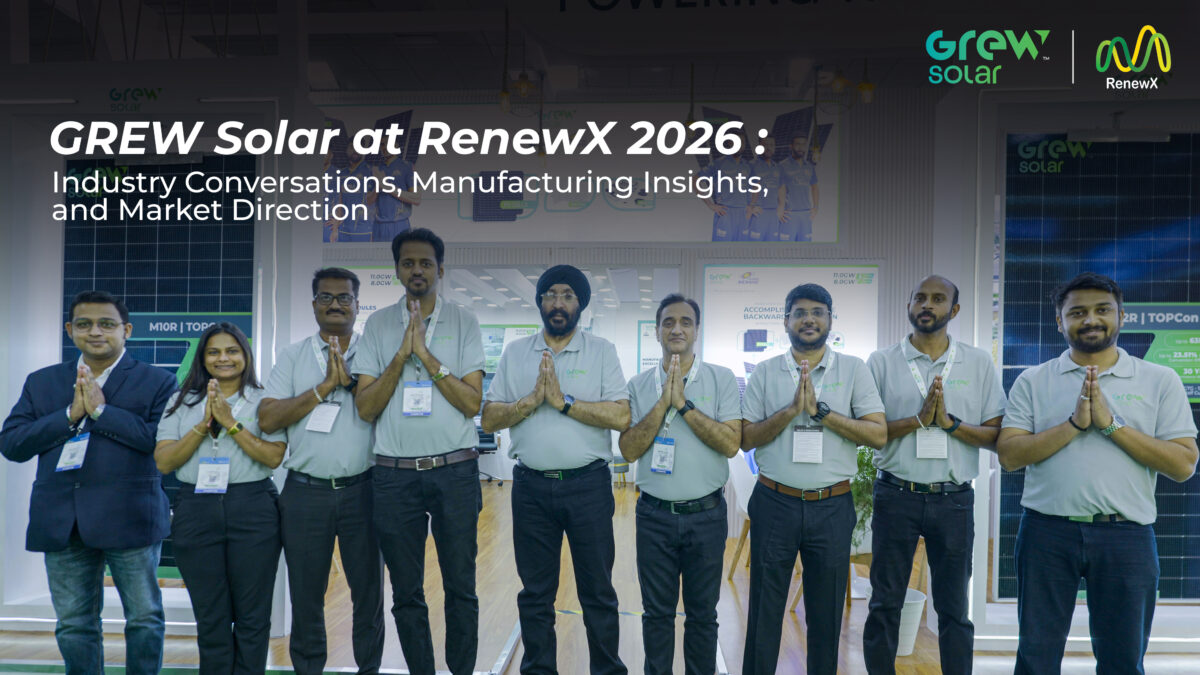
GREW Solar at RenewX 2026: Industry Conversations, Manufacturing Insights, and Market Direction

RenewX’s10th edition under the theme “A Decade of Impact – A Future of Abundance” was a three-day event that brought together over 8,000 industry professionals, 200+ leading brands, and more than 50 speakers across solar, energy storage, bioenergy, and emerging clean technologies. 

For manufacturers, the event offered a direct view of how market expectations are evolving. Conversations at booths and sessions reflected a clear shift in procurement priorities, with greater emphasis on manufacturing quality, system integration, and long-term performance rather than upfront cost alone.  

GREW Solar at RenewX 2026 

GREW Solar exhibited its G12R and M10R solar PV modules designed for utility-scale and commercial applications.

Engagement at the booth extended beyond product specifications. Conversations with EPCs, developers, channel partners, and project financiers reflected a shift in how modules are being evaluated today. 

Questions focused on performance consistency across batches, degradation behavior under high ambient temperatures, long-term reliability, and manufacturing traceability. These discussions pointed to a broader industry trend where modules are assessed as long-term performance assets rather than standalone procurement items.

Members of the GREW Solar team also participated in conference sessions addressing critical industry challenges, including the transition to hybrid projects, energy storage deployment, manufacturing quality, and export readiness.

Key Industry Conversations at RenewX 2026

Discussions across the event indicated a gradual shift from standalone solar projects to more integrated energy systems. Hybrid configurations that combine solar, wind, and storage are becoming more common, with a stronger focus on delivering firm and dispatchable power.

Energy storage was a recurring theme, particularly in the context of managing variability and supporting grid requirements. At the same time, there was continued attention on domestic manufacturing and supply chain depth, especially as India increases its installed capacity. 

Another noticeable shift was in evaluation criteria. While cost remains relevant, there is more consistent focus on performance, degradation, and long-term reliability.

Manufacturing and Scale: Insights from Leadership

One of the key discussions at RenewX 2026 focused on how Indian manufacturers can position themselves in global markets. As part of a BloombergNEF-powered panel on unlocking global opportunities through strategic alliances, Hardip Singh, COO at GREW Solar, shared perspectives on the practical realities of scaling solar manufacturing in India.

A central point was the importance of execution. Experience across different states has shown that policy intent alone is not sufficient. Infrastructure readiness, logistics, and access to supply chains have a direct impact on how effectively manufacturing can be set up and scaled. 

There has also been a clear shift in how product quality is perceived. With advancements in technology and stronger regulatory frameworks, discussions are now focused on consistency of performance and the ability to deliver at scale rather than comparisons with global benchmarks. 

Manufacturing discipline, including process control and integration across the value chain, is becoming a more relevant factor in how manufacturers are evaluated in both domestic and export markets. 

Evolving Market Dynamics and Demand Patterns

Market dynamics were also discussed in the context of changing project structures and emerging technologies. In a CRISIL-powered session focused on the evolution of energy storage demand across utility-scale, commercial and industrial, and residential segments, Ankur Baranwal, National Sales Head – KAM at GREW Solar, highlighted how these shifts are influencing solar demand.

The move toward hybrid tenders is changing how solar PV modules are evaluated. Instead of being assessed primarily on cost, modules are now part of a larger system where performance, reliability, and generation profile directly impact project outcomes.

This transition is also leading to more structured demand patterns. As projects are designed to meet defined output requirements, there is less emphasis on short-term pricing and more focus on long-term performance.

At the same time, energy storage deployment is expected to be more closely aligned with demand centres and grid requirements, rather than following the same geographic patterns as solar generation.

Preparing for Export Markets

Sessions exploring India’s readiness for global markets drew lessons from sectors like textiles and chemicals. Three takeaways stood out: consistency beats cost, integration matters for controlling quality, and export markets require patience to build long-term relationships.

India has built domestic manufacturing capacity through PLI, ALMM, and basic customs duty. The next phase should focus on export-linked incentives, trade access through bilateral agreements, support for upstream manufacturing, and competitive financing to enable Indian manufacturers to plug into global supply chains.

What This Means for Solar Manufacturing

RenewX 2026 reflected a sector maturing in its expectations. The focus is shifting from volume addition to system performance, integration, and long-term reliability. Modules are no longer evaluated only on upfront cost but on how they perform within larger systems over time.

This increases the importance of manufacturing quality, process control, and backward integration. As domestic capacity expands, consistency and reliability are becoming more important than incremental cost differences.

For GREW Solar, participation in the event provided valuable insights into how developers, EPCs, and financiers are evaluating manufacturers today. These conversations will continue to inform our approach to capacity expansion and product development as we work toward 11.0 GW of module manufacturing capacity and 8.0 GW of cell manufacturing capacity in 2026.

We thank everyone who visited our booth and engaged with our team during the event.

Categories
solar home Grew Solar

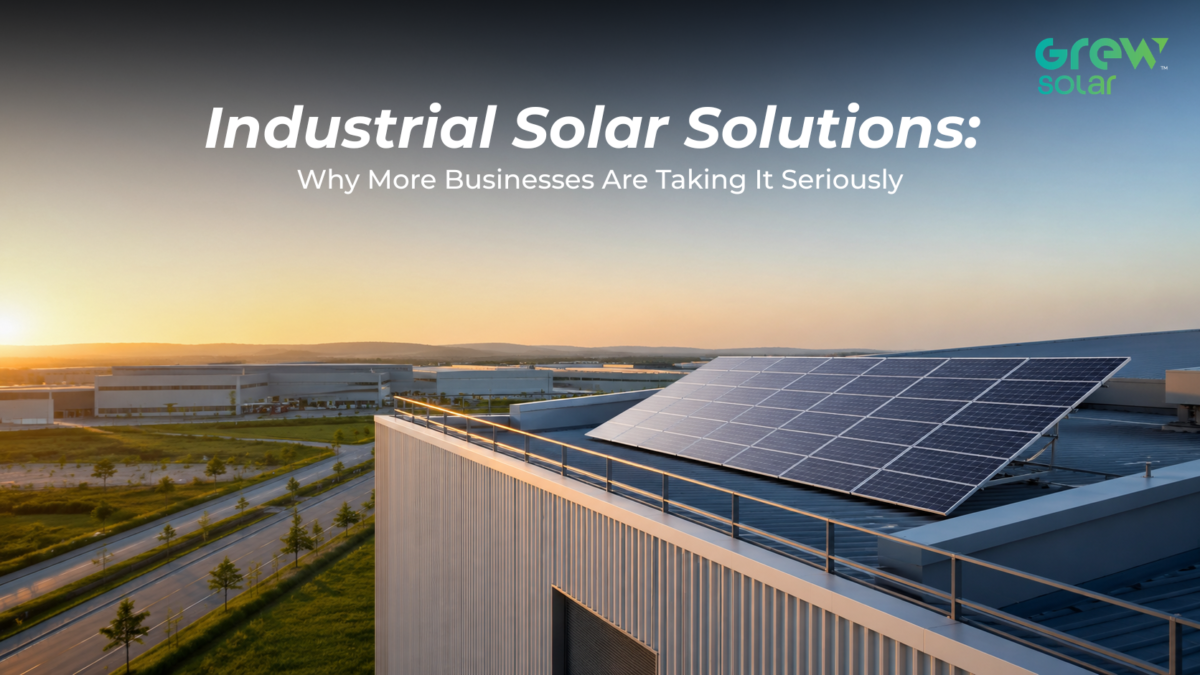
Industrial Solar Solutions: Why More Businesses Are Taking It Seriously

For a long time, energy was just another line item in operational costs. Something you paid for and moved on.

That approach is slowly changing.

With electricity prices becoming less predictable and consumption steadily increasing, many businesses are now looking at energy a bit differently, not just as a cost, but something that can be managed better.

This is where industrial solar solutions are starting to come into the picture more often.

Not Just an Alternative Anymore

Earlier, solar was often seen as an optional upgrade. Something companies would consider later.

Now, it’s becoming part of the conversation much earlier.

The reason is fairly simple. When a business runs on large-scale operations, even small changes in energy cost can have a noticeable impact over time. And relying entirely on external power doesn’t always give that level of control.

Solar doesn’t solve everything overnight, but it does shift some of that control back to the business.

What “Industrial Solar” Actually Means in Practice

At a basic level, it’s about generating electricity at your own facility using solar panels.

But in practice, it’s not just about installing panels on a roof.

A system has to be planned around:

  • how much energy you use
  • when you use it
  • how your operations might grow in the future

If these things are not considered properly, the system might still work, just not as efficiently as it could.

Why Location Still Matters

One thing that works in favor of businesses across regions like Gujarat, Rajasthan, Maharashtra, and Delhi is the availability of sunlight.

These areas generally receive good solar exposure for most of the year, which makes it easier for systems to generate consistent output.

That said, sunlight alone doesn’t guarantee performance. The way the system is designed still plays a big role.

Where the Real Difference Comes In

Two setups can look similar on paper but perform quite differently over time.

Usually, the gap comes from a few things that are not always visible upfront.

Design decisions, for example, can affect how much sunlight is actually captured.
Material quality influences how the panels handle heat and wear over the years.
And installation, even small errors here can quietly reduce efficiency.

These are not issues that show up immediately, which is why they’re easy to overlook at the beginning.

The Role of Manufacturing (Often Underrated)

A lot of attention goes to installation, but manufacturing quality matters just as much.

Solar panels are expected to last 20 to 25 years. Over that period, even minor inconsistencies can affect output.

Better manufacturing usually means:

  • more uniform performance
  • slower degradation
  • fewer unexpected issues later

It’s not something you notice on day one, but it becomes clear over time.

A Quick Note on GREW Solar

GREW Solar has been expanding its manufacturing capabilities with this long-term view in mind.

With an operational module manufacturing facility in Rajasthan and plans to scale further, the focus is on maintaining consistency in production while supporting larger industrial requirements.

Their use of technologies like N-type TOPCon modules is aimed at improving efficiency, but equally important is the emphasis on process control and quality checks behind the scenes.

Looking Beyond Immediate Savings

Cost savings are usually the starting point for most businesses considering solar.

But over time, the conversation tends to shift.

It becomes less about “how much are we saving this month” and more about:

  • how stable our energy costs are
  • how much control we have
  • how reliable the system is over the years

That’s where well-planned industrial solar systems tend to stand out.

So, Is It the Right Move?

There isn’t a single answer that fits every business.

But for operations with high and consistent energy usage, solar is increasingly becoming a practical option rather than just an alternative.

Not because it’s trending, but because, in many cases, it makes operational sense.

Industrial solar solutions don’t change everything overnight. But they do change how businesses approach energy.

And in a space where costs, efficiency, and long-term planning matter, that shift is becoming more relevant than ever.

Categories
solar home

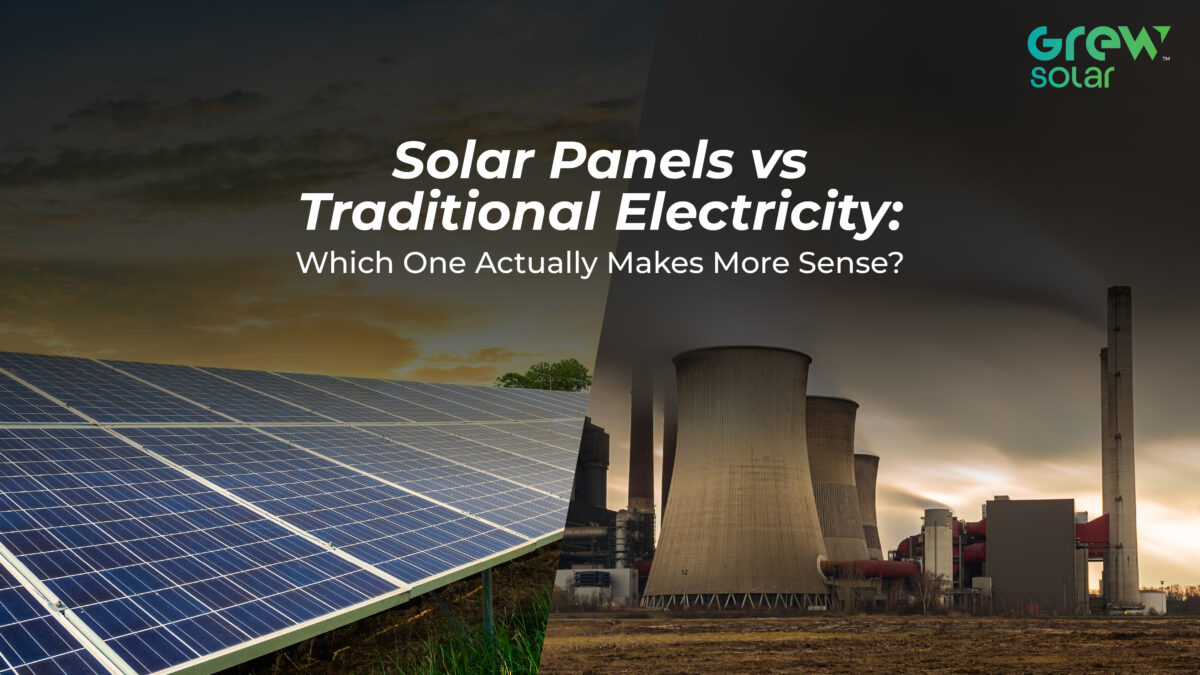
Solar Panels vs Traditional Electricity: Which One Actually Makes More Sense?

Electricity has long been a constant in everyday use. It powers everything we rely on, and for the most part, people haven’t had to think much about where it comes from or how it is priced. That model still holds, but rising tariffs and changing energy needs are now making people take a closer look at their options.

Solar energy has become one of the most considered alternatives in this shift. The comparison today is not just about access to power, but about how energy is generated, how it is managed, and how it holds up over time.

Understanding Traditional Electricity Generation 

Electricity has traditionally been generated at centralized power plants and then transmitted over long distances before reaching end users. This system has supported energy demand for decades and continues to play an essential role.

At the same time, the way it is priced is influenced by factors outside the user’s control. Tariffs tend to increase over time, and changes in fuel costs or supply conditions can affect overall pricing. This makes it difficult to plan energy costs with certainty over the long term.

While the supply itself is generally reliable, the cost of that supply is not always as stable.

How Solar Works Differently

Solar changes how energy is generated and used. Instead of depending entirely on external supply, electricity is produced closer to where it is consumed.

Solar energy also reduces reliance on the grid and introduces a level of control over energy generation. In the regions with strong and consistent sunlight, solar becomes a practical and scalable option for different types of energy needs and usage.

The shift is also structural in nature since here, energy moves from being entirely supplied to being partially self-generated. 

Cost in a Longer-Term View

One of the key differences between solar and traditional electricity is the cost is viewed over time.

Traditional electricity generation does not need upfront investment, but tariffs increase gradually which leads to rising energy expenses over the years.


When it comes to generating electricity with solar, it involves an initial investment, but once the installation is finished, it offers a stable cost structure. Over time, this allows for better visibility and control over energy-related expenses.

The comparison here is not limited to immediate or initial costs but also they evolve over time.

Performance and Efficiency

Energy performance depends on how efficiently power is generated and delivered.

With traditional electricity, some energy loss is experienced during transmission but solar systems generate power closer to the point of use which reduces these losses.

Modern solar modules are designed to operate under a range of conditions, including high temperatures and partial shading. However, performance is closely linked to system design and execution. Well-planned systems deliver consistent output, while gaps in design or installation can affect performance.

Environmental Considerations

Energy decisions are directly related  to environmental impact. Traditional electricity generation involves emissions and resource use, which are now being looked at and reviewed more closely than before.

Solar offers a cleaner alternative, as it relies on renewable energy without direct emissions. This makes it relevant not only from a cost perspective, but also from a long-term sustainability standpoint. 

Why System Quality Matters

Solar performance is affected by a variety of factors besides installation such as module quality, manufacturing consistency, system design, and execution.

Even well-designed systems will underperform if there are inconsistencies in production or gaps in implementation. This is why choosing the right solar panel company is very important. 

A solar company’s manufacturing standards, testing processes, and system planning all play a role in how reliably a system performs over time.

GREW Solar: The Most Trusted Solar Manufacturer 

GREW Solar is one of the youngest-and-fastest manufacturing companies that is known for its manufacturing quality and performance consistency across its solar PV module portfolio. With a roadmap of 11.0 GW of PV module manufacturing capacity and 8.0 GW in PV cell manufacturing capacity in 2026, the company is building scale alongside systems to support solar supply, and strengthen domestic solar manufacturing.

The G12R and M10R solar PV modules are ALMM-certified and have been developed with a focus on efficiency and long-term performance, supported by in-house testing and process control.

The Future of Energy 

The way energy is produced and used is gradually evolving. Traditional electricity will continue to remain an important part of the system, but there is a clear shift toward solutions that offer greater control and long-term stability.

Solar is becoming a part of this shift. It allows energy to be generated closer to where it is used and introduces a more predictable approach to managing energy needs. As adoption increases, the focus is moving beyond cost to include performance, reliability, and sustainability.

The future of energy lies in combining these approaches to create systems that are both stable and adaptable.