Categories
TOPCon vs PERC solar panels

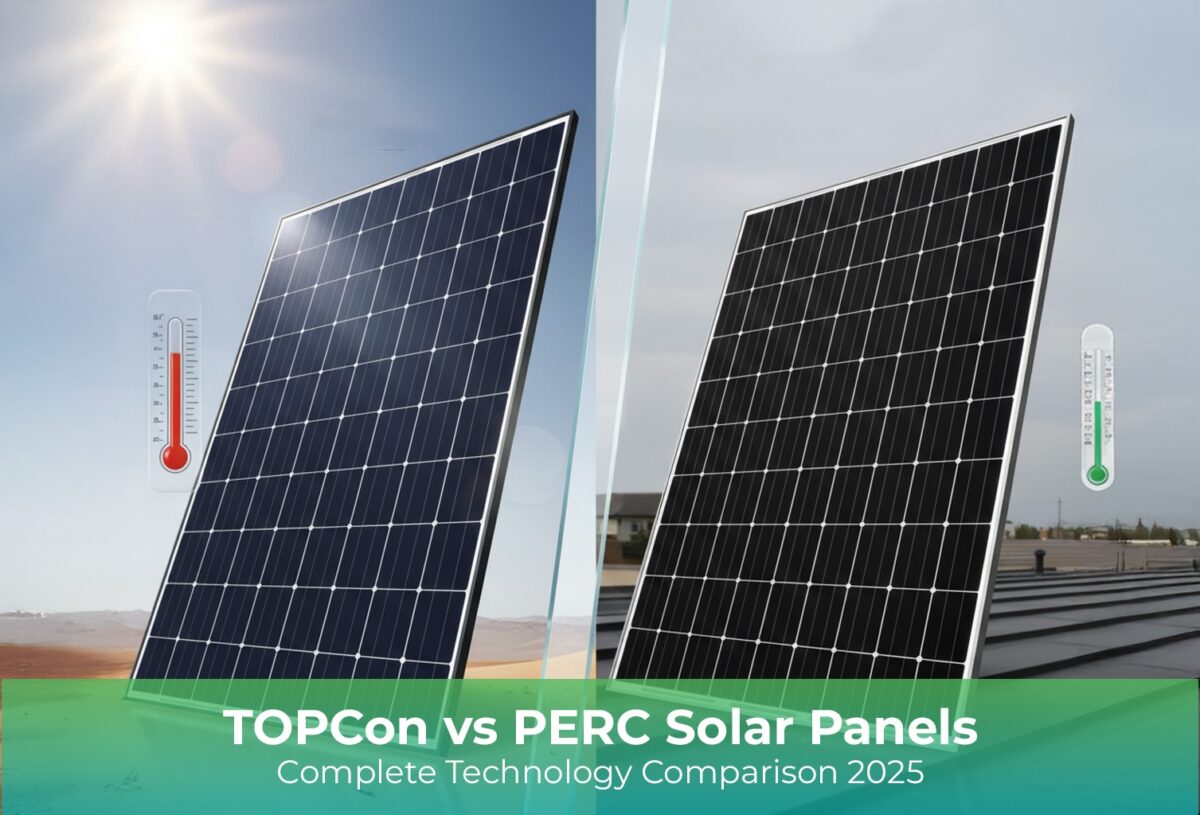
TOPCon vs PERC Solar Panels: Complete Technology Comparison 2025

The solar industry stands at a technological crossroads in 2025, witnessing an unprecedented shift from traditional PERC (Passivated Emitter and Rear Cell) technology to the revolutionary TOPCon (Tunnel Oxide Passivated Contact) architecture. This transformation represents more than an incremental improvement—it’s a fundamental evolution that’s reshaping how we capture, convert, and optimize solar energy. As global solar capacity surges toward record-breaking installations of 597 GW in 2024, representing a 33% increase over the previous year, the choice between PERC and TOPCon technologies has become critical for maximizing energy output, reducing costs, and ensuring long-term performance reliability.


TOPCon technology leads the charge in solar innovation, achieving remarkable cell efficiencies exceeding 26% compared to PERC’s 24.5% maximum, while delivering superior bifacial performance with 85% bifaciality factor versus PERC’s 70%. Industry leaders like GREW Solar are positioning themselves at the forefront of this technological revolution, leveraging advanced manufacturing capabilities and three-stage backward integration to deliver next-generation TOPCon modules with efficiencies reaching 22.84%. With the global TOPCon solar cell market projected to grow from $12.22 billion in 2025 to $26.34 billion by 2032, representing a robust CAGR of 11.6%, the strategic importance of understanding these technologies cannot be overstated.


Understanding PERC Solar Panel Technology

PERC Technology Fundamentals and Architecture


PERC (Passivated Emitter and Rear Cell) technology represents a significant advancement over traditional crystalline silicon solar cells, incorporating a sophisticated passivation layer on the rear surface to dramatically improve light absorption and energy conversion efficiency. The fundamental innovation of PERC lies in its dielectric surface passivation system, which reduces electron surface recombination while simultaneously increasing rear surface reflection through a strategically positioned dielectrically displaced rear metal reflector. This dual-action approach allows photons to be absorbed both when entering the cell initially and when reflected back from the rear surface, effectively providing a second opportunity for light capture and conversion.


The manufacturing process of PERC solar cells begins with high-purity silicon wafer preparation, followed by sophisticated texturing procedures to minimize reflectance and maximize light absorption. The critical differentiation occurs during the application of the rear passivation layer, typically achieved through chemical vapor deposition (CVD) or atomic layer deposition (ALD) techniques that create an ultra-thin but highly effective barrier against electron recombination. This passivation layer, combined with precision-applied anti-reflective coatings and optimized metal contact formation, enables PERC cells to achieve efficiency rates between 20% to 22%, representing a substantial 6-12% improvement over conventional crystalline silicon alternatives.


Comparison of PERC and standard solar cell structures showing additional passivation layers in PERC cells enhancing efficiency.


PERC Performance Characteristics and Market Position


PERC solar panels demonstrate exceptional performance characteristics that have made them the dominant technology in the global solar market, achieving approximately 45% market share in 2025.


The technology excels in diverse environmental conditions, delivering superior low-light performance and maintaining stable energy output across varying temperature ranges with temperature coefficients typically ranging from -0.35% to -0.40% per degree Celsius. This thermal stability, combined with improved spectral response characteristics, enables PERC panels to generate approximately 3% higher efficiency in challenging conditions compared to traditional alternatives.


The cost-effectiveness of PERC technology has been a primary driver of its widespread adoption, offering manufacturers a relatively straightforward upgrade path from conventional cell production with minimal additional equipment investment. Manufacturing costs for PERC cells remain approximately 47% lower than emerging TOPCon alternatives, making them particularly attractive for price-sensitive markets and large-scale utility installations where initial capital expenditure optimization is paramount.


However, this cost advantage must be balanced against PERC’s limitations, including moderate resistance to Light-Induced Degradation (LID), higher annual degradation rates of 0.6-0.8%, and maximum bifaciality factors limited to approximately 70%.


Revolutionary TOPCon Solar Technology Explained

TOPCon Innovation and Advanced Architecture


TOPCon (Tunnel Oxide Passivated Contact) technology represents the next evolutionary leap in solar cell engineering, utilizing an ultra-thin tunnel oxide layer combined with heavily doped polysilicon contacts to achieve unprecedented levels of carrier selectivity and recombination suppression. The revolutionary architecture of TOPCon cells builds upon N-type silicon substrates, which inherently offer superior tolerance to metal impurities, dramatically reduced susceptibility to Light-Induced Degradation (LID), and exceptional long-term stability characteristics that surpass traditional P-type alternatives. This advanced foundation enables TOPCon cells to achieve remarkable efficiency levels exceeding 26%, with leading manufacturers like GREW Solar demonstrating commercial module efficiencies of 22.84% in their latest G2G N-Type TOPCon series.


The sophisticated manufacturing process of TOPCon solar cells involves precision thermal oxidation to create the critical tunnel oxide layer, typically measuring just a few nanometers in thickness, followed by chemical vapor deposition of heavily doped polysilicon contacts. This intricate layering system creates an almost perfect selective contact that allows majority carriers to pass through efficiently while blocking minority carriers, resulting in dramatically reduced recombination losses and enhanced open-circuit voltages. The manufacturing complexity requires advanced equipment including high-temperature furnaces, precision CVD systems, and sophisticated laser scribing technology, representing a significant technological upgrade from PERC production lines.


TOPCon Performance Superiority and Market Trajectory


TOPCon solar panels deliver exceptional performance advantages across multiple critical metrics, achieving bifaciality factors of 85% compared to PERC’s 70%, enabling superior energy harvest from both front and rear surfaces. The superior temperature coefficient of TOPCon technology, ranging from -0.29% to -0.32% per degree Celsius, provides significant advantages in high-temperature environments typical of many global solar installations. This enhanced thermal performance, combined with reduced annual degradation rates of just 0.4-0.5%, ensures that TOPCon panels maintain over 90% of their original efficiency after 25 years of operation.


The market trajectory for TOPCon technology demonstrates explosive growth potential, with projections indicating the technology will capture 60% of the global solar market by 2030, representing a remarkable 22.5% CAGR from 2025 levels. Industry leaders are rapidly transitioning production capacity to TOPCon, with major manufacturers including JinkoSolar, JA Solar, Longi Solar, Canadian Solar, and Trina Solar committing substantial resources to N-type TOPCon module production. The bifacial TOPCon market specifically is experiencing unprecedented growth, valued at $23.45 billion in 2024 and projected to reach $58.08 billion by 2032, driven by utility-scale installations seeking maximum energy density and reduced LCOE.


Comprehensive Performance Comparison Analysis

Efficiency and Power Output Comparative Analysis


The efficiency differential between PERC and TOPCon technologies represents a fundamental shift in solar energy capture capabilities, with TOPCon consistently demonstrating 8.8% higher efficiency ratings compared to PERC alternatives. Laboratory achievements showcase TOPCon cells reaching efficiency levels of 26.1% and beyond, while PERC technology typically peaks at 24.5% under optimal conditions. This efficiency advantage translates directly into real-world power output improvements, with TOPCon modules commonly achieving 500-635W output ratings compared to PERC’s 400-550W range, enabling higher energy density installations and reduced balance-of-system costs.


The fill factor performance of TOPCon solar panels consistently exceeds PERC alternatives, achieving 82-85% compared to PERC’s 79-82% range, indicating superior current collection and reduced resistive losses. This enhanced performance characteristic becomes particularly significant in large-scale installations where even marginal improvements compound into substantial energy yield increases over the system’s operational lifetime. The superior spectral response of TOPCon technology enables enhanced energy capture across broader wavelength ranges, providing particular advantages during low-light conditions including dawn, dusk, and overcast weather scenarios.


Environmental Performance and Durability Assessment


TOPCon technology demonstrates superior environmental resilience compared to PERC alternatives, particularly in high-temperature operating conditions where the enhanced temperature coefficient provides measurable performance advantages. The reduced degradation rate of TOPCon panels, ranging from 0.4-0.5% annually compared to PERC’s 0.6-0.8%, ensures more predictable long-term energy production and improved financial returns over the system’s 30+ year operational lifetime. This enhanced durability stems from TOPCon’s N-type silicon foundation, which exhibits virtually no Light-Induced Degradation (LID) and complete immunity to Light and Elevated Temperature Induced Degradation (LeTID), common challenges affecting P-type PERC technology.


The bifacial capabilities of TOPCon solar panels provide substantial energy yield improvements, particularly in installations with high ground reflectance or elevated mounting configurations. Research demonstrates that bifacial TOPCon modules can achieve energy gains of up to 30% compared to monofacial alternatives, with actual performance improvements of 10-25% commonly observed in utility-scale installations depending on environmental conditions and system design. This enhanced energy capture capability, combined with TOPCon’s superior low-light performance, enables extended daily energy production periods with up to 2 additional hours of meaningful power generation during dawn and dusk periods.


Manufacturing Excellence and Cost Economics

Manufacturing Complexity and Investment Requirements


The manufacturing transition from PERC to TOPCon technology requires substantial capital investment and technological upgrading, with TOPCon production lines demanding approximately 50% higher equipment costs and 100% increased R&D investment compared to PERC alternatives. The sophisticated nature of TOPCon manufacturing necessitates precision thermal oxidation equipment, advanced chemical vapor deposition systems, and high-temperature processing capabilities that extend beyond traditional PERC production requirements. However, leading manufacturers like GREW Solar have successfully navigated this transition, achieving three-stage backward integration and establishing state-of-the-art manufacturing facilities capable of producing 3.0 GW annually, expanding to 11.0 GW by 2026.


The manufacturing cost differential between TOPCon and PERC technologies reflects the advanced materials and processing requirements, with TOPCon cells typically costing $0.28/Wp compared to PERC’s $0.19/Wp manufacturing cost. This 47% cost premium is partially offset by TOPCon’s superior efficiency and extended lifespan, resulting in a 16% lower Levelized Cost of Energy (LCOE) despite higher initial manufacturing expenses. The improving cost dynamics of TOPCon production, driven by manufacturing scale economies and technological optimization, indicate continued cost reduction potential as production volumes increase and learning curve effects take hold.


Economic Performance and Market Value Proposition


TOPCon technology delivers superior economic performance through reduced payback periods, enhanced energy yield, and lower lifetime costs despite premium initial pricing. The typical payback period for TOPCon installations averages 5.8 years compared to PERC’s 6.5 years, reflecting the technology’s enhanced energy production capabilities and improved long-term performance characteristics. Market pricing trends demonstrate TOPCon commanding a 5-15% premium over PERC alternatives, positioning it as a premium technology solution that delivers measurable value through enhanced performance rather than competing solely on initial cost.


The total cost of ownership analysis for TOPCon versus PERC systems consistently favors TOPCon over extended operational periods, with the enhanced efficiency, reduced degradation, and extended lifespan combining to deliver superior financial returns. Utility-scale projects particularly benefit from TOPCon’s performance advantages, with reduced module counts per MW installation leading to significant balance-of-system cost savings including reduced inverter capacity requirements, simplified electrical infrastructure, and optimized mounting systems. These system-level cost reductions, combined with enhanced energy production, position TOPCon as the economically superior choice for performance-focused installations.


GREW Solar’s Innovation Leadership Position

Technological Excellence and Manufacturing Capabilities


GREW Solar has established itself as a pioneering force in TOPCon technology adoption, achieving remarkable three-stage backward integration within just two years of inception and positioning the company as India’s youngest and fastest-growing solar PV module manufacturer. The company’s state-of-the-art manufacturing facilities embody technological sophistication and sustainability, equipped with comprehensive quality assurance infrastructure including advanced R&D and Reliability Labs capable of performing 25 types of IEC tests. This extensive testing capability, substantially exceeding the industry average of 15-20 tests, ensures that every GREW Solar module meets the highest performance and reliability standards.


The company’s G2G N-Type TOPCon Series represents breakthrough engineering achievement, delivering module efficiencies up to 22.84% and peak power output reaching 590Wp. These performance specifications exceed industry averages and position GREW Solar’s products among the most efficient commercially available TOPCon modules globally. The superior temperature coefficient of -0.29% per °C ensures optimal performance in India’s varied climate conditions while enabling up to 2 additional hours of energy production daily during dawn and dusk periods.


Market Leadership and Strategic Vision


GREW Solar’s strategic vision extends beyond traditional manufacturing to encompass systemic change in India’s energy sector and global renewable energy leadership. The company’s ambitious expansion plans include scaling operational capacity from 3.0 GW to 11.0 GW by 2026, supported by recent ₹300 crore funding to enhance manufacturing capabilities and accelerate product development. This expansion strategy positions GREW Solar among India’s largest AI-powered, integrated solar PV module manufacturing facilities, equipped with proprietary R&D capabilities and advanced automation systems.


The company’s commitment to innovation leadership is evidenced by its 8-10% revenue allocation to R&D activities, substantially exceeding the industry average of 3-5%. This investment approach enables continuous technological advancement and ensures GREW Solar remains at the forefront of emerging solar technologies including bifacial TOPCon modules, advanced cell interconnection methods, and smart solar integration capabilities. The company’s participation in major industry events like RE+ 2025 demonstrates its commitment to global technology leadership and knowledge sharing within the renewable energy community.


Market Trends and Technology Adoption Patterns

Global Market Transformation and Growth Projections


The global solar technology landscape is experiencing unprecedented transformation in 2025, with TOPCon technology rapidly gaining market share and fundamentally reshaping industry dynamics. Market analysis indicates TOPCon will achieve parity with PERC at 45% market share in 2025, before surging to 60% dominance by 2030, representing a remarkable 22.5% CAGR growth trajectory. This transformation reflects the industry’s recognition that TOPCon’s superior performance characteristics justify the technology transition despite higher initial manufacturing costs.


The bifacial solar module market specifically demonstrates explosive growth potential, expanding from $23.45 billion in 2024 to a projected $486.6 billion by 2035, with TOPCon bifacial technology leading this expansion. Major manufacturers including JinkoSolar, which leverages extremely efficient N-type TOPCon bifacial technology, are driving large-scale adoption through utility projects seeking maximized energy generation and reduced LCOE. The Asia-Pacific region dominates this growth, capturing 58.67% of the global bifacial solar market, with India playing a crucial role through companies like GREW Solar advancing manufacturing capabilities and technological innovation.


Industry Innovation and Future Technology Roadmap


Emerging technological innovations are further enhancing TOPCon performance capabilities, with next-generation developments including tandem cell architectures, advanced interconnection methods, and AI-integrated optimization systems. The integration of perovskite-silicon tandem cells with TOPCon technology has achieved laboratory efficiencies exceeding 33.9%, pushing beyond theoretical single-junction silicon limits and opening new possibilities for ultra-high-efficiency commercial modules. Smart solar panel technology incorporating IoT capabilities and AI-driven optimization is revolutionizing system monitoring, maintenance, and performance optimization, with TOPCon’s advanced architecture providing an ideal platform for these intelligent features.


The sustainability focus of TOPCon technology development aligns with global environmental objectives, offering reduced carbon footprint manufacturing, enhanced recyclability, and extended operational lifespans that support circular economy principles. Advanced manufacturing techniques including improved automation, reduced material consumption, and enhanced energy efficiency are continuously reducing TOPCon’s environmental impact while improving cost competitiveness. These sustainability advantages, combined with superior performance characteristics, position TOPCon as the preferred technology for environmentally conscious installations and green building certifications.


Future Outlook and Strategic Recommendations

Technology Evolution and Market Dynamics


The solar industry’s trajectory toward TOPCon dominance appears irreversible as manufacturing costs continue declining through scale economies and technological optimization while performance advantages become increasingly significant. Industry projections indicate PERC technology will experience a -10.8% CAGR decline from 2025-2030 as manufacturers and consumers transition to superior alternatives, creating substantial opportunities for TOPCon technology leaders like GREW Solar. The convergence of enhanced efficiency, reduced degradation, superior bifacial performance, and improving cost dynamics positions TOPCon as the optimal technology choice for virtually all solar applications.


Strategic market positioning requires early adoption and manufacturing excellence in TOPCon technology to capture market share during this critical transition period. Companies like GREW Solar, with established TOPCon manufacturing capabilities and continuous innovation investment, are well-positioned to capitalize on market growth while competitors struggle with technology transitions and capacity constraints. The importance of comprehensive quality assurance, advanced R&D capabilities, and strategic backward integration cannot be overstated in achieving competitive advantage during this technological evolution.


Investment and Adoption Considerations


For solar project developers and investors, TOPCon technology represents the optimal balance of performance, reliability, and long-term economic value despite premium initial pricing. The 16% LCOE advantage of TOPCon over PERC, combined with reduced payback periods and enhanced energy yield, provides compelling financial justification for technology adoption across residential, commercial, and utility-scale applications. The extended 30+ year operational lifespan and reduced degradation characteristics of TOPCon panels ensure superior return on investment over complete system lifecycles.


The strategic importance of selecting technology leaders like GREW Solar extends beyond product performance to encompass manufacturing reliability, innovation continuity, and service excellence throughout the system’s operational lifetime. Companies demonstrating three-stage backward integration, comprehensive quality assurance, and substantial R&D investment provide the technological foundation and manufacturing stability essential for long-term project success. As the solar industry continues its rapid evolution, partnering with innovation leaders positioned at the forefront of TOPCon technology development ensures access to continuously improving products and cutting-edge technological advancement.


Conclusion: Embracing the TOPCon Revolution


TOPCon technology represents a paradigm shift in solar energy capture and conversion, delivering measurable performance advantages across efficiency, bifacial capability, thermal performance, and long-term reliability that position it as the definitive choice for 2025 and beyond. The comprehensive analysis demonstrates TOPCon’s superior 26.1% cell efficiency, enhanced 85% bifaciality factor, and reduced 0.4-0.5% annual degradation rate combine to deliver substantially higher energy yields and improved economic returns compared to PERC alternatives. With global market share projected to reach 60% by 2030 and leading manufacturers rapidly transitioning production capacity, TOPCon adoption has become essential for maintaining competitive advantage in the rapidly evolving solar industry.


GREW Solar’s leadership in TOPCon technology innovation and manufacturing excellence exemplifies the strategic approach required to succeed in this technological transition. The company’s achievement of 22.84% module efficiency, three-stage backward integration, and comprehensive quality assurance infrastructure positions it as a premier technology leader capable of delivering next-generation solar solutions. As the solar industry continues its explosive growth trajectory toward unprecedented global capacity installations, the choice between PERC and TOPCon technology becomes increasingly clear—TOPCon represents not just incremental improvement, but fundamental advancement that will define the future of solar energy harvesting and conversion.

The convergence of enhanced performance, improving economics, and growing market adoption confirms that TOPCon technology is powering the next generation of solar energy solutions, with innovation leaders like GREW Solar at the forefront of this transformative revolution.

Categories
Uncategorized

RE+ 2025: A Milestone Achievement for GREW Solar

The energy that filled the Las Vegas Convention Centre from September 9–11, 2025, during RE+ 2025 was truly remarkable. As North America’s premier renewable energy exhibition concluded, we at GREW Solar reflect on three transformative days that reinforced our position as a leading solar PV manufacturer and opened new avenues for global collaboration. These moments stand out as the true RE+ 2025 solar highlights.


Outstanding Industry Response at Booth V13940

Our presence at Booth V13940 on Venetian Level 2 exceeded expectations. The response from industry professionals, project developers, EPCs, and renewable energy stakeholders was overwhelming. Throughout the three-day exhibition, our booth remained a hub of meaningful conversations, strategic discussions, and partnership explorations.


The diversity of visitors who engaged with our team demonstrated the growing recognition of GREW Solar’s manufacturing excellence and our commitment to serving the North American market. From utility-scale developers seeking reliable module partners to residential solar installers exploring premium solutions, the diversity of interactions validated our comprehensive product approach.


Product Portfolio Reception

All-Black Premium Solar Modules: Residential Market Enthusiasm


The introduction of our All-Black premium solar modules created considerable excitement in the residential solar segment. Installers and distributors appreciated the combination of up to 440 Wp output with sophisticated aesthetics that complement American architectural styles.


The enhanced shade tolerance and class-leading durability features addressed key concerns from residential solar installers, who prioritize long-term performance and customer satisfaction. Several distribution partnerships were initiated based on the positive reception of this product line.


G12R High-Power Series: Economic Impact Recognition

Our G12R High-Power Series generated significant attention among utility and commercial project stakeholders. Delivering up to 635Wp while reducing total module count by 6–8% per MW created immediate interest from cost-conscious developers.


Multiple project managers calculated the potential savings from requiring only 160,000 G12R modules versus 172,414 standard modules for a typical 100MW installation. The reduced BOS costs and installation time savings became compelling talking points throughout our demonstrations.


G2G N-Type TOPCon Series: Market Validation

The response to our G2G N-Type TOPCon Solar Module series was exceptional. Professionals highlighted its 590 Wp output, 22.84% efficiency, and superior -0.29%/°C temperature coefficient, making it well suited to America’s diverse climates.


Utility-scale developers also valued its extended generation, with up to two extra hours of production at dawn and dusk, addressing the critical need to maximize energy yield.


Supply Chain Confidence: UFLPA-Compliant Manufacturing

As supply chain traceability becomes a decisive factor in U.S. solar projects, GREW Solar’s UFLPA compliant modules and transparent, ethical solar manufacturing attracted major interest. Developers and EPC partners engaged deeply with our documentation processes, affirming trust in our supply chain standards.


Quality Assurance Recognition

Industry professionals showed considerable interest in our quality assurance infrastructure. Our state-of-the-art R&D and Reliability Lab, capable of performing 25+ types of IEC tests, impressed technical teams and quality managers.


The rigorous validation process covering Environmental Chambers, UV testing, Hi-Pot & IR testing, and hail impact testing resonated with stakeholders who prioritize long-term module performance and reliability.


Strategic Partnerships and Market Opportunities

RE+ 2025 facilitated numerous strategic discussions with potential partners across the renewable energy value chain. From module distribution agreements to utility-scale supply partnerships, the exhibition opened multiple avenues for market expansion.


Several engineering firms expressed interest in collaborating on custom module specifications for specific project requirements. These technical partnerships align perfectly with our manufacturing capabilities and commitment to meeting diverse market needs.


Industry Insights and Market Intelligence

Beyond showcasing our products, RE+ 2025 offered valuable insights into North American trends:

  • Supply chain transparency and domestic content requirements are creating strong opportunities for compliant manufacturers like GREW Solar.
  • Utility-scale projects now prioritize efficiency and reliability over lowest-cost modules, aligning with our quality-first approach.
  • Residential markets are demanding aesthetically pleasing yet powerful solutions, validating our Premium All-Black Series

“Made in India, For America” Philosophy


Throughout the exhibition, our “Made in India, For America” philosophy received strong recognition. This approach, combining Indian manufacturing excellence with American market requirements, resonated with developers seeking reliable, cost-effective solutions.


Our commitment to serving the North American market while leveraging manufacturing expertise created a compelling value proposition that differentiated us from other international manufacturers.


Future Commitments and Growth Trajectory

With partnerships initiated at RE+ 2025, GREW Solar is accelerating its North American market focus. Our upcoming 11.0 GW PV module and 8.0 GW PV cell capacity expansion by 2026 will further support the region’s demand for utility-scale solar developers, EPC partners, and residential solar installers.


The market response validated our three-stage backward integration approach and confirmed demand for our expanding product portfolio.


Based on the partnerships initiated and market intelligence gathered, we are accelerating our North American market development plans while maintaining our commitment to quality and reliability.


Conclusion: Momentum for the Future

GREW Solar at RE+ 2025 marked a defining moment in our North American journey. The strong product reception, meaningful partnerships, and valuable insights gained serve as the foundation for our continued growth.


As we return to our manufacturing facilities with renewed energy, our focus remains on delivering quality, reliability, and innovation that North American renewable energy projects demand.


The future of solar energy is being built today, and GREW Solar is proud to contribute to that story with our comprehensive product portfolio, manufacturing excellence, and unwavering commitment to powering the next generation of clean energy solutions.


For partnership opportunities and product inquiries, contact us at sohil.b@grew.one

Categories
Uncategorized

GREW Solar at RE+ 2025: Powering Conversations, Showcasing What’s Next

Every year, RE+ brings together the world’s clean energy leaders, innovators, and change makers in North America. As the largest gathering of its kind, it is a place where the future of renewable energy takes shape. From new technologies and manufacturing breakthroughs to the latest policy shifts and market trends, RE+ will set the tone for what’s next in clean energy worldwide.


This year, the exhibition is in Las Vegas, Nevada, and GREW Solar is proud to be part of the momentum once again.


GREW Solar at RE+ 2025


We are excited to announce our participation at RE+ 2025. For us, this event is about showcasing products but also about engaging in conversations that shape the direction of renewable energy globally. RE+ provides the perfect platform to demonstrate our capabilities, learn from global peers, and reinforce GREW Solar’s role as a reliable, future-ready manufacturing partner for the world.

Backed by the Chiripal Group’s 52+ years of manufacturing legacy and global trade relations spanning over 50 countries, GREW Solar stands as one of India’s leading solar PV manufacturers. As one of only 11 trusted companies to win PLI allocation of 2.0GW capacity for PV Modules, PV Cells, Wafers/Ingot manufacturing, we are setting industry benchmarks as India’s youngest and fastest-growing solar PV module manufacturer.


What We’re Looking Forward To


Every edition of RE+ offers new opportunities. This year, we look forward to:

  • Networking with global industry leaders, policymakers, and innovators who are driving the clean energy transformation.
  • Learning from the latest insights into the North American solar market and its unique dynamics.
  • Showcasing our comprehensive product portfolio including the G2G N-Type TOPCon Series, G12R High-Power Series, and our Premium All-Black Series – each engineered to meet specific market demands from utility-scale to residential applications.
  • Demonstrating our UFLPA-compliant manufacturing processes and transparent supply chain designed specifically for the North American market.


The North American Solar Market: A Catalyst for Global Growth


North America continues to stand as one of the fastest growing and most influential clean energy markets. With supportive policies, a growing emphasis on decarbonization, and increasing demand for reliable solar solutions, the region is setting benchmarks that resonate globally.


For GREW Solar, the North American market represents both an opportunity and a responsibility. With our “Made in India, For America” philosophy and state-of-the-art manufacturing capabilities, we are supporting the region’s ambitious renewable energy goals while demonstrating the strength and trustworthiness of Indian manufacturing on a global stage.


GREW Solar’s Innovation Portfolio


Founded in 2022, GREW Solar has achieved unprecedented growth through strategic three-stage backward integration within just 2 years of establishment. With an ambitious target of 11.0 GW PV module manufacturing and 8.0 GW PV cell manufacturing capacity by 2026, we are steadily building capacity and expertise that will serve the world’s clean energy transition.

Our manufacturing excellence is anchored by comprehensive quality assurance infrastructure, including a state-of-the-art R&D and Reliability Lab equipped to perform 25 types of IEC tests. From Environmental Chambers and UV testing to Hi-Pot & IR testing and Hail impact testing, every module undergoes rigorous validation to ensure long-term performance.


G2G N-Type TOPCon Series: Breakthrough Performance


Our G2G Series represents next-generation solar engineering where advanced cell architecture meets proven manufacturing excellence. With peak power up to 590Wp and module efficiency up to 22.84%, these modules deliver extended power generation with up to 2 additional hours of energy production daily during dawn and dusk. The superior -0.29% per °C temperature coefficient ensures optimal performance in America’s varied climate conditions.

G12R High-Power Series: Economic Revolution


When utility projects demand peak power with minimal complications, our G12R Series delivers unprecedented output up to 635Wp. These super-modules reduce total module count by 6-8% per MW, with a typical 100MW installation requiring approximately 160,000 G12R modules versus 172,414 standard modules leading to significant BOS cost savings and weeks of reduced installation time.


Premium All-Black Series: Residential Perfection


This year, we are also bringing something new. Our Premium All-Black Series proves that solar shouldn’t be a compromise between aesthetics and performance. With up to 440Wp output in a sophisticated all-black design that complements American architectural styles, these modules feature enhanced shade tolerance and class-leading durability for decades of worry-free operation.


Event Details & Invitation


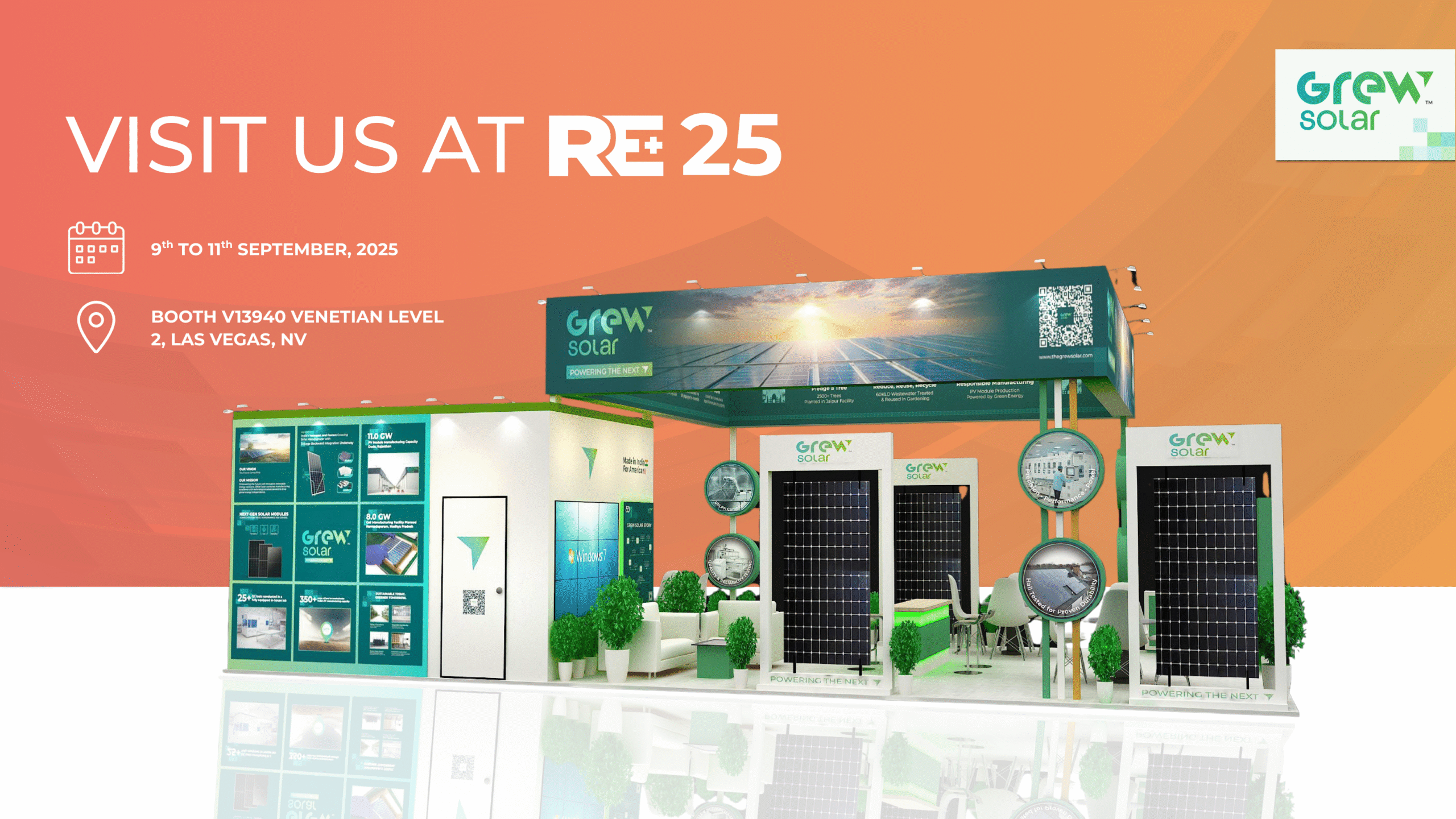
RE+ 2025 takes place from September 9-11, 2025 in Las Vegas, NV.


You can find GREW Solar at Booth V13940, Venetian Level 2.


We invite you to visit our booth, connect with our team, and explore how GREW Solar is setting new benchmarks in solar module manufacturing. Whether you’re seeking reliable module partners for utility-scale projects, exploring the future of residential solar with our Premium All-Black Series, or simply looking to connect with a fast-growing clean energy manufacturer backed by 52+ years of Chiripal Group legacy, our team will be there to engage.


Conclusion: Powering the Next


As GREW Solar prepares for RE+ 2025, our focus is on scale, reliability, and building solutions that last. From strengthening our manufacturing base to introducing our complete product ecosystem – G2G TOPCon Series, G12R High-Power modules, and Premium All-Black residential solutions, every step we take is about delivering value at a global level.

With our “Made in India, For America” approach, UFLPA-compliant supply chain, and end-to-end quality control from cells to modules, we’re not just manufacturing solar panels – we’re engineering energy revolutions that transform how America captures and utilizes solar energy.


This year, we’re bringing that progress to Las Vegas, and we look forward to engaging with the industry on what comes next.


Visit us at Booth V13940, Venetian Level 2 at RE+ 2025.


Book your appointment at sohil.b@grew.one

Categories
Uncategorized

The Future Comes First: GREW Solar’s Story of Growth and Scale

The global shift to clean energy is increasing, but its success depends on the ability to manufacture solar modules at a massive scale while maintaining quality and sustainability. As demand for solar energy grows worldwide, the need for reliable, high-volume production becomes important.


India has quickly become one of the world’s top five most promising manufacturing hub, combining industrial capacity with engineering expertise to fulfill the renewable energy goals. One of the companies leading this transformation in India is GREW Solar, a company that has built its foundation on responsible growth, smart innovation, and sustainable manufacturing practices.


Where the Journey Began


GREW Solar was founded in 2022 under the established industrial legacy of the Chiripal Group. From day one, the company entered the market with a clear mission, to build a manufacturing system that could meet today’s demand while preparing for tomorrow’s opportunities. The vision was to deliver high-performance solar modules using the manufacturing processes that make sustainability a priority throughout operations.


The company’s manufacturing facility in Dudu, Rajasthan, became the foundation for this vision. Equipped with advanced automation, strict quality control systems, and a skilled workforce, the Dudu facility is the cornerstone of the company’s operations.


Scaling Without Compromise


In just a few years, GREW Solar has planned to strategically expand its manufacturing footprint to multiple strategic locations across India. This expansion has been carefully planned to maintain the standards established.


By 2026, GREW Solar will have 11.0 GW PV module manufacturing capacity and 8.0 GW PV cell manufacturing capacity. This level of scale will provide greater supply reliability, better cost efficiency, and more competitive product delivery for domestic and international markets.


However, this growth at GREW Solar has never come at the expense of quality or environmental responsibility. The Dudu plant has been designed with complete process control in mind, allowing greater overview of every production stage. The company’s plans to establish PV cell manufacturing facilities represent a move toward vertical integration, a step that will improve quality consistency, delivery times, and supply chain strength in the market.


This approach reflects a fundamental understanding that in the solar industry, reliability matters as much as capacity. Customers prefer suppliers who can deliver consistent quality at volume, and GREW Solar has structured its growth to meet this demand.


The GREW Solar Manufacturing Edge


What sets GREW Solar apart is how it produces its products. The production lines use the latest automation technologies to reduce variation and human error. This includes precision cell stringing, laser-based cell cutting, automated lamination systems, and AI-enabled inspection tools that catch defects before they become problems.


Each module passes 25+ rigorous tests for quality and reliability.This includes electroluminescence scans to detect hidden defects and environmental simulations that replicate extreme conditions such as high winds, heavy snow, intense heat, and humidity. By simulating decades of wear & tear conditions in a controlled laboratory, the company ensures that every module is built for lasting performance in real-world applications.


The manufacturing facilities are of international standards. This global compliance opens international opportunities and also builds confidence among customers who demand consistency and reliability from their solar module suppliers.


The Future Comes First


At GREW Solar, “The Future Comes First” serves as a vision statement and a principle for making decisions. Every expansion plan, technology investment, and sustainability initiative is evaluated based on what the market, the planet, and the industry will need in the coming years.


Our manufacturing facilities use solar panels to reduce dependence on fossil fuels. Water recycling systems minimize waste, while comprehensive waste management protocols ensure waste does not end up in landfills. The production process itself is optimized to reduce energy consumption, lowering the carbon footprint of each module produced. Other than operations, our commitment to sustainability extends to restoring green cover through initiatives like “Pledge a Tree” initiatives. Under this initiative, we have already planted 2,500+ saplings, reinforcing our vision of sustainability that goes beyond manufacturing.


By making sustainability central to manufacturing operations, GREW Solar proves that scale and environmental responsibility can grow together. Building bigger manufacturing capacity simply requires smarter planning and better execution.


Shaping the Ecosystem


GREW Solar’s manufacturing growth contributes to strengthening India’s entire solar value chain. By expanding PV cell and module production capacity domestically, the company supports India’s goal to reduce import dependence, stabilize supply chains, and establish the country as a global leader in renewable energy manufacturing.


The company’s vertical integration plan will also create a more resilient manufacturing ecosystem. By controlling upstream processes, GREW Solar will be able to reduce supply disruptions and ensure consistent quality and advantages that benefit all the stakeholders throughout the solar industry.


People, Process & Performance


While scale and technology are central to GREW Solar’s success, people remain the most valuable asset. The company invests in building workforce capabilities, from training production operators in advanced manufacturing techniques to developing leadership skills among supervisory staff.


This focus on people ensures that as infrastructure scales, operational discipline and quality culture scale alongside it. Every module represents the result of coordinated effort between skilled professionals and precision processes.


The emphasis on workforce development also creates opportunities for career growth and skill building that benefit the broader manufacturing sector. As GREW Solar expands, it contributes to building the human capital that India needs to become a global manufacturing leader.


Powering the Next


GREW Solar’s rapid growth demonstrates the strength of its vision and the execution capability behind it. The company is building manufacturing capacity while building trust in Indian manufacturing, proving that India can lead in delivering sustainable, high-quality solar modules at global scale.


As GREW Solar looks ahead, its commitment to continue Powering the Next remains clear. This means enabling the next phase of sustainable industrial growth, setting new standards in manufacturing excellence, and advancing the world’s transition to renewable power through reliable, high-quality solar technology.


Carrying this vision forward, GREW Solar will be showcasing its latest solar technology at the upcoming RE+ and REI expos, platforms that bring together the global renewable energy industry.

Categories
Uncategorized

How Solar Panels Can Increase Your Home Value in India

Solar is Now a Real Estate Feature, Not Just a Utility


In India, rooftop solar has moved from being a rare “green tech” upgrade to a mainstream home improvement.
It’s no longer only about reducing electricity bills—it’s now a recognized value booster in the property market.

A decade ago, when buyers walked into an open house, they asked about square footage, the number of bathrooms, and the kitchen fittings. In 2025, energy savings and sustainability credentials are becoming part of that conversation—and solar panels are at the top of the list.


For homeowners, this means that installing a solar energy system isn’t just an environmental or cost-saving decision—it’s also a strategic investment in property value.


Why Solar is Seen as a Premium Upgrade in India?


Think of it like this: a home with a modular kitchen or a water purifier system is automatically seen as better equipped. Solar power systems are falling into the same category—they’re modern, desirable, and future-proof.

In urban markets such as Bengaluru, Pune, Gurugram, Hyderabad, and Chennai, where educated middle-class buyers are concerned about rising power costs and environmental impact, rooftop solar is now a competitive advantage in property listings.


Real estate agents report that buyers actively notice and assign value to a property that already has solar installed because:


  • They know they will save on electricity bills immediately.
  • They see it as a hassle-free installation since it’s already done
  • They recognize the environmental benefit and feel good about it.


1. The Financial Angle—Real Savings Buyers Can Calculate


Let’s use a typical Indian household example.

  • A family in Delhi installs a 3 kW rooftop solar system.
  • Cost after subsidies: ₹1.6 lakh.
  • Monthly savings: ₹2,500–₹3,500.
  • Annual savings: ₹30,000–₹42,000.

Over a 20-year lifespan, that’s ₹6–₹8.4 lakh in savings, and that’s without considering electricity price hikes, which are inevitable.

For a potential buyer, those numbers translate to predictable, locked-in savings for decades. In real estate valuation, this reliable cost reduction is something they’re willing to pay a premium for—much like paying extra for a fuel-efficient car.


2. How Much Can Solar Increase Home Value in India?


While exact percentages vary by location and system size, multiple market analyses indicate:

  • 3–4% increase in resale value for homes with rooftop solar.
  • Higher in metros where awareness of renewable energy is stronger.


For example, if your home is valued at ₹80 lakh, a 3% bump adds ₹2.4 lakh to its selling price. That’s more than enough to cover a big portion of your solar investment.


3. Government Incentives Make it Even More Attractive


The Indian government has aggressively pushed rooftop solar adoption through schemes such as

  • PM Surya Ghar Muft Bijli Yojana—providing up to ₹78,000 in subsidies for residential systems.
  • Net Metering Policies—available in most states, allowing homeowners to sell excess power back to the grid.
  • State-Level Top-Ups—additional subsidies or faster approvals in states like Gujarat, Maharashtra, and Kerala.
  • Soft Loans—lower interest rates for solar loans under green finance programs.

From a buyer’s perspective, a home that already complies with these programs is ready to deliver immediate monetary benefits from day one.


4. Why Solar is Attractive?


It’s not only about money — modern Indian buyers care about sustainability.
Millennial and Gen Z buyers in particular are drawn to homes that reflect eco-conscious values.

Owning a solar home is often perceived as:

  • A status symbol (tech-forward and environmentally responsible).
  • A future-ready investment in a time when energy costs are uncertain.
  • A smarter, self-reliant home that can operate during power cuts.

In cities with chronic power outages like Patna, Ranchi, or parts of UP, the energy independence factor is a major selling point.


5. Turning Homes into Mini Power Plants


Net metering is a game-changer.
Under this system:

  • You use the electricity generated by your solar panels.
  • Any surplus is sent back to the grid.
  • The utility company gives you credits against future consumption.


For buyers, a home with an active net metering account is not just a place to live—it’s also a mini income-generating asset.


6. Warranties and Long-Term Confidence


Quality solar panels come with 20–25-year performance warranties, while inverters often carry 5–10-year warranties.

Buyers appreciate this because:

  • It reduces their risk — they know they won’t face big replacement costs soon.
  • It adds trust that the system will keep working efficiently long after purchase.


If you have complete documentation—purchase receipts, warranty papers, service records—it further reassures buyers.


7. Standing Out in Real Estate Listings 


On real estate websites like MagicBricks or 99acres, homes with solar can be tagged as eco-friendly or energy-efficient, which attracts more clicks.


Properties with visible solar panels in listing photos often generate higher inquiry rates because they signal modernity and savings potential at first glance.


8. Return on Investment Timeline


Let’s break down ROI for an Indian household:

  • System Size: 3 kW
  • Post-Subsidy Cost: ₹1.6 lakh
  • Monthly Savings: ₹3,000
  • Payback Period: ~5 years
  • Free Energy Years Remaining (assuming 25-year life): ~20 years
 

When you sell a home with 15 years of free energy left, that’s a built-in financial asset for the new owner.


9. Other Benefits That Sell 


  • Reduced Carbon Footprint — appeals to environmentally conscious buyers.
  • Energy Security — less affected by grid failures.
  • Lower Heat Island Effect — rooftop panels shade and cool the roof surface.
  • Compliance with Future Regulations—as India moves towards green building codes.


10. Potential Concerns and How to Address Them


Some buyers may hesitate due to:

  • Fear of Maintenance Costs—assure them latest technology (TOPCon) panels require minimal upkeep.
  • Roof Integrity Concerns — show professional installation records.
  • Technology Obsolescence — explain that solar efficiency improves slowly, so systems remain competitive for decades.

Conclusion 


In India’s real estate market, solar panels have evolved from a niche choice to a mainstream selling point.
They not only boost home resale value but also reduce monthly electricity bills, attract eco-conscious buyers, and help homes sell faster.


With subsidies, net metering benefits, and 20–25-year warranties, the decision to install solar is both a financial investment and a commitment to a sustainable future. For homeowners ready to take the step, partnering with a trusted expert is key.


GREW Solar, with its high-quality technology, customized rooftop solutions, and end-to-end service, ensures your solar system is installed for maximum performance and long-term reliability. By choosing the right partner, your solar investment can deliver decades of energy savings and a significant boost to your property’s market value.


Now is the right time to future-proof your home — with solar.

Categories
Uncategorized

Made in India, Powering America: The Rise of Indian Solar Modules in the US Market

The global solar industry is witnessing a shift. At the heart of this shift lies India’s rise as America’s solar manufacturing partner of choice.


Just three years ago, India’s solar module exports to the world totaled $85 million. Today, that figure has grown to billions, signaling a fundamental shift in the global solar ecosystem. Indian manufacturers have emerged as the reliable, quality-driven partners the world has been looking for.

The Numbers That Changed Everything


The numbers tell a clear story of market dominance. According to a report by the Institute for Energy Economics and Financial Analysis (IEEFA) and JMK Research, India’s solar module exports hit $2 billion in fiscal 2024 which is a massive jump from previous years. What’s more important is how the United States has become India’s main customer, taking 97% of India’s solar exports in fiscal 2023 and 99% in fiscal 2024.


This goes beyond just numbers, it’s about trust. When American solar companies put almost all their Indian solar purchases in one market, it shows they believe in the quality and reliability of Indian manufacturing. The data shows that India has taken over the India-to-America solar trade.


India also surpassed South Korea last year to become the fifth-largest solar exporter to the United States. This puts Indian manufacturers among the top suppliers to the world’s second-largest solar market, showing how quickly the industry has grown and focused on strategy.

Convergence of Market Forces


Several connected factors have created the right conditions for India’s solar export boom, each one strengthening the others to build momentum that keeps growing.

Supply Chain Diversification Imperative


The “China Plus One” strategy has become a must-have. Companies around the world are working to diversify their supply chains and reduce their dependence on single-source manufacturing. India has become the best alternative, offering manufacturing capability, competitive costs, and political stability that few other countries can provide.


This diversification is about managing risk and creating strong, sustainable supply chains that can handle global disruptions while keeping quality high and costs reasonable. Indian manufacturers have positioned themselves perfectly to meet this demand.

Domestic Market Dynamics Creating Export Opportunities


India’s own policy changes have actually helped boost exports. The delayed implementation of the Approved List of Models and Manufacturers (ALMM) in April 2024 temporarily reduced domestic demand for solar modules. Instead of seeing this as a problem, Indian manufacturers shifted their focus to international markets, especially the United States.


Evolving Trade Landscape


The end of certain Free Trade Agreements and ongoing antidumping and countervailing duty investigations have changed the competitive landscape. With these changes, India could potentially replace Southeast Asian countries as the leading solar exporting region to the United States. This shift represents a chance for Indian manufacturers to build long-term partnerships with American stakeholders.


Strategic Benefits: A Partnership That Works


The surge in Indian solar exports to America benefits both markets in ways that go far beyond trade numbers.


For Indian manufacturers, working in the demanding US market drives improvement and growth. As Vibhuti Garg, Director – South Asia at IEEFA and contributing author of the key report, explains: “Focusing on the US market can benefit the Indian PV manufacturing ecosystem. The exposure to the US market will enable Indian PV manufacturers to attain economies of scale, ultimately enhancing their product quality and competitiveness.”


This touches on a basic principle of manufacturing excellence: demanding customers drive innovation and quality improvements that benefit everyone. American buyers, known for their strict standards and quality requirements, push Indian manufacturers to continuously improve their processes, products, and capabilities.


GREW Solar: Leading India’s Manufacturing Excellence


Within this broader story of Indian solar success, GREW Solar shows how Indian manufacturers are not just participating in the American market but leading it through innovation, quality, and strategic vision.


GREW Solar’s approach to the American market reflects the broader Indian strategy of delivering superior quality products that meet the high standards of US buyers while maintaining the cost competitiveness that makes solar energy accessible and economical. With manufacturing facilities strategically located across 350+ acres in Rajasthan, Madhya Pradesh, and Jammu & Kashmir, GREW Solar has built the scale and capability needed to serve large American projects while maintaining the flexibility to meet diverse customer requirements.


The UFLPA-compliant supply chain addresses one of the most critical concerns for American buyers i.e. transparency and ethical sourcing. In a market increasingly focused on supply chain integrity, GREW Solar’s commitment to responsible manufacturing practices provides American customers with the confidence they need to specify its products for their projects.


The Road Ahead


The transformation of India from a small player to a major force in the American solar market represents the emergence of a sustainable, long-term partnership that benefits both nations’ clean energy goals.


For India, success in the American market proves the country’s manufacturing capabilities and opens doors to other international opportunities. The experience gained from serving the world’s most sophisticated solar market will improve Indian manufacturers’ capabilities and competitiveness globally.


For America, Indian manufacturers provide a crucial element in building a resilient clean energy supply chain. As the United States works toward its ambitious clean energy targets, having reliable, high-quality suppliers outside of traditional manufacturing centers becomes not just helpful but essential.


The relationship also creates opportunities for technology transfer, joint innovation, and collaborative development of next-generation solar technologies. As both countries invest heavily in renewable energy research and development, the commercial relationships being built today could evolve into strategic partnerships that advance the entire global solar industry.

Categories
Uncategorized

How is GREW Solar Setting the Standards for Sustainability in the Solar Industry?

Clean energy should start with clean manufacturing. While solar panels help create a low-carbon future, the way we make them matters just as much as how they perform. Real sustainability goes beyond installing panels, it’s about how we manufacture them, what resources we use, and the environmental impact we leave behind. For the solar industry to scale responsibly, we need to think about every step of the process.


GREW Solar is aligning with this mindset through a combination of integrated facility practices, renewable-powered operations, and measurable green initiatives. Recognized as the second runner-up in the ESG – Large category at the ET NOW Machinist Super Shopfloor Awards 2025, our approach is steadily evolving to meet higher environmental standards at every level of manufacturing.


Manufacturing Solar Panels with Solar Power


The real sustainability story starts with your energy source. At our manufacturing facility in Dudu, Jaipur, we power our operations with the same solar technology we produce. This action reduces emissions and proves that clean energy manufacturing works in practice.


By putting sustainability into action, we’re showing that solar manufacturers can lead India’s renewable energy transition from the factory floor up. As buyer expectations evolve and policy frameworks become more strict, manufacturers who decarbonize their own operations have a competitive advantage.


Smart Water Management


Manufacturing can be water-intensive practice, but it doesn’t have to be wasteful. Our Jaipur manufacturing facility has an in-house Sewage Treatment Plant with a 30 KLD daily capacity that processes 100% of incoming wastewater.


Here’s how our system works:

  • Biological treatment safely breaks down wastewater from facilities and canteens
  • A filter press system reduces sludge generation to nearly zero
  • 100% of treated water gets reused for campus landscaping
  • Overall, 55% of our total water needs come from recycled sources


This closed-loop approach meets all national and international wastewater standards while dramatically reducing our freshwater consumption. The system also creates a buffer against water supply disruptions, ensuring consistent operations while maintaining our environmental commitments. It’s proof that industrial processes and environmental responsibility can work hand in hand. 


Rethinking Logistics and Supply Chain


Our sustainability practices extend beyond our manufacturing facility. We’ve replaced single-use wooden pallets with reusable alternatives to cut down transport-related waste. This circular approach to logistics helps reduce our Scope 3 emissions, something which is important to buyers and project developers.


Our material sourcing follows strict protocols to ensure every component has verified origins and meets international compliance standards. When we know where our materials come from, we can say that they’re manufactured with environmentally responsible processes. 


Each solar cell goes under multiple testing and certification assessments which directly support our sustainability goals. Rigorous testing means our modules last longer in the field and reduce the frequency of replacements which minimises solar waste. When a solar panel operates reliably for 25+ years instead of failing after 10-15 years, the environmental impact per kilowatt-hour of energy produced drops. It is a fact that products that last longer require fewer resources over their lifecycle.


This traceability reduces module failures, minimizes e-waste, and helps customers achieve better long-term energy yields. Reliable modules mean fewer site visits for maintenance, reducing transportation emissions. When customers can count on consistent performance, they’re more likely to invest in solar installations more and move towards cleaner energy. Our quality-first approach multiplies the environmental benefits of every solar panel we produce.


Building Environmental Culture


We believe that environmental responsibility starts with people because when employees make sustainability a part of their day-to-day work, it becomes a part of their life. This cultural shift has been an important part of our plan to create long-term environmental impact.


Through our “Pledge A Tree” campaign, we’ve planted over 2,500 trees on our Jaipur campus so far, creating a green ecosystem, a physical reminder of our environmental commitment. When team members see these trees growing, they’re reminded that their work contributes to something bigger than just work.


Our Nature Pod initiative involving employees was another important part of our environmental action. Team members created over 420 sustainable planting units. Employees who participate in these programs become sustainability champions within their teams, spreading awareness organically.


These programs improve environmental footprint and they build awareness and responsibility. Whether it’s choosing suppliers or optimising processes, employees who understand our environmental mission make choices that align with our values.


Setting the Standard for the Industry


As solar energy becomes central to India’s and the world’s clean energy future, manufacturers must lead by example whether its product output or how responsibly that output is achieved. Our practices like solar-powered plants, water recycling systems, sustainable packaging and tree plantation programs signal a shift toward sustainability-first manufacturing.


With plans to scale to 11.0GW of solar module manufacturing and 8.0 GW of cell manufacturing by 2026, we’re committed to environmentally responsible growth. Every operational decision we take,we’ll be continuously working to enhance our sustainable operations and introduce new practices to redefine what’s possible in clean manufacturing.


Why? Because we believe that clean energy is not only an end product but a part of the entire process.

Categories
Uncategorized

How Solar Energy Contributes to Global Net-Zero Goals

The world is getting warmer, and developments like record-breaking heatwaves to devastating floods prove that climate change is a pressing concern. The solution everyone’s talking about is net-zero emissions, but what does that actually mean?


Net zero means balancing the amount of greenhouse gases we put into the atmosphere with the amount we remove from it. The goal is to reach this balance by 2050 to prevent dangerous climate change. The global net zero targets to accomplish by 2050 is to keep global warming below 1.5°C. This may sound simple but this is a big challenge. Now, this is where solar energy comes in, one of the most viable tools to deal with this challenge.


The Reality of Global Emissions

According to Climate Trace, global greenhouse gas emissions for February 2025 reached 5.04 billion tonnes CO2e. Energy-related CO2 emissions reached an all-time high of 37.8 Gt CO2 in 2024, which is an 0.8% increase from the previous year.


This is not about numbers, it’s about the fundamental systems that power our world. The energy sector drives three-quarters of all global greenhouse gas emissions. The story these numbers tell is clear, we’re not just missing our climate targets, we’re moving further away from them.


A challenge like this also creates opportunities and that’s exactly what’s happening with renewable energy, particularly in India.


India’s Renewable Energy Revolution


India is writing one of the world’s most impressive renewable energy stories. The country now has 226.9 GW of renewable energy capacity as of June 2025, and the pace of growth is accelerating. In 2025 alone, India has reached 110.9 GW of solar capacity which is more than many other countries.


What makes this transformation remarkable is how quickly we’ve scaled our clean energy ecosystem. A decade ago, this wouldn’t have been possible but today, it is part of our reality. Non-fossil-based sources now generate 49% of India’s total power installed capacity, and these numbers are growing. The country is on its way to achieve 500 GW of non-fossil fuel capacity by 2030.


One of the key reasons solar power is at the forefront of India’s clean energy transition is its increasing cost-effectiveness. States like Rajasthan and Gujarat have already demonstrated how large-scale solar development can drive both environmental and economic progress by building massive solar parks and generating thousands of jobs. Madhya Pradesh is also emerging as a strategic player in this shift, with several operational solar parks and many more in the pipeline. Upcoming manufacturing initiatives, including GREW Solar’s solar cell facility, will further strengthen the state’s position in India’s renewable energy ecosystem.


The transition to solar energy is not just about replacing coal plants, it’s also about building energy security, reducing import dependence to strengthen our clean energy ecosystem. 


How Solar Energy Drives Net-Zero Goals


Solar energy helps with the climate problem in multiple ways. One of the most direct ways is replacing fossil fuels with solar for energy production as it reduces carbon emissions. What makes solar even more beneficial is its energy production efficiency. A single solar panel produces about 20 times more energy during its lifetime than was needed to manufacture it.


But solar is not just one of the cleanest ways to produce energy, it’s also affordable. Solar costs less than coal or gas making it an attractive option for businesses. This makes choosing solar the natural choice rather than being policy-driven.


Solar is also being used to power a whole network of clean technologies. Battery systems can store solar energy for use at night or during cloudy days. Solar-powered facilities can split water molecules to create green hydrogen, which can then decarbonize heavy industries like steel and cement production. Electric vehicles charged with solar power complete the clean energy circle, creating transportation with zero emissions from start to finish.


As more solar projects get built, manufacturers produce more panels, it drives down the costs of solar further. Lower costs lead to more installations, which creates more manufacturing demand, and this improves technology and reduces costs even more. This cycle then keeps on driving solar energy’s growth


The Challenges We Still Face


Despite all this progress, solar energy growth has its challenges. One of the technical challenges is grid integration. Solar power produces electricity only when the sun is out, this is why we need better energy storage systems and smarter grid planning that can help balance supply and demand in real-time.


The other challenge is the financial aspect. While solar panel costs have reduced, large-scale projects require huge capital. This is one of the main reasons so many developing countries struggle to get financing for renewable energy projects. 


Supply chain issues are another complex challenge. Solar panels need specific materials and manufacturing processes. Since most of the production is concentrated in a few countries, this creates a problem. One of the solutions is to build more resilient, distributed supply chains that help scale solar globally.


Land use is another complication. Utility-scale solar projects need significant land areas which can create issues for agriculture or conservation needs. However, innovative solutions like agrivoltaics combine solar panels with farming, setting an example for how we can address multiple needs together. 


GREW Solar’s Role in the Net-Zero Journey


Solar energy is one of the ways to combat climate change issues and it is the foundation of our clean energy future. It is technologically advanced, economical and has an accelerating growth rate, making it one of the best clean energy sources. 


At GREW Solar, we’re proud to be part of this transformation. Our plans to scale to 10.0 GW of solar module manufacturing and 6.0 GW of cell manufacturing by 2026 are targets that will contribute to India’s net-zero goals. Every module manufactured with sustainable manufacturing practices helps in making the clean energy transition cleaner.


The path to achieving the net-zero goals that our country has set will require a joint cooperation between industries, governments, and the people. With solar energy, we can build a better, more prosperous future for everyone. 


FAQs 

  1. How do solar panels contribute to net zero?

Solar panels help with net zero goals by replacing electricity that would normally come from fossil fuels. When solar panels generate power it means less greenhouse gas emissions. Over their lifespan, solar panels prevent far more emissions than were created during their manufacturing.

  1. What is the goal of solar energy?

The main goal of solar energy is to provide clean energy by replacing fossil fuels as our primary energy source while reducing air pollution. It also helps bring solar power to areas that don’t have electricity and creates job opportunities in the clean energy sector.

  1. What is the goal of net zero?

Net zero means balancing the amount of greenhouse gases we put into the atmosphere with the amount we remove from it to prevent climate change from getting worse. To achieve this will require cutting emissions while also removing carbon from the air through forests and clean technology.

  1. What is India’s new goal for solar energy capacity by 2030?

India has set the target of 500 GW of renewable energy capacity by 2030, with solar energy being a large part of it. This goal is part of India’s sustainability commitment to reduce its carbon footprint.

Categories
Uncategorized

The Role of Wafer Enhancements in Solar Panel Efficiency

As solar technology continues to evolve, the role of individual components in maximizing efficiency and performance becomes increasingly important. The solar wafer is actually one of the most important of these parts. Every solar cell is built on a thin slice of silicon, which directly impacts the amount of sunlight that is captured, transformed, and stored.


Wafer improvements have been pushing technological boundaries and having a real-world impact on solar performance and sustainability in today’s competitive and quality-driven market.


Solar Wafers: The Foundation of Photovoltaic Technology


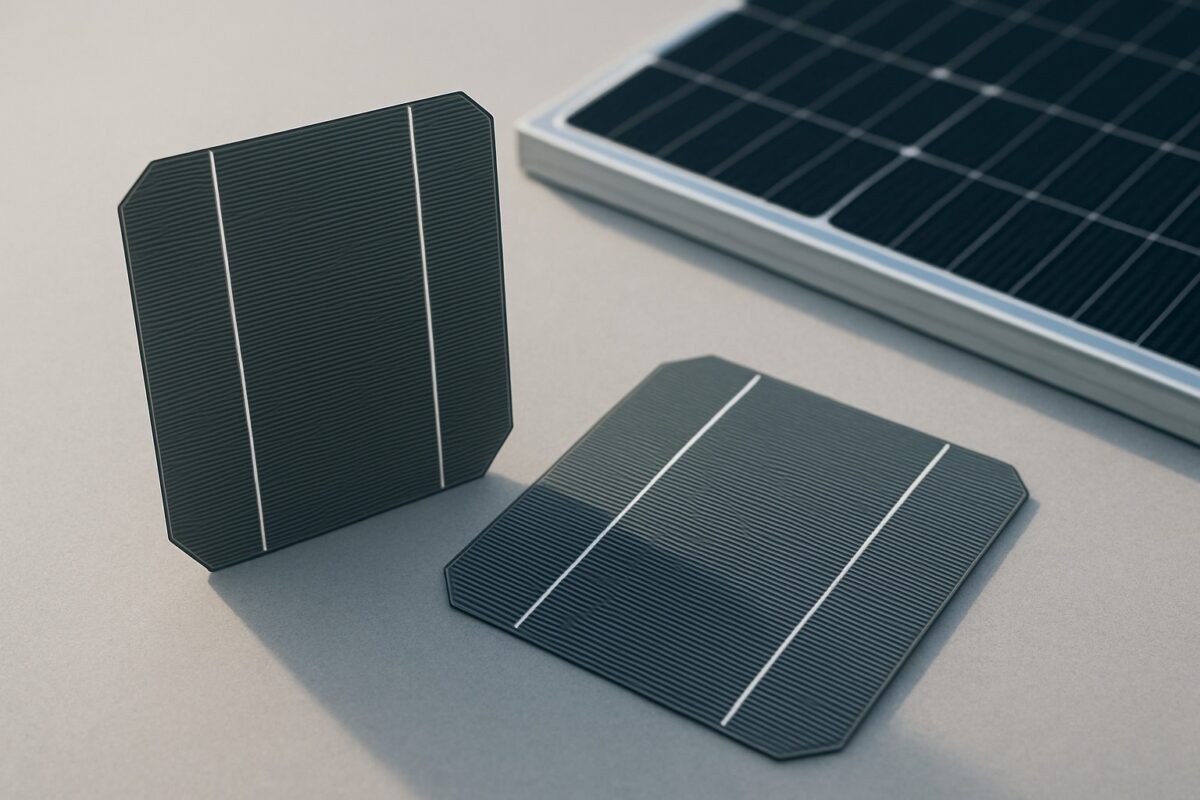
Every solar panel starts with something simple yet essential, a wafer. It’s a thin slice of silicon, cut from a larger block, and it forms the base of every solar cell. Without it, the entire process of turning sunlight into electricity wouldn’t be possible.


But not all wafers are created equal. How pure the silicon is, how well the crystal structure is formed, and how smooth the surface is, these things are important. If any of them are off, even just slightly, the panel’s efficiency can take a hit. Over time, these small flaws can lead to bigger performance drops.


That’s why, when aiming for better solar performance, the work has to start at the wafer.


How Wafer Standards Drive Module Performance


When the wafer is made right, everything else falls into place more easily:

  • More efficient energy conversion. Clean, high-purity wafers allow electricity to move through the cell with less resistance, which means more power from the same amount of sunlight.
  • Stronger in extreme conditions. Fewer flaws in the material mean it can handle heat and cold cycles better — ideal for climates like India’s.
  • Longer-lasting panels. Defect-free wafers are less likely to develop cracks or degrade over time, which keeps energy production steady for years.
  • Better compatibility with new tech. When the wafer surface is well prepared, it works better with advanced solar cell designs, helping the entire system perform more efficiently.


Evolution in Wafer Dimensions


Over the last few years, solar panel manufacturers have made a big shift in the size of wafers they use. The older M2 wafer measured just 156.75mm was once the standard. But that’s now been replaced by larger formats like G1 (158.75mm), M6(166mm), M10 (182mm), and even the massive G12, which comes in at 210mm.


Why Companies Choose Larger Wafers: The main reason for using bigger wafers is simple, more surface area means more space to collect sunlight. This allows solar panel manufacturers to create panels with higher power output without having to spend much more money on production.


Making Wafers Thinner: At the same time that wafers are getting larger, manufacturers are also working to make them thinner. Using less silicon material in each wafer helps reduce costs because silicon is one of the most expensive parts of making solar panels. But making wafers thinner introduces new challenges. They become more fragile and prone to breaking during manufacturing or installation. To tackle this, manufacturers are now focusing on ways to reinforce these ultra-thin wafers without giving up their cost and environmental advantages.


New Technology Improvements in Wafer Manufacturing


Several technology developments are changing how wafer manufacturers make their products and how well these wafers perform in solar panels:


  • Switching to N-Type Silicon Material: More and more manufacturers are moving away from the older P-type silicon and switching to N-type silicon. Ntype is a cleaner, more reliable material that performs better when sunlight is low and it doesn’t wear out as quickly over time. Also, it’s a better match for panels that collect light from both the front and the back, which means more energy.
  • Working with New Cell Technologies: Modern solar cell technologies like TOPCon and HJT require wafers that are made with very precise methods. For TOPCon cells to work properly, the wafers must be made with very high quality and have surfaces that are treated in special ways. HJT cells need wafers with very smooth and pure surfaces because even small amounts of dirt or roughness can prevent them from working correctly.
  • Better Surface Treatments: To help wafers capture more sunlight, manufacturers are using advanced surface treatments. One method, called black silicon, darkens the surface so it reflects less light and absorbs more. Another technique creates tiny patterns on the wafer surface that trap sunlight more effectively. When combined with protective coatings, these techniques help panels generate more power from the same sunlight.
  • Single Crystal Wafers Leading the Market: Most high-performance solar panels today use monocrystalline wafers, made from a single, solid piece of silicon. These are more efficient than polycrystalline wafers, which are made by melting smaller crystals together. While monocrystalline options cost a bit more, they produce more power in less space, making them a popular choice for both homes and large-scale solar projects.


GREW Solar’s Manufacturing Commitment


At GREW Solar, we’re working toward a future where solar energy is not just efficient, but also widely accessible and built on reliability. Our focus is on creating a solid, scalable manufacturing base with quality built into every step. Right now, we operate a 3.0 GW solar module manufacturing facility in Dudu, Rajasthan, and we’re in the process of expanding that capacity to 8.0 GW by 2026.


Alongside this, construction is underway for a 3.0 GW solar cell manufacturing unit in Narmadapuram, Madhya Pradesh which is part of a broader effort to strengthen domestic solar production and reduce dependence on imports.


While our ingot and wafer production is still in the planning stage, we see it as a critical part of the journey. The upcoming solar cell facility is the next step in moving toward a fully integrated manufacturing setup. Over time, we aim to bring ingot and wafer capabilities in-house as well, completing the value chain.


Ultimately, our goal is to contribute to a resilient, future-ready solar manufacturing ecosystem, one that supports India’s clean energy goals while keeping pace with global needs.


Conclusion


Wafer enhancements are a foundational pillar in the journey toward higher performing, longer-lasting solar modules. As solar technology evolves, the importance of wafer design, material selection, and manufacturing precision will only grow.


Frequently Asked Questions (FAQs)


  1. What is a solar wafer?
    Solar wafer is the starting block for a solar cell. It’s a super-thin slice of crystalline silicon that acts as the foundation for a solar panel.
  1. What are solar wafers used for
    Wafers are a key component in making solar cells, which are then pieced together to form solar panels.
  1. What is a solar wafer made of?
    The majority of solar wafers are crafted from refined silicon. This can be either monocrystalline or polycrystalline silicon, depending on the specific type of solar panel being produced and the efficiency requirements.
  1. What is the difference between a solar cell and a solar wafer
    A wafer is basically the raw silicon slice whereas a solar cell is what you get once that wafer has been processed, layered, and turned into a functioning part of a solar panel.
  1. How many types of solar wafers are there?
    There are two main types – P-Type Wafers that are made by adding boron to the silicon and N-Type Wafers that use phosphorus instead.
Categories
Uncategorized

Clean Energy, Cleaner Practices: GREW Solar’s Sustainability Pledge

The climate crisis requires unwavering, year-round commitment. As leaders in clean energy, we cannot afford to treat sustainability as a seasonal initiative. Every decision we make today shapes the world we leave for future generations. The urgency is real, the solutions are within reach, and the responsibility rests with all of us to act decisively, consistently, and with unprecedented scale.


With GREW Solar, sustainability isn’t merely about producing clean energy products, it’s about fundamentally reimagining how industry can serve as a catalyst for environmental preservation. True environmental leadership extends far beyond manufacturing solar modules, it is a holistic commitment to climate action, biodiversity restoration, and community empowerment. Our vision is anchored in the understanding that business success and environmental preservation are not competing priorities, but complementary forces that can drive transformative change.


This philosophy of integrated sustainability is present in every aspect of our operations at GREW Solar. From strategic planning to daily operations, we view each business decision through the lens of long-term environmental impact. Our approach is built on the principle that genuine climate leadership requires systemic thinking, addressing our operational footprint, while fostering a broader ecosystem of sustainable practices across our industry and communities.


Operational Excellence Rooted in Environmental Innovation


Our commitment to sustainability is part of our operations, beginning with our Jaipur facility, which operates entirely on rooftop solar power. This initiative represents our dedication to producing clean energy solutions while minimizing our own carbon footprint.


Water preservation is another important part of our environmental commitment. Our comprehensive water management initiative features an advanced sewage treatment system that processes 100% of incoming water, with 55% being recirculated daily for facility maintenance and landscaping. This closed-loop approach, enhanced by our filtration and waste recovery systems is for resource efficiency and zero-waste principles. The treated organic matter is repurposed as natural fertilizer, demonstrating our circular approach to resource utilization.


These initiatives reflect our belief that sustainable operations create both environmental and economic value.


Community-Centered Environmental Responsibility


Environmental responsibility transcends organizational boundaries and needs meaningful community engagement. Through our “Pledge a Tree” initiative, we’ve planted over 2,500 saplings, contributing to carbon sequestration, biodiversity enhancement, and air quality improvement. While this represents a meaningful start, we recognize that true reforestation impact requires sustained, large-scale commitment over decades.


These community-focused efforts directly advance critical UN Sustainable Development Goals, particularly Climate Action (SDG 13) and Life on Land (SDG 15). Our approach emphasizes measurable environmental impact while fostering community ownership of environmental stewardship, recognizing that lasting change requires collective participation.


Strategic Leadership in Sustainability Culture


As organizational leaders, we understand that sustainable practices start with people. Our internal programs engage employees as environmental champions through hands-on initiatives like the Nature Pod Challenge, resource efficiency training, and community outreach programs. This approach builds genuine environmental consciousness throughout our organization, creating a workforce that naturally integrates sustainability thinking into their daily work.


Our leadership strategy emphasizes that every team member from production associates to senior executives plays a crucial role in advancing our vision of the ‘Future Comes First’. This culture of shared responsibility has created visible changes throughout our organization and demonstrates that sustainability requires collective commitment at every level.


Advancing Global Climate Goals


Our sustainability initiatives align strategically with multiple UN Sustainable Development Goals. Through our work in Affordable & Clean Energy (SDG 7), we accelerate global clean energy adoption by making high-efficiency solar technology more accessible. Our commitment to Industry, Innovation & Infrastructure (SDG 9) drives sustainable manufacturing practices that minimize resource consumption while maximizing output efficiency. Additionally, our climate action and biodiversity initiatives directly support Climate Action (SDG 13) and Life on Land (SDG 15), creating integrated impact across multiple environmental challenges.


These alignments represent actionable commitments and guide our strategic decision-making as we scale our operations and expand our environmental impact.


Scaling Sustainable Impact


Our expansion roadmap of growing to 8.0GW of module manufacturing and adding 3.0GW of solar cell capacity by 2026 is designed with sustainability as a foundational principle. Each new facility will integrate renewable energy systems, water recycling infrastructure, and zero-discharge waste management from day one.


Our circular economy initiatives focus on achieving specific, measurable outcomes in the near future: material recovery rates, closed-loop recycling for all production waste, and packaging systems that eliminate single-use materials. Our expanded reforestation program targets 5,000 additional trees planted by 2027.


These commitments represent concrete steps toward a regenerative business model that creates positive environmental impact at scale.


A Call for Collective Climate Action


The climate challenge confronting humanity demands unprecedented collaboration across industries, governments, and communities worldwide. While we’re proud of GREW Solar’s sustainability initiatives, we recognize that meaningful climate progress requires systemic transformation across the global economy. The transition to clean energy represents one of our most powerful tools for addressing climate change, but success depends on collective commitment from manufacturers, policymakers, investors, and consumers.


We invite every stakeholder in the clean energy ecosystem to join us in this critical mission. Together, we can accelerate the deployment of renewable energy technologies, support communities in building climate resilience, and create an economic system that regenerates rather than depletes our planet’s resources. The future depends on the actions we take today, let’s make them count.