Categories
Grew Solar Industrial Solar Solutions Rajasthan Solar Solar Company Solar Energy Company Solar Panel Manufacturer

Adani vs Tata Solar Panels 2026: Detailed Comparison

Search for solar panels in India today, and two names dominate the results almost immediately i.e., Adani Solar and Tata Power Solar. Both carry significant market presence, and both are counted among the leading solar panel manufacturers in India.

But scale alone doesn’t answer the question that actually matters: which one fits what you’re building?

A residential rooftop system, a commercial facility in Gujarat’s industrial belt, and a utility-scale solar park have very different requirements. The right manufacturer for one isn’t necessarily the right manufacturer for another and in 2026, that distinction is sharper than it used to be.

Tata Power Solar: Legacy Built on Two Decades of Manufacturing

Tata Power Solar’s Bengaluru facility has been operational since 1992, it’s manufacturing history that predates most of India’s current solar industry. That facility produces 682 MW of modules and 530 MW of cells annually.

The bigger story is more recent. In 2025, Tata Power commissioned a 4.3 GW solar cell and module manufacturing plant in Tirunelveli, Tamil Nadu which is India’s largest single-location facility of its kind, built on a ₹4,300 crore investment. The plant runs on TOPCon and Mono PERC technology, and is notable for an 80% women workforce, a detail Tata Power has actively highlighted as part of its operational identity.

Combined, the two facilities give Tata Power Solar 4.9 GW of manufacturing capacity. In the first nine months of FY26 alone, the company produced 2.9 GW of modules and 2.8 GW of cells.

For buyers prioritising brand history and rooftop solar experience, particularly residential and smaller commercial installations, Tata’s manufacturing pedigree carries real weight.

Adani Solar: Scale Through Integration

Adani Solar has taken a different route to the same conversation building scale through vertical integration rather than legacy alone.

Operating out of the Mundra Special Economic Zone in Gujarat, Adani Solar currently runs 4 GW of integrated cell and module capacity, alongside 2 GW of ingot-wafer capacity. That capacity is expanding fast: the company has accelerated its timeline to reach 10 GW of integrated cell and module manufacturing by mid-2026, ahead of its original 2027 target.

What sets Adani Solar apart is the depth of that integration, with its polysilicon through to the finished module, under one roof. It’s a model few Indian manufacturers have replicated at this scale, and it’s part of why Adani Solar ranks 6th globally on Wood Mackenzie’s 2026 list of module manufacturers, the only non-Chinese company in the top six.

For businesses researching commercial solar installation Gujarat options, or evaluating large industrial projects elsewhere, that integration matters. It typically translates into tighter supply chain control and more consistent component quality,  factors that become more visible the larger the project gets.

Why Manufacturing Depth Matters More in 2026

A few years ago, most buyers compared solar panels on price, wattage, and warranty length. That comparison has gotten more sophisticated.

For buyers exploring industrial solar solutions Gujarat and other large-scale deployments, the questions buyers are asking now go deeper: 

  • How consistent is module performance across a production batch? 
  • What does the degradation curve actually look like after year eight or ten? 
  • Is the manufacturer sourcing cells from a third party, or producing them in-house under controlled conditions?

These questions matter because two modules with near-identical datasheet specifications can perform very differently a decade into their operational life. That difference is usually traceable back to the manufacturing process itself.

Both Adani Solar and Tata Power Solar have moved decisively toward TOPCon technology, which offers better low-light performance and lower degradation rates than older Mono PERC modules. For commercial and industrial buyers, higher module efficiency also means fewer modules per project which reduces land use, balance-of-system costs, and installation complexity.

Which One Should You Choose?

There’s no universal answer, it depends on what you’re building.

  • Tata Power Solar tends to be the stronger fit for residential rooftops and smaller commercial projects, where brand familiarity, service reliability, and Tata’s long operating history carry weight with buyers.
  • Adani Solar tends to be the stronger fit for utility-scale deployment and large industrial projects, where integrated supply chain control and high-volume procurement capacity matter more than legacy alone.

Price is part of the equation, but it shouldn’t be the deciding factor. A lower upfront module cost means little if faster degradation or inconsistent quality erodes 25-year generation output. For large-scale projects, the more relevant calculation is lifecycle generation and operational stability, not just the price on day one.

A Market That’s Bigger Than Two Names

What’s worth noting is that India’s solar manufacturing landscape is no longer a two-player conversation. The market is shifting toward manufacturers who combine integrated production, rigorous quality testing, and long-term scalability and that shift is creating room for newer players to compete seriously.

GREW Solar, a solar company in Gujarat headquartered in Ahmedabad and backed by the Chiripal Group, is one example. The company operates a 6.5 GW solar PV module manufacturing facility in Dudu, Rajasthan which is expanding to 11 GW alongside a 3.5 GW solar PV cell manufacturing facility in Narmadapuram, Madhya Pradesh, set to expand to 8.0 GW in 2026. GREW Solar is one of only 11 companies in India to receive a PLI allocation for fully integrated solar manufacturing, and its modules are ALMM certified.

It’s a reminder that India’s manufacturing base is broadening, and that the comparison worth having in 2026 does not stay limited to two names for long.

The Real Decision Factor

Adani Solar and Tata Power Solar represent two different paths to scale in India’s solar manufacturing industry. Tata brings legacy, service reliability, and a strong rooftop track record. Adani brings integrated manufacturing depth and utility-scale capacity, expanding faster than almost any other Indian manufacturer right now.

The right choice depends on your project’s scale, its timeline, and how much weight you place on manufacturing integration versus brand familiarity. 

Either way, the decision is no longer just about price. It’s about which manufacturer’s capabilities actually match what you’re building.
Categories
Grew Solar Rajasthan Solar

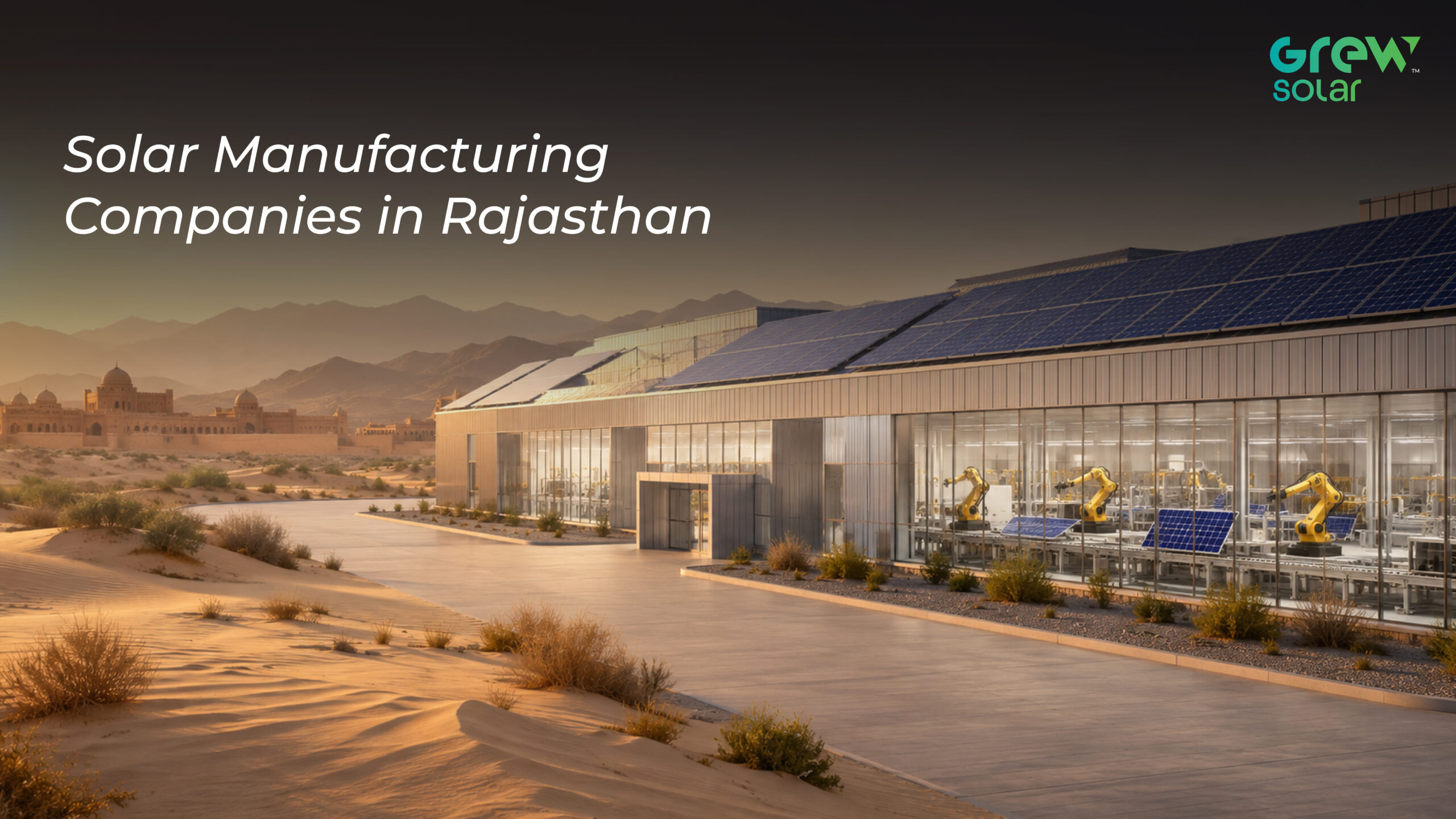
Solar Manufacturing Companies in Rajasthan

Everyone knows Rajasthan for its solar parks, Bhadla, the Thar Desert, and 325-plus sunny days a year. What gets less attention is what’s been building alongside all of that, a manufacturing base that didn’t really exist five years ago.

Rajasthan now holds around 10% of India’s total solar module manufacturing capacity, per Mercom India. Third nationally, behind Gujarat and Tamil Nadu. The companies responsible for that share aren’t fringe players, many are among the most seriously capitalised manufacturers in the country. Here are five with confirmed, operational facilities in the state.

1. GREW Solar

Location: Dudu, Jaipur District Module Manufacturing Capacity: 6.5 GW (expanding to 11 GW in 2026)

The 6.5 GW facility is expanding to 11.0 GW in 2026, and its modules are ALMM certified, a requirement for supplying government-backed solar projects in India. But capacity numbers alone don’t tell the full story. GREW Solar is one of only 11 companies in India to have received a PLI allocation for fully integrated solar manufacturing, not just modules, but the supply chain behind them.

That supply chain ambition is already taking shape. The 3.5 GW solar PV cell manufacturing facility in Narmadapuram, Madhya Pradesh is set to expand to 8.0 GW in 2026. It is the first step in a deliberate long-term backward integration strategy. Cells today, with further upstream integration to follow.

The company was named Solar Energy Manufacturer of the Year in 2025. Three years old, and already setting the pace.

2. INA Solar (Insolation Energy)

Location: Three facilities across Jaipur (including Sawarda, Delhi-Ajmer Expressway) Module Manufacturing Capacity: 5.5 GW combined

INA Solar started in 2015 with 80 MW of capacity. Today it runs three facilities in Jaipur with a combined 5.5 GW and plans on the table to reach 7.0 GW of modules and 4.5 GW of solar cells across Rajasthan and Madhya Pradesh.

The newest facility, at Sawarda on the Delhi-Ajmer Expressway, is worth singling out. 600,000 sq ft, AI and robotics-driven production lines, manufacturing M10R TOPCon modules with minimal manual intervention. It’s a different kind of facility to what India’s solar manufacturing sector looked like even three years ago.

INA Solar is BSE SME listed, ALMM listed, and its panels supply government programmes including PM-Kusum and PM Surya Ghar. One of Rajasthan’s most established manufacturing names.

3. ReNew Photovoltaics

Location: Mahindra World City, Jaipur Module Manufacturing Capacity: 3.55 GW

ReNew Photovoltaics is the manufacturing arm of ReNew Power, one of India’s largest renewable energy companies. Its Jaipur plant sits on 22 acres at Mahindra World City, producing around 15,000 modules a day. The March 2026 ALMM List-I update confirms 3.55 GW of enlisted capacity.

The reason for being in Rajasthan isn’t complicated. ReNew Power has a large project pipeline here. Manufacturing locally cuts procurement risk and logistics costs, and keeps the company competitive for government tenders that require ALMM-listed domestic supply.

It’s a model more developers are moving toward, own your generation, own part of your supply chain. For any solar panel company thinking about vertical integration, ReNew’s approach in Rajasthan is worth watching.

4. SAEL Industries

Location: Rajasthan Module Manufacturing Capacity: 3.2 GW TOPCon module assembly

SAEL is best known as a solar IPP with over 6.7 GW of solar assets across India, operational and under construction. Manufacturing came later, as a backward integration play. Rather than sourcing modules from the open market, the company built the capacity to supply its own projects.

The Rajasthan facility runs 3.2 GW of bifacial N-type TOPCon module assembly, with a 300 MW unit in Punjab alongside it. The technology choice reflects where utility-scale solar is heading, i.e., towards higher efficiency, better low-light performance, longer useful life.

SAEL has announced a larger integrated plant in Greater Noida, suggesting the Rajasthan operation is a step in a longer manufacturing build-out rather than a standalone move.

5. Acme Group (Acme Renewable Equipment Manufacturing)

Location: Jaipur Module Manufacturing Capacity: 1.2 GW

Acme Group invested roughly ₹230 crore to commission a 1.2 GW module manufacturing plant in Jaipur. It’s operational, ALMM listed, and employs over 700 people. The manufacturing entity, Acme Renewable Equipment Manufacturing, is a dedicated vertical within the group, not a side project.

The numbers Acme is targeting give a sense of intent. ₹10,000 crore in revenue from the manufacturing business by 2030. The Jaipur plant is the starting point for that ambition, with cell manufacturing capacity in the pipeline as the company moves toward backward integration.

At 1.2 GW, it’s the smallest facility on this list but Acme isn’t a small company and the trajectory here points firmly upwards.

The Bigger Picture

Gujarat still dominates around 45% of India’s module manufacturing capacity as of December 2025, per Mercom India. Rajasthan is not catching up to that overnight.

But the five companies here have a combined module capacity exceeding 17.5 GW, and most of them are actively expanding. More importantly, they chose Rajasthan for reasons that haven’t changed: land, sunlight, proximity to the country’s most active solar project market, and a state government that has made investment incentives a consistent part of its pitch.

The manufacturing story here is younger than the generation story. It’s also moving faster than most people realise.

Categories
Grew Solar Rajasthan Solar

India’s Growing Role in Global Solar Manufacturing

The global solar industry has a concentration problem. As of 2024, China accounted for more than 80% of global polysilicon, wafer, cell, and module manufacturing capacity, according to BloombergNEF’s Energy Transition Supply Chains 2025 report. One country, one supply chain and the rest of the world has spent the last several years trying to work out what to do about it.


India’s answer has been to build.

Where India Stands in the Global Picture

The scale of China’s manufacturing lead puts India’s position in context. Global PV module production reached 726 GW in 2024, with total manufacturing capacity at 1,405 GW per year, 83% of it located in China, per the IEA PVPS Trends in Photovoltaic Applications 2025 report. India, by comparison, held approximately 3% of global module production capacity as recently as 2023.

What matters, though, is the trajectory. India overtook Japan in 2024 to rank fourth globally in cumulative installed solar capacity at 124.6 GW, per IEA PVPS data. Its domestic manufacturing base is expanding at a pace that few anticipated even three years ago. 

The country is not yet a dominant force in global solar manufacturing but the direction of travel is clear, and the policy machinery driving it is substantial.

The Policy Framework Behind the Growth

India’s manufacturing push is not market-driven in isolation. It is the result of deliberate, layered policy designed to reduce import dependency and build domestic industrial capacity.

The centrepiece is the Production Linked Incentive (PLI) scheme for high-efficiency solar PV modules, administered by the Ministry of New and Renewable Energy with an outlay of ₹24,000 crore. The scheme targets GW-scale domestic manufacturing and is designed specifically for manufacturers willing to commit to fully integrated production.

Running alongside it is the Approved List of Models and Manufacturers (ALMM) mandate, reimposed in April 2024, which limits government-backed solar projects to domestically listed modules and manufacturers. The effect is a protected, captive demand base for Indian producers that directly incentivises capacity expansion.

The results are visible. India added 25.3 GW of solar modules and 11.6 GW of solar cell manufacturing capacity in 2024 alone, per Mercom India’s State of Solar PV Manufacturing in India 2025 report. In the first half of 2025, a further 42.2 GW of module capacity and 7.5 GW of cell capacity were added. MNRE data showed India’s total solar module manufacturing capacity was 74 GW and cell capacity stood at 25 GW as of March 2025.

These are not incremental gains. They represent a structural shift in India’s manufacturing footprint.

The Export Opportunity and Its Limits

India’s growing manufacturing base has opened an export lane that did not meaningfully exist five years ago.

PV module exports grew from $83 million in FY2021-22 to $1.97 billion in FY2023-24, per statements made by India’s Minister of State for New and Renewable Energy to parliament, as reported by PV Magazine. In Q2 2025, India exported solar cells and modules worth $549 million which is a 105.1% quarter-on-quarter increase with the United States accounting for 96.2% of total export volume, per Mercom India.

The US opportunity is largely a consequence of trade policy. High tariffs on solar imports from Vietnam, Cambodia, China and other Southeast Asian suppliers are prompting American developers to look for alternatives. India has picked up some of the slack, with its share of US solar module imports rising to 9% in 2023 from 2.2% in 2021.

However, over-reliance on a single export market, particularly one that may introduce new trade barriers, is a vulnerability that Indian manufacturers will need to manage carefully.

The more fundamental challenge remains upstream. India currently has no commercial production of silicon ingots or wafers, with China accounting for 97% of both globally, per ORF America. Without closing this gap, Indian module manufacturers remain dependent on Chinese components which is a structural dependency that limits the depth of India’s role in the global supply chain.

The Companies Building India’s Manufacturing Future

India’s manufacturing expansion is being led by a growing cohort of domestic producers. IBEF says that Waaree Energies, Adani Solar and Vikram Solar exported more than 50% of their annual production in FY2024, whereas companies like Grew Energy, ReNew Power and Saatvik Energy are expanding their global presence.

One of the manufacturers shaping India’s solar future is GREW Solar. Backed by the Chiripal Group’s 52-year manufacturing legacy, it stands out for the scale and integration of its operations. 

Established in 2022, the company operates a solar PV module manufacturing facility in Dudu, Rajasthan, with 6.5 GW of installed capacity and an ongoing expansion to 11.0 GW in 2026. Complementing this is a 3.5 GW solar PV cell manufacturing facility in Narmadapuram, Madhya Pradesh, set to expand to 8 GW in 2026, a footprint that reflects a deliberate move toward deeper supply chain integration rather than module assembly alone.

GREW Solar is one of only 11 companies in India to receive a PLI allocation for fully integrated solar manufacturing, a distinction that reflects both the ambition and the credibility of its industrial model.

For any solar panel company operating at this level of integration, India’s policy environment, growing domestic demand, and expanding export footprint represent a significant long-term opportunity. The upstream gaps are real, and the global competitive landscape is unforgiving. But the foundation being built in manufacturing capacity, policy support, and industrial expertise positions India as a serious and growing participant in the global solar supply chain.

The distance between “growing role” and “global force” will be determined by how consistently that foundation is built upon.

Categories
solar home Grew Solar

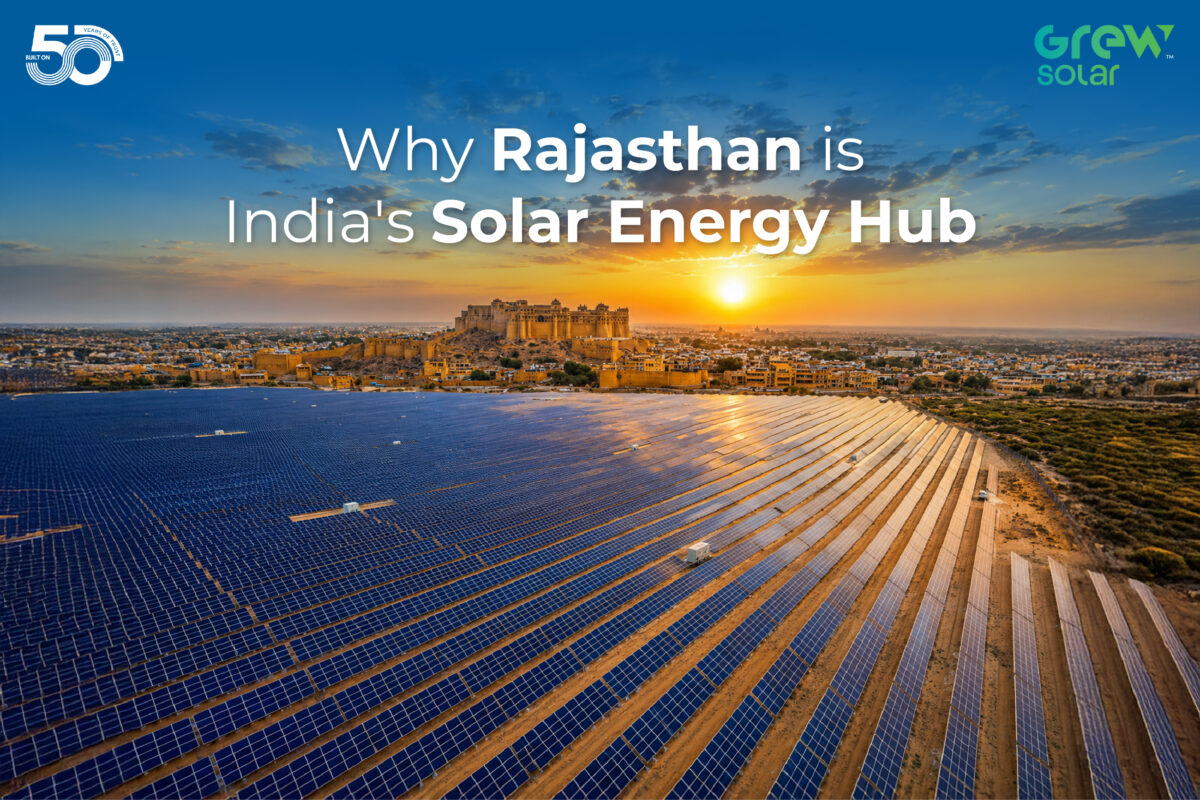
Why Rajasthan is India’s Solar Energy Hub

India has committed to reaching 500 GW of non-fossil fuel capacity by 2030, one of the most ambitious clean energy targets in the world. Achieving it will need ground level execution besides policy initiatives. It demands the right geography, the right scale, and consistent execution. On all three counts, one state stands apart more than any other, i.e., Rajasthan.

The Geography Makes the Case

Solar energy is, at its core, a geography-driven industry. Rajasthan’s natural conditions are perfect for it.

The state receives 6 to 7 kWh of solar radiation per square metre each day, with over 325 sunny days annually. In the western areas of the Thar Desert, rainfall occurs on as few as 10 to 20 days per year. Rajasthan has the highest total solar generation potential among all Indian states, assessed at 142 GW by the Ministry of New and Renewable Energy (MNRE).

Other than the sunlight factor, the state also has a significant land advantage. The Thar Desert covers nearly two-thirds of Rajasthan, offering vast stretches of flat, largely uninhabited terrain with barely any agricultural or urban use. For utility-scale solar infrastructure, this means fewer land conflicts, lower acquisition costs, and faster project clearances; most Indian states cannot match these conditions.

Together, these two factors, i.e., high solar irradiation and abundant usable land form the foundation on which everything else in Rajasthan’s solar story is built.

The Scale of What’s Already in Place

Rajasthan’s solar credentials are already well-established.

The state is home to the Bhadla Solar Park in Jodhpur which spans over 14,000 acres and has 2,245 MW of installed capacity. It is the world’s largest fully operational solar park. Bhadla is an example of how seriously Rajasthan has translated their solar potential into reality.

There are other numbers that reinforce this. According to data from the Global Energy Monitor, Rajasthan accounted for around 31% of India’s non-hydro renewable energy installations between 2020 and March 2024. In Q1 2025, Rajasthan generated 13.1 billion units of solar power, outpacing all other states and registering an 11.1% growth over the last quarter, as per Mercom India’s analysis of data from the Central Electricity Authority (CEA) and Ministry of New and Renewable Energy (MNRE).

Rajasthan has also crossed a milestone that no other Indian state has reached, i.e., more than 50% of its total installed power capacity is solar. This reflects where the state stands today.

A Policy Environment Built for Investment

Rajasthan’s solar scale has been consistently backed by its natural advantages with structured, long-term policy.

The Rajasthan Renewable Energy Policy 2023 had a target of 90 GW renewable energy by 2030, out of which 65 GW was to be solar. The following year, the Integrated Clean Energy Policy 2024 upped the target to 125 GW renewable energy by 2029-30, of which 90 GW was to be solar.

To attract private capital, the Rajasthan Investment Promotion Programme 2024 provides 100 per cent exemption on electricity duty for seven years for renewable energy projects, and big waivers on stamp duty and land conversion charges. For capital-intensive projects where tariff margins are closely managed, these incentives have a huge impact on project economics.

The response from industry has been equally significant. GREW Solar, backed by the Chiripal Group’s 52-year manufacturing legacy and established in 2022 chose Dudu, Rajasthan as the location for its solar PV module manufacturing facility. The plant is now one of India’s largest, with 6.5 GW of operational capacity and an ongoing expansion to 11.0 GW in 2026. 

The decision by a solar panel company of this scale to root itself in Rajasthan reflects what the state’s policy environment has made possible across the full solar value chain.

What the Next Phase Needs to Solve

Rajasthan’s scale is real and so is the infrastructure work required to sustain it.

Solar generation capacity in the state has grown faster than the grid’s ability to move that power. An 18-month delay in a critical transmission strengthening programme created evacuation bottlenecks for 8.1 GW of renewable capacity, as documented in Grid-India’s official Operational Feedback on Transmission Constraints report for April-June 2025. 

Between March and August 2025, curtailment rates climbed from 8.5% to 51.5% during peak solar hours. The Central Transmission Utility of India has identified connectivity challenges for approximately 60 GW of renewable capacity in the state. These are problems that come with moving fast and Rajasthan is moving to address them. 

A 1,000 MW/2,000 MWh battery energy storage project is currently underway, with an additional 4,000 MWh allocated under the PSDF scheme. Demand-side flexibility regulations are set to take effect from April 2026 to better integrate variable solar generation into the grid.

The investment in storage and transmission infrastructure is what will allow Rajasthan to convert its generation capacity into delivered, usable power at the scale the state is clearly capable of.

The Bigger Picture

No other Indian state brings together Rajasthan’s combination of solar irradiation, land availability, installed capacity, and policy infrastructure. That ecosystem is now attracting not just project developers, but manufacturers and the broader solar value chain.

For any solar panel company looking to grow within India’s energy transition, Rajasthan is not to be overlooked. The foundations are proven, the ambition is clear, the only thing that remains is closing the gap between what the state can generate and what its grid can carry.

That is the defining challenge and opportunity of Rajasthan’s next phase.

Categories
solar home Grew Solar

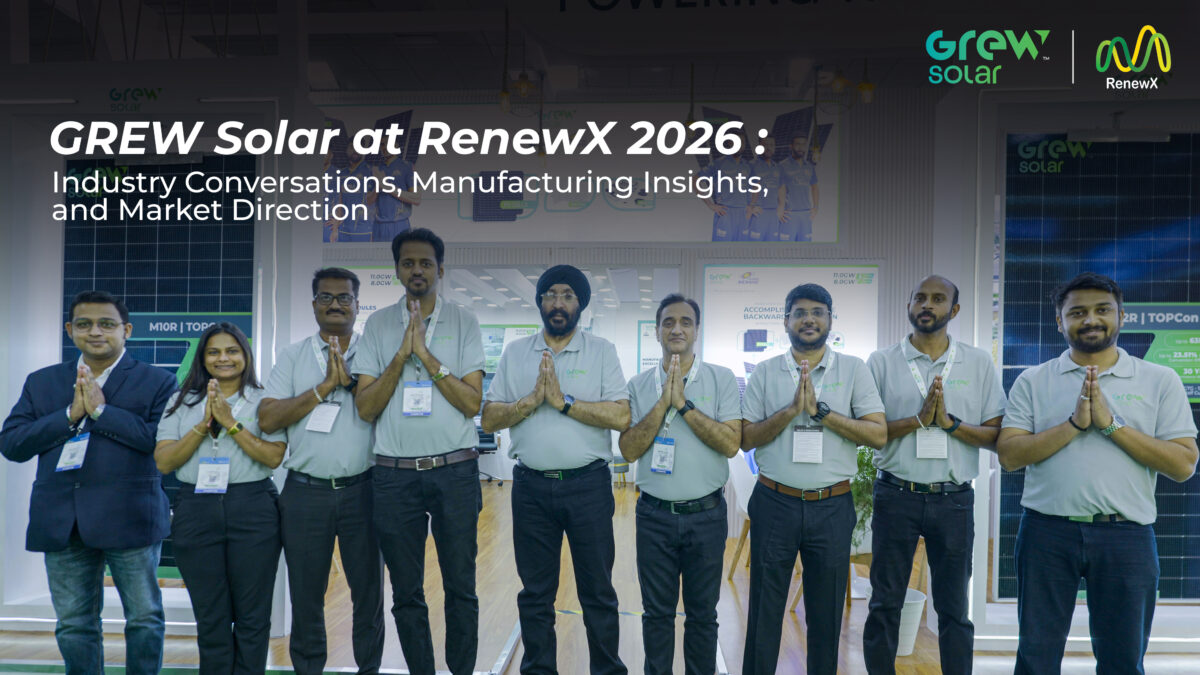
GREW Solar at RenewX 2026: Industry Conversations, Manufacturing Insights, and Market Direction

RenewX’s10th edition under the theme “A Decade of Impact – A Future of Abundance” was a three-day event that brought together over 8,000 industry professionals, 200+ leading brands, and more than 50 speakers across solar, energy storage, bioenergy, and emerging clean technologies. 

For manufacturers, the event offered a direct view of how market expectations are evolving. Conversations at booths and sessions reflected a clear shift in procurement priorities, with greater emphasis on manufacturing quality, system integration, and long-term performance rather than upfront cost alone.  

GREW Solar at RenewX 2026 

GREW Solar exhibited its G12R and M10R solar PV modules designed for utility-scale and commercial applications.

Engagement at the booth extended beyond product specifications. Conversations with EPCs, developers, channel partners, and project financiers reflected a shift in how modules are being evaluated today. 

Questions focused on performance consistency across batches, degradation behavior under high ambient temperatures, long-term reliability, and manufacturing traceability. These discussions pointed to a broader industry trend where modules are assessed as long-term performance assets rather than standalone procurement items.

Members of the GREW Solar team also participated in conference sessions addressing critical industry challenges, including the transition to hybrid projects, energy storage deployment, manufacturing quality, and export readiness.

Key Industry Conversations at RenewX 2026

Discussions across the event indicated a gradual shift from standalone solar projects to more integrated energy systems. Hybrid configurations that combine solar, wind, and storage are becoming more common, with a stronger focus on delivering firm and dispatchable power.

Energy storage was a recurring theme, particularly in the context of managing variability and supporting grid requirements. At the same time, there was continued attention on domestic manufacturing and supply chain depth, especially as India increases its installed capacity. 

Another noticeable shift was in evaluation criteria. While cost remains relevant, there is more consistent focus on performance, degradation, and long-term reliability.

Manufacturing and Scale: Insights from Leadership

One of the key discussions at RenewX 2026 focused on how Indian manufacturers can position themselves in global markets. As part of a BloombergNEF-powered panel on unlocking global opportunities through strategic alliances, Hardip Singh, COO at GREW Solar, shared perspectives on the practical realities of scaling solar manufacturing in India.

A central point was the importance of execution. Experience across different states has shown that policy intent alone is not sufficient. Infrastructure readiness, logistics, and access to supply chains have a direct impact on how effectively manufacturing can be set up and scaled. 

There has also been a clear shift in how product quality is perceived. With advancements in technology and stronger regulatory frameworks, discussions are now focused on consistency of performance and the ability to deliver at scale rather than comparisons with global benchmarks. 

Manufacturing discipline, including process control and integration across the value chain, is becoming a more relevant factor in how manufacturers are evaluated in both domestic and export markets. 

Evolving Market Dynamics and Demand Patterns

Market dynamics were also discussed in the context of changing project structures and emerging technologies. In a CRISIL-powered session focused on the evolution of energy storage demand across utility-scale, commercial and industrial, and residential segments, Ankur Baranwal, National Sales Head – KAM at GREW Solar, highlighted how these shifts are influencing solar demand.

The move toward hybrid tenders is changing how solar PV modules are evaluated. Instead of being assessed primarily on cost, modules are now part of a larger system where performance, reliability, and generation profile directly impact project outcomes.

This transition is also leading to more structured demand patterns. As projects are designed to meet defined output requirements, there is less emphasis on short-term pricing and more focus on long-term performance.

At the same time, energy storage deployment is expected to be more closely aligned with demand centres and grid requirements, rather than following the same geographic patterns as solar generation.

Preparing for Export Markets

Sessions exploring India’s readiness for global markets drew lessons from sectors like textiles and chemicals. Three takeaways stood out: consistency beats cost, integration matters for controlling quality, and export markets require patience to build long-term relationships.

India has built domestic manufacturing capacity through PLI, ALMM, and basic customs duty. The next phase should focus on export-linked incentives, trade access through bilateral agreements, support for upstream manufacturing, and competitive financing to enable Indian manufacturers to plug into global supply chains.

What This Means for Solar Manufacturing

RenewX 2026 reflected a sector maturing in its expectations. The focus is shifting from volume addition to system performance, integration, and long-term reliability. Modules are no longer evaluated only on upfront cost but on how they perform within larger systems over time.

This increases the importance of manufacturing quality, process control, and backward integration. As domestic capacity expands, consistency and reliability are becoming more important than incremental cost differences.

For GREW Solar, participation in the event provided valuable insights into how developers, EPCs, and financiers are evaluating manufacturers today. These conversations will continue to inform our approach to capacity expansion and product development as we work toward 11.0 GW of module manufacturing capacity and 8.0 GW of cell manufacturing capacity in 2026.

We thank everyone who visited our booth and engaged with our team during the event.

Categories
solar home Grew Solar

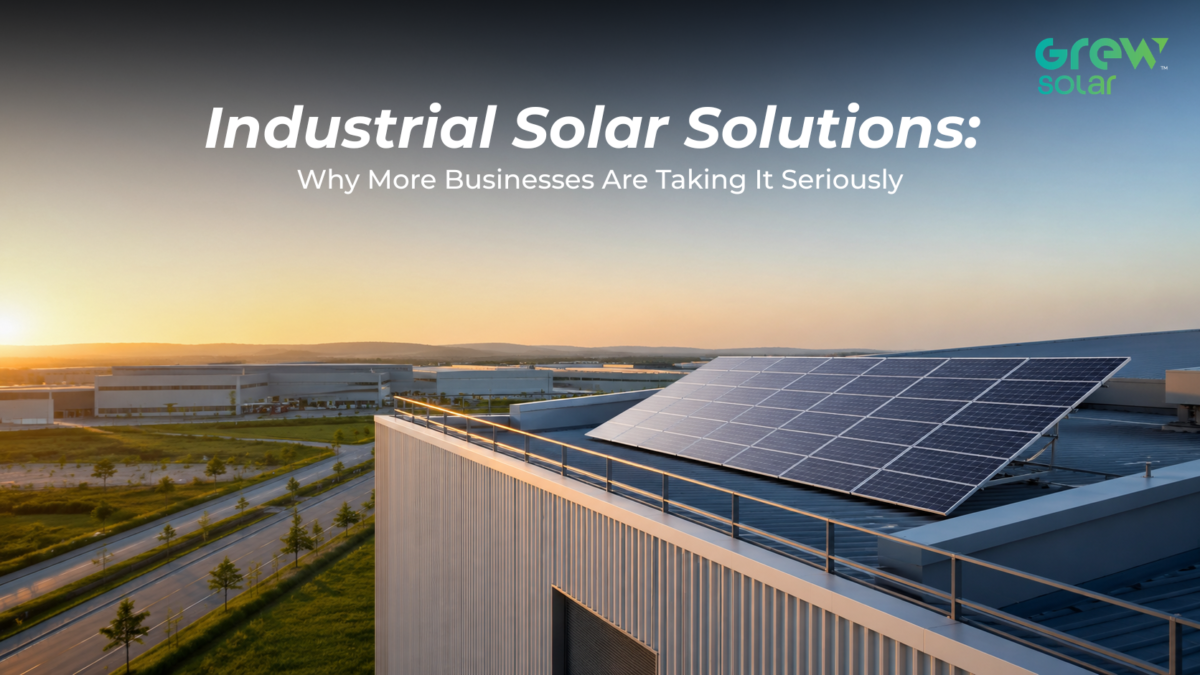
Industrial Solar Solutions: Why More Businesses Are Taking It Seriously

For a long time, energy was just another line item in operational costs. Something you paid for and moved on.

That approach is slowly changing.

With electricity prices becoming less predictable and consumption steadily increasing, many businesses are now looking at energy a bit differently, not just as a cost, but something that can be managed better.

This is where industrial solar solutions are starting to come into the picture more often.

Not Just an Alternative Anymore

Earlier, solar was often seen as an optional upgrade. Something companies would consider later.

Now, it’s becoming part of the conversation much earlier.

The reason is fairly simple. When a business runs on large-scale operations, even small changes in energy cost can have a noticeable impact over time. And relying entirely on external power doesn’t always give that level of control.

Solar doesn’t solve everything overnight, but it does shift some of that control back to the business.

What “Industrial Solar” Actually Means in Practice

At a basic level, it’s about generating electricity at your own facility using solar panels.

But in practice, it’s not just about installing panels on a roof.

A system has to be planned around:

  • how much energy you use
  • when you use it
  • how your operations might grow in the future

If these things are not considered properly, the system might still work, just not as efficiently as it could.

Why Location Still Matters

One thing that works in favor of businesses across regions like Gujarat, Rajasthan, Maharashtra, and Delhi is the availability of sunlight.

These areas generally receive good solar exposure for most of the year, which makes it easier for systems to generate consistent output.

That said, sunlight alone doesn’t guarantee performance. The way the system is designed still plays a big role.

Where the Real Difference Comes In

Two setups can look similar on paper but perform quite differently over time.

Usually, the gap comes from a few things that are not always visible upfront.

Design decisions, for example, can affect how much sunlight is actually captured.
Material quality influences how the panels handle heat and wear over the years.
And installation, even small errors here can quietly reduce efficiency.

These are not issues that show up immediately, which is why they’re easy to overlook at the beginning.

The Role of Manufacturing (Often Underrated)

A lot of attention goes to installation, but manufacturing quality matters just as much.

Solar panels are expected to last 20 to 25 years. Over that period, even minor inconsistencies can affect output.

Better manufacturing usually means:

  • more uniform performance
  • slower degradation
  • fewer unexpected issues later

It’s not something you notice on day one, but it becomes clear over time.

A Quick Note on GREW Solar

GREW Solar has been expanding its manufacturing capabilities with this long-term view in mind.

With an operational module manufacturing facility in Rajasthan and plans to scale further, the focus is on maintaining consistency in production while supporting larger industrial requirements.

Their use of technologies like N-type TOPCon modules is aimed at improving efficiency, but equally important is the emphasis on process control and quality checks behind the scenes.

Looking Beyond Immediate Savings

Cost savings are usually the starting point for most businesses considering solar.

But over time, the conversation tends to shift.

It becomes less about “how much are we saving this month” and more about:

  • how stable our energy costs are
  • how much control we have
  • how reliable the system is over the years

That’s where well-planned industrial solar systems tend to stand out.

So, Is It the Right Move?

There isn’t a single answer that fits every business.

But for operations with high and consistent energy usage, solar is increasingly becoming a practical option rather than just an alternative.

Not because it’s trending, but because, in many cases, it makes operational sense.

Industrial solar solutions don’t change everything overnight. But they do change how businesses approach energy.

And in a space where costs, efficiency, and long-term planning matter, that shift is becoming more relevant than ever.

Categories
Grew Solar

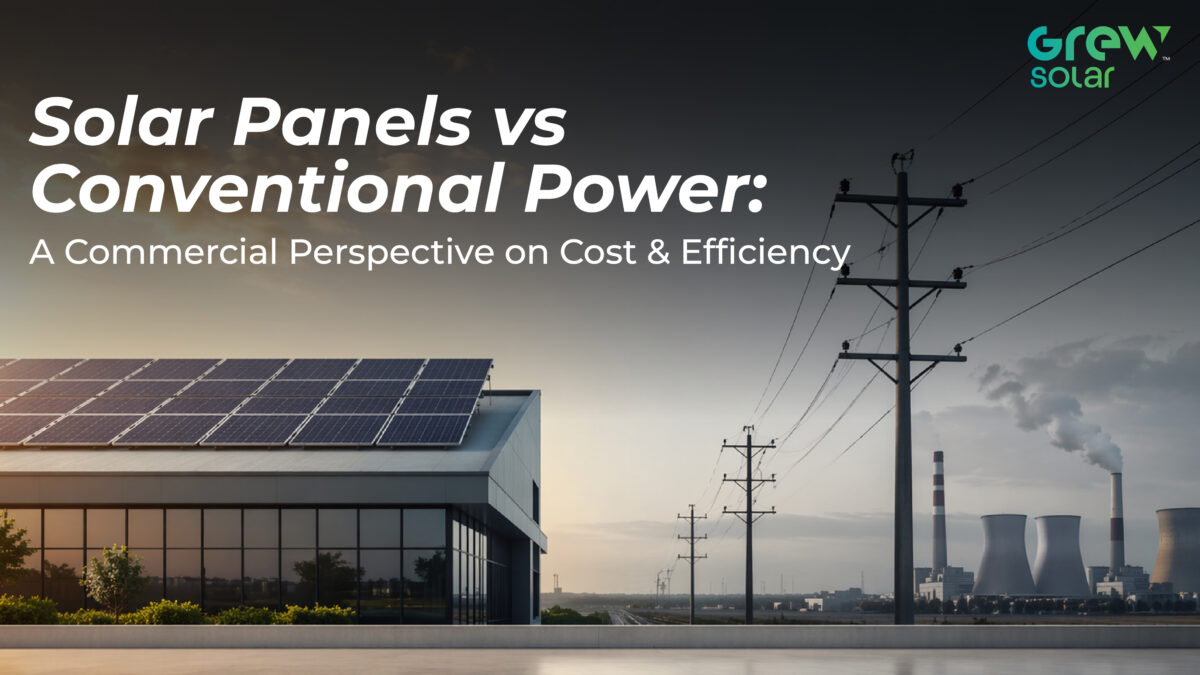
Solar Panels vs Conventional Power: A Commercial Perspective on Cost and Efficiency

Energy costs have become a more visible part of business planning, especially as tariffs continue to fluctuate across regions and sectors. For many organisations, the question is no longer whether to adopt solar, but how it compares with conventional power over time.

This comparison is not only about today’s cost per unit, but also about how energy is sourced, managed, and sustained. The solar panel company chosen here also factors into this decision, as the system’s performance depends on more factors than installation alone.

Understanding Conventional Power Costs

Conventional power is usually seen as a predictable utility expense, but in reality, it is affected by many external factors. Grid tariffs can change over time due to external factors, fuel costs also affect how power generation, and peak demand charges is yet another factor that can make monthly bills less predictable. These changes are not always gradual, which makes long-term planning more difficult.

For large businesses, this means energy costs can be unpredictable. Grid power is still essential, but pricing doesn’t stay stable over time. While grid power remains important, it lacks long-term cost stability.

How Solar Changes the Cost Structure

Solar changes the way a business thinks about energy costs. Instead of being a recurring expense, it becomes a planned investment with a more predictable output. While there is an upfront cost involved, the energy generated over time reduces reliance on grid electricity and helps stabilise overall energy expenditure.

This makes energy easier to plan around since over time costs become more stable, which works well for businesses with a steady demand.

Efficiency and Energy Output Comparison

The comparison between solar and conventional power is not limited to availability because it also includes how efficiently energy is generated and used. When designed and set up properly, solar systems can deliver steady output that matches a business’s operational needs.

Solar efficiency depends on a few key factors like module quality, system design, and how the system is installed. This is where the role of a solar panel company matters, since both manufacturing and planning affect performance. Better modules and proper system alignment can increase energy output without needing more space.

Long-Term Performance and Reliability

Solar and conventional power differ mainly in how they perform over time. Solar systems are built to last for decades and usually deliver steady, predictable output, which makes planning easier.

Conventional power, on the other hand, depends on external supply and conditions that are not always in your control. It keeps operations running, but costs and performance can vary. Solar systems, when designed and built properly, offer more consistent and stable performance over the long term.

Operational and Strategic Advantages for Businesses

Besides cost and efficiency, solar also supports other operational objectives. It reduces exposure to tariff changes, provides a degree of energy independence, and aligns with sustainability goals that are increasingly becoming part of business strategy.

For organisations with long-term planning horizons, these factors contribute to more predictable operations. Energy becomes less of a variable and more of a controlled input, which can support both financial and operational stability.

What Determines Solar Project Performance

The effectiveness of a solar installation depends on how well different elements come together. Module efficiency, manufacturing consistency, system design, and execution all affect actual output. Even well-designed systems can underperform if there are issues in production or gaps during installation.

A good solar panel company makes sure all these parts work together smoothly, so the system performs well over time. This means they focus on quality manufacturing, thorough testing, and making sure the product fits the job. When these things are managed well, the system is more likely to give consistent and reliable energy generation for years to come.

Where GREW Solar Fits In

GREW Solar focuses on large-scale manufacturing and designs for strong performance. With plans for 11.0 GW of module production and 8.0 GW of cell production, the company is growing its capacity while making sure its systems deliver steady results.

GREW Solar’s modules, including ALMM-certified types, are made for efficiency and reliability, with in-house testing and careful process control. This helps projects get steady performance over time and stay in line with rules and business needs.

Conclusion

Comparing solar panels and conventional power isn’t just about short-term costs. It shows a bigger change in how businesses plan and manage energy. Conventional power still matters, but it doesn’t give much control over long-term costs or changes.

With good design and manufacturing, solar offers a more stable and predictable option. For businesses thinking about switching, it’s important to look beyond installation and consider how well the system will perform in the long run.

Categories
Grew Solar RE+ 2024

How a Solar Panel Company Can Help You Save More Energy

Most people think of solar energy savings as lower electricity bills, but for businesses, it goes further. It’s also about how much energy your system can produce each day and how efficiently it converts sunlight into energy. Choosing the right solar panel company is core to getting a system that performs well and lasts.

What Does “Saving More Energy” Really Mean?

In simple terms, saving more energy means getting more power from your solar system and keeping that performance steady over the years. It depends on how well your system turns sunlight into electricity and how reliably it works. 

For bigger setups, even a small increase in efficiency can make a big difference and improve your return on investment.

How Technology Boosts Your Energy Output

Modern solar technology has improved and advanced a lot. Today’s high-efficiency panels are designed and built to handle real-world challenges such as temperature changes, cloudy weather, and even shading losses. This lets you get more energy without needing extra installation space for the modules. 

Better designs and materials also make your system more reliable, so it keeps working well in all kinds of weather.

Why Quality Manufacturing Matters for the Long Haul

The way solar panels are produced has a direct impact on how they perform over the years. Solar systems are usually designed to last 25 years or more, but even the smallest of issues during production can cause them to wear out faster or produce less energy. 

These issues may not appear immediately, which is why careful manufacturing matters.

Here’s what makes a difference:

Consistent cell quality: Any variations in the solar cells can cause energy losses and reduce long-term solar panel performance.

Durable materials: High-quality glass, protective layers, and backing materials are what make sure that solar panels can withstand and perform consistently in harsh weather for years.

Reliable production processes: Automated and controlled manufacturing can reduce defects or variations in solar modules and ensure consistent quality.

Thorough testing: Advanced quality check methods can identify issues before panels leave the factory.

Slower degradation: Well-made panels retain power output, providing steady energy generation for decades.

Focusing on these details helps your system perform reliably year after year. Top manufacturers use quality checks at every step, which lowers long-term risks and keeps energy output high.

Design and Installation That Works

Even the best panels need smart design and careful installation to work at their best. The way your system is arranged, the choice of inverters, and the quality of installation all affect how much energy you get. 

If a system is not well planned, it can lose out on energy because of shading or bad layout, but with thoughtful design and professional installation, the system can capture the sunlight and work smoothly in real conditions.

Choosing the Right Partner

Choosing a solar panel company is not limited to looking at technical specs. It’s important to see how they combine quality manufacturing, practical technology, and real-world experience. 

Make sure to check their production capacity, industry certifications, testing methods, and track record. For businesses, these details help ensure you get a system that is efficient and reliable for years, focusing on integrated manufacturing and designs that prioritise performance.

With plans for 11.0 GW of solar PV module manufacturing capacity and 8.0 GW of solar PV cell manufacturing capacity, GREW Solar is scaling up while maintaining the systems needed for consistent quality. 

Their modules, including ALMM-certified options, are developed with an emphasis on productivity and long-term stability, backed by in-house testing and careful process control. This means projects are built for sustained performance, not just impressive day-one numbers.

The Bottom Line

As solar energy becomes more common, the idea of savings is becoming more detailed. It’s not only about peak power output, but also about steady performance over your system’s lifetime. That’s why picking the right solar panel company is so important. 

The best long-term results come from strong manufacturing, smart design, and a lasting focus on efficiency.

Book an appointment info@grewsolar.com 

Categories
Grew Solar

GREW Solar’s 2025 Journey as One of India’s Youngest & Fastest-Growing Solar Panel Manufacturers

2025 was a year that brought sharper focus across the solar manufacturing ecosystem bringing the need for consistency, reliability, and long-term thinking into focus for all besides solar panel prices. But for solar panel manufacturers like GREW Solar, the year showed how scale and discipline must move together for quality progress.


We made significant progress, received recognition, and learned how to improve this past year. Our major focus was on enhancing our manufacturing efficiency and moving towards the next stage of growth.


Changes in the Solar Landscape in 2025

A significant shift in how the industry and even buyers search for solar energy companies has been brought to light over the past year. Buyers are increasingly looking for solar partners whose principles and processes reflect reliability, transparency, and steady manufacturing growth.


This involves creating a balance between competitive pricing and reliable, superior performance for solar module manufacturers. Solar panel prices remained under pressure, but so did the expectations around testing standards, ESG responsibility, and consistent supply output. This environment pushed all the solar manufacturing companies to strengthen process discipline and focus on long term goals.


GREW Solar’s 2025 in Review

In 2025, we manufactured 10,000+ solar PV modules in a day. Another important milestone was our transformation into GREW Solar, with a new purpose as a  solar manufacturing company. 


On the product front, 2025 saw the launch of our All Black solar PV module and the G12R solar PV module, expanding our portfolio of solar PV modules designed for performance and long term consistency. Each launch reflected our focus on aligning product development with evolving market needs.


Recognition That Reflected Consistency

In 2025, recognition came from a lot of sources, but the type of recognition was especially significant. GREW Solar was ranked among India’s leading and Top 10 solar module suppliers, reinforcing our growing presence among established solar panel manufacturers.


We were honoured with the ‘Leadership in Performance- Solar PV Module Manufacturing’ award at the CII Performance Excellence Awards and named Solar Energy Manufacturer of the Year at the Go Global Awards in London. Our ESG-first approach was also recognised at the ET NOW Machinist Super Shopfloor Awards, highlighting the importance of sustainability alongside scale.


For us, these recognitions were outcomes of consistent execution towards our mission.


Leadership and People at the Centre

The appreciation of GREW Solar’s teams and leadership was another significant theme for 2025. Our Director and CEO, Vinay Thadani, received numerous leadership honors, and senior management members received recognition for their contributions on different industry platforms.


These recognitions mattered because leadership visibility builds confidence in solar power companies. Simultaneously, our company’s culture awards and employer brand recognition showed that when teams are motivated, encouraged, and committed to a common goal can they achieve sustainable growth. 


Engaging Where the Industry Comes Together

In the past year, through different industry events in and out of India i.e.,  conferences, exhibitions, product launches, and other industry gatherings, we exchanged views with peers, partners, and policymakers on manufacturing problems, new technologies, and what the next future of solar could look like in different markets. For solar panel manufacturers, these conversations help keep perspective grounded.


Culture, Community, and Shared Values

Other than the business milestones, 2025 was also about strengthening culture and shared responsibility. Team offsites, sustainability-led celebrations, and community initiatives played an important role in shaping the year.


From environmental pledges and tree plantation drives to blood donation camps and national celebrations, these moments reflected our belief that manufacturing leadership must go hand in hand with social responsibility. Sporting events, cultural festivals, and group challenges further strengthened the sense of collective ownership across teams.


What 2025 Reinforced for Us

Looking back, 2025 reinstated a number of important lessons. It emphasized the importance of manufacturing discipline. It also served as a reminder that, despite their importance, solar panel prices should be measured against their performance, dependability, and lifecycle value.


2025 strengthened our belief that solar module manufacturers are infrastructure builders and how our responsibilities go beyond just providing solar PV modules, as we enable businesses to work towards their energy objectives and contribute to India’s shift to renewable energy.


Looking Ahead to 2026

As we begin 2026, our focus remains on scaling responsibly. Reflecting on the year gone by, Vinay Thadani, Director and CEO of GREW Solar, said that 2025 marked a phase of progress for the company’s goals but that the priority moving forward is to accelerate India’s transition towards Net Zero and support long-term energy transformation.


By 2026, GREW Solar aims to strengthen India’s clean energy ecosystem by expanding to 11 GW of solar PV module manufacturing capacity and 8.0 GW of solar PV cell manufacturing capacity. This 2026 roadmap is part of our long term goal towards contributing to the net zero goals.


As we move into 2026, we do so with a clear sense of purpose and with the mission to continue powering the next.

Categories
Grew Solar

GREW Solar and the Role of Sustainability in Building Trusted Solar Panel Companies

Sustainability is often talked about as a given in the solar industry since solar energy itself is clean energy but over the past few years, it has become clear that energy generation is only one part. The other part is how the modules are produced, the resources they use, and how operations are run on the factory floor as this also influences the impact they ultimately create.


Since the energy industry becomes more and more eco-conscious, solar panel manufacturers need to make sure that sustainability is no longer just an add-on but a way to build long-term trust and credibility. This shift is changing how the best solar panel companies are chosen today.


Looking Beyond Energy Generation

There is a common assumption that solar products are automatically sustainable but the manufacturing of solar PV modules involves energy, water, materials, and logistics. When the production is low, these impacts may seem small but when it scales, they become difficult to ignore.


Factories consume power. Processes generate waste. Water is required at multiple stages. If these elements are not managed carefully, the environmental benefit of solar energy can be diluted. This is why sustainable manufacturing is just as important as the energy that it generates.


Sustainable Manufacturing for the Environment

Every large manufacturing operation leaves a footprint. The difference lies in how deliberately that footprint is reduced. In solar manufacturing, sustainability is related to efficiency because less waste, better energy generation, and cleaner manufacturing processes are all important factors .


Steps such as improving energy efficiency within plants, reusing water where possible, and optimising material usage may seem operational in nature, but with solar installations increasing in the country, these decisions and their cumulative effect is significant.


Long-Term Value Of Sustainability

In solar manufacturing, sustainability is not just about environmental responsibility but also about how a solar panel performs in the long run. Manufacturing processes that are stable and well-controlled tend to produce a more consistent output, fewer defects, lower failure rates, and a longer product lifecycle.


This is where the conversation around solar panel price has changed because instead of being viewed only as a number, price is increasingly linked to performance over the full life of a project. Solar panels that last longer and perform consistently delivers better value in the long term, even if the initial cost is not low.


GREW Solar’s Approach to Sustainable Manufacturing

At GREW Solar, sustainability is an integral part of daily operations as opposed to being a separate program or initiative. The organization has focused its efforts in developing production systems that provide efficiency, quality, and reliability over time. 


Resource usage is tracked and controlled throughout all of the different processes. GREW Solar’s goal is to continually eliminate waste and improve energy efficiency which will contribute to both the environment and to increase operational consistencies over time which supports higher quality products and less down-time.


Quality assurance is as important as quality control. High-quality testing and strong process disciplines will lower rework and waste of materials. The durable nature of the solar PV modules comes directly from this approach. Products that work consistently in the field will have fewer needs for replacement/repair. This means less total resources will be consumed over time.


The people working within this system are also a major component of it. People with safe workplaces, defined procedures and long-term skill development will produce a stable operation environment. Teams and systems that can sustainably grow will be there longer than ones that do not.


Long-Term Thinking through Sustainability

The “Future Comes First” philosophy of long-term planning at GREW Solar has an impact on all aspects of solar manufacturing, quality control, and growth. As opposed to making decisions based solely on short-term results, GREW Solar gives significant consideration to the long-term implications of its decisions i.e., how will today’s choices perform in years to come?


Long-term thinking is illustrated in how sustainability has been incorporated into the overall operations of GREW Solar. Examples of this type of thinking include implementing solar powered manufacturing at its Jaipur facility; using in-house systems for water conservation by way of a Sewage Treatment Plant; and utilizing more environmentally friendly logistical methods as a means of reducing GREW Solar’s total environmental footprint and sustaining the operational efficiencies and production stability associated with it.


Similarly, GREW Solar’s environmental focus does not stop with its manufacturing process and includes both ecosystem restoration and responsible management of resources. The company’s tree planting program, the development of community driven “green” projects and the systematic reforestation of areas damaged by development are all examples of long-term oriented environmental initiatives that are intended to produce quantifiable environmental results over a period of time. All of these activities support GREW Solar’s focus on developing long-term sustainable systems, rather than creating short-term gains which do not create long-term value.


Long term thinking is also related to being sustainable. Manufacturers who think about what their company needs to be able to perform well into the future (i.e., better able to meet changing technological demands, growing consumer demand for higher performance products, etc.) will have systems and processes that are more adaptable to changes in both regulations and consumer expectations. Therefore, manufacturers can invest in systems that may cost more money upfront, or require a longer period of time to build but ultimately provide a greater degree of resilience into the long term.


Changing Expectations from Buyers

As the solar industry matures, so too will the buying behavior of buyers (EPCs and Developers) and their expectations. In addition to looking at the specifications and delivery schedule associated with an installation project, buyers increasingly view aspects of sustainability, reliability and governance as key determinants of long-term credibility when evaluating potential providers.


In this context, solar panel prices are rarely evaluated in isolation. Buyers want confidence that products are backed by stable manufacturing practices and responsible operations. Environmental discipline often signals operational discipline, and that connection matters when projects are expected to run for decades.


What Builds Trust in Solar Panel Manufacturers

The decision to trust one manufacturer or another is not made overnight, it happens over time due after evaluating the manufacturer on consistency, transparency and the ability to continue delivering consistent levels of quality. This is why the top solar companies in India are often those that prioritise discipline over rapid expansion.


Rather than just relying on claims, building trust is based upon results. The conversation about which solar panel company is the “best” in India is shifting towards reliability over the long term and away from short-term growth.


Long Term Reliability As A Shared Responsibility

In order for companies to be truly sustainable, they cannot do it alone. In an ever-growing world of solar, all stakeholders including; manufacturers, suppliers, partners, etc., have the responsibility to work together to ensure sustainability throughout the supply chain and to align their efforts.


In recognition that sustainable development promotes overall ecosystem development, many of the top solar companies in India now see that environmentally responsible growth supports the objectives of their clean energy goals.


Thinking Sustainably in Building Long Term Value

How companies think about sustainability is directly related to building trust and long term value in the solar manufacturing sector. How products perform, how companies operate and how they are viewed long term will all be influenced by how companies view sustainability.


The way GREW Solar views sustainability as a way of thinking is a reflection of its belief in being thoughtful when building and to prepare for the future. The idea of sustainability is always going to be connected to providing long term value, and not just short term value, especially as we see ongoing discussion surrounding solar panel pricing and long term value continues to evolve.