
Categories
Uncategorized

Intersolar Europe 2026: Market Conversations Driving the Future of Global Solar Manufacturing

Intersolar Europe 2026 once again reaffirmed why it remains the most influential meeting point for the global solar industry. As the sector accelerates towards higher efficiency, diversified supply chains, and localized manufacturing, the conversations at this year’s exhibition reflected a clear shift—from evaluating products to selecting long-term technology and manufacturing partners.

For GREW Solar, the event was an opportunity to engage with EPC companies, project developers, distributors, utilities, independent power producers (IPPs), investors, and procurement leaders from across Europe, the Middle East, Africa, and emerging international markets. More importantly, it provided valuable market insights into what customers expect from next-generation solar manufacturers.

The Industry is Looking Beyond Module Specifications

While module efficiency and pricing remain important, they are no longer the primary differentiators. Buyers today are evaluating manufacturers based on their ability to ensure supply continuity, product reliability, manufacturing quality, financial stability, and long-term service support.

Across multiple meetings, five discussion areas consistently emerged:

  • Bankability and manufacturing credibility
  • Product reliability validated through third-party testing
  • Integrated manufacturing capabilities and future expansion plans
  • Supply chain diversification outside conventional sourcing markets
  • Long-term strategic partnerships with consistent delivery commitments

The message was clear: customers are reducing procurement risks by partnering with manufacturers capable of delivering both scale and consistency.

Growing Demand for High-Performance Module Technologies

Visitors to the GREW Solar booth showed significant interest in our advanced product portfolio, particularly our G12R PV Modules and All-Black Modules, which are engineered to address the performance and design requirements of utility-scale, commercial & industrial, and premium rooftop applications.

Technical discussions focused on:

  • Higher power output with optimized module dimensions
  • Improved BOS (Balance of System) optimization
  • Enhanced energy yield across diverse climatic conditions
  • Mechanical reliability for long-term field performance
  • Product suitability across European and emerging global markets

Customers increasingly evaluated products based on total lifecycle value rather than only module wattage, highlighting the industry’s growing focus on long-term project economics.

Manufacturing Scale is Becoming a Strategic Advantage

One of the strongest trends observed during the exhibition was the increasing preference for manufacturers with integrated and scalable production capabilities.

Stakeholders were keen to understand GREW Solar’s manufacturing roadmap, including:

  • Expansion of PV module manufacturing capacity to 11 GW
  • Development of 8 GW solar cell manufacturing capacity
  • Future backward integration into wafer and ingot manufacturing
  • Advanced automation and quality control across manufacturing facilities
  • Production processes aligned with international quality standards

For international customers, manufacturing scale is no longer viewed simply as production capacity—it represents supply assurance, shorter lead times, consistent quality, and reduced execution risk for large-scale projects.

India’s Role in the Global Solar Supply Chain Continues to Strengthen

Another significant takeaway was the growing confidence in India as a global solar manufacturing hub.

International buyers are actively exploring diversified sourcing strategies to improve supply chain resilience while maintaining high-quality standards. India’s policy support, expanding manufacturing ecosystem, engineering expertise, and increasing export capabilities are positioning the country as a preferred manufacturing destination.

These discussions reinforced the growing global confidence in Indian manufacturers capable of delivering technology, quality, and scale.

From Product Discussions to Partnership Opportunities

While exhibitions often begin with product demonstrations, the conversations at Intersolar Europe quickly evolved into discussions around business collaboration.

Our team engaged with organizations exploring opportunities in:

  • Module procurement for utility-scale projects
  • Distribution partnerships across Europe, Africa, and the Middle East
  • OEM and private-label manufacturing
  • Strategic sourcing for EPC companies
  • Commercial and industrial solar deployments
  • Long-term supply agreements for upcoming renewable energy portfolios

Rather than transactional purchases, many discussions centered on building dependable partnerships that can support multi-year project pipelines.

A Shared Vision for the Future

The global solar industry is entering a phase where manufacturing excellence, technology innovation, and partnership reliability will define market leadership.

Intersolar Europe 2026 reinforced that customers are seeking more than competitive pricing—they are looking for manufacturers with proven quality systems, scalable production capabilities, transparent business practices, and the ability to support projects throughout their lifecycle.

As GREW Solar continues expanding its integrated manufacturing ecosystem and global presence, we remain committed to delivering high-performance solar solutions that help our partners execute projects with confidence.

We sincerely thank every customer, partner, EPC, developer, distributor, and industry stakeholder who visited our booth and shared valuable insights. The discussions initiated in Munich have laid the foundation for new collaborations, stronger partnerships, and continued growth in the global renewable energy market.

We look forward to transforming these conversations into successful projects that accelerate the world’s transition to clean energy.
Categories
Grew Solar Industrial Solar Solutions Rajasthan Solar Solar Company Solar Energy Company Solar Panel Manufacturer

TOPCon vs Mono PERC Solar Panels: Which Technology Will Lead in 2026?

Mono PERC dominated the Indian solar market for the better part of a decade. It was efficient enough, affordable enough, and backed by a manufacturing ecosystem mature enough to supply projects at any scale. For a long time, it was the obvious default.

That default is changing and faster than most people expected.

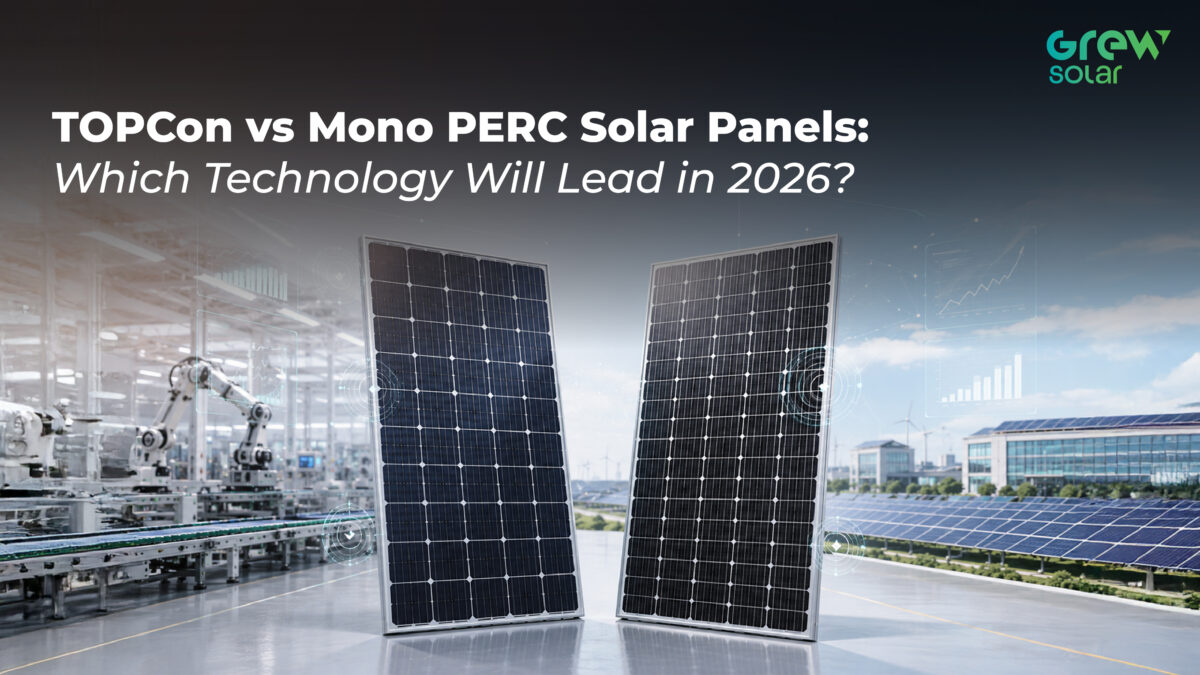
According to the Fraunhofer ISE Photovoltaics Report 2025, TOPCon technology accounted for approximately 65% of global silicon solar cell production in 2024, up from roughly 20% in 2022. Over the same period, PERC’s share fell from 80% to under 25%. That isn’t a gradual shift. It’s a technology transition already well underway and the reasons behind it have direct implications for anyone making procurement decisions in 2026.

What Makes These Technologies Different

Both Mono PERC and TOPCon are built on monocrystalline silicon, so the fundamental starting point is the same. The difference is in how each handles the physics of energy conversion.

Mono PERC adds a passivation layer to the rear of the cell, reducing electron recombination and improving light absorption. It was a meaningful efficiency leap over earlier polycrystalline technology, and it remains a reliable, well-understood option.

TOPCon goes further. It deposits an ultra-thin tunnel oxide layer and a doped polysilicon film on the cell’s rear surface, reducing recombination losses more aggressively and improving open-circuit voltage. Also, TOPCon uses N-type silicon rather than P-type which means it has no sensitivity to Light-Induced Degradation (LID) or Light and Elevated Temperature Induced Degradation (LeTID), both of which affect PERC panels to varying degrees.

The result is a technology that starts higher on efficiency and holds that efficiency longer over time.

What the Performance Data Shows

Efficiency and degradation are the two figures that determine long-term project economics and on both, the gap between TOPCon and Mono PERC is measurable.

Mono PERC modules currently operate at 20.5-22% efficiency. TOPCon modules reach 22-23.5% in mass production formats. For large-scale commercial and industrial projects, even that 1-2% difference matters because fewer modules per project means lower balance-of-system costs, reduced land use, and simpler installation logistics.

On degradation, manufacturer warranties place Mono PERC at 0.55% annual degradation and TOPCon at 0.40%. The gap looks small in year one. Over 25 years, it represents a meaningful difference in total energy output and therefore in return on investment.

TOPCon also handles heat better than Mono PERC. For commercial solar installation Gujarat projects where panels operate under sustained high temperatures for much of the year, that performance difference shows up in actual annual yield, not just datasheet specifications.

Upfront Cost vs. Lifetime Value

TOPCon modules currently carry a 5-15% price premium over Mono PERC. That premium is real though it has been narrowing steadily as TOPCon manufacturing scale increases and production processes mature.

The relevant question isn’t whether TOPCon costs more upfront. It’s whether the cost per unit of energy generated over the project’s lifetime justifies the investment. For utility-scale and large industrial projects where a module’s 25-year yield is the core financial variable, the answer is increasingly yes.

For businesses evaluating industrial solar solutions Gujarat and similarly scaled deployments, procurement decisions made on upfront module cost alone without accounting for degradation trajectory and lifetime yield tend to look worse as the asset ages. For cost-sensitive residential installations where upfront budget is the primary constraint, Mono PERC still holds a practical case.

What Investment Patterns Are Saying

Market transitions are often announced before they’ve happened. In this case, manufacturing investment confirms what procurement trends suggest.

Across India, solar panel manufacturers in India have been redirecting capital expenditure toward TOPCon production lines rather than expanding PERC capacity. This reflects where order books and technology roadmaps are pointing, and where buyer specifications for new utility-scale and industrial projects are landing.

GREW Solar, a solar company in Gujarat headquartered in Ahmedabad and backed by the Chiripal Group, is among the manufacturers that have built their strategy around N-type TOPCon technology. Its facility in Dudu, Rajasthan, manufactures N-type bifacial TOPCon modules at 6.5 GW of capacity, expanding to 11.0 GW with solar PV cell manufacturing in Narmadapuram, Madhya Pradesh providing upstream integration. That commitment reflects a manufacturing view of where the market is heading, one supported by the global production data.

Does Mono PERC Still Have a Future?

Mono PERC still has a defensible position in residential rooftop projects where upfront cost is the dominant consideration, in weight-constrained installations, and in repowering of existing PERC-based systems. The technology is mature, the supply chain is established, and for standard applications it continues to perform reliably.


But the trajectory is clear. For new utility-scale procurement, for industrial projects where long-term yield drives ROI, and for any application where sustained output over 25 years is the primary measure of value, TOPCon is increasingly the specification of choice, not the premium alternative.


The debate between the two technologies has largely been settled by the market. The more useful question in 2026 is which manufacturer’s TOPCon modules are built with the process control and supply chain integration to deliver on what the technology is actually capable of consistently, across a full project lifetime.

Categories
Grew Solar Industrial Solar Solutions Rajasthan Solar Solar Company Solar Energy Company Solar Panel Manufacturer

How India is Reducing Dependence on Chinese Solar Imports

For years, the conversation around India’s solar industry has been built on Chinese imports. That picture has started to shift, and the numbers behind the shift are worth looking at closely.

Between March 2021 and August 2025, India’s solar module manufacturing capacity scaled twelvefold, from 8.2 GW to 100 GW, according to a CEEW analysis published in November 2025. Over the same broad period, the value of India’s solar module imports fell from $4,353 million in FY2024 to $2,151 million in FY2025.

That’s a real shift, not a policy talking point. 

The Gap That Remains

Module manufacturing capacity isn’t the same as cell manufacturing capacity. The difference between the two is where India’s import picture gets more complicated.

As of October 2025, ALMM List-I enlisted module manufacturing capacity stood at 119.8 GW, per CEEW. Domestic cell manufacturing capacity, however, falls well short of what that module capacity actually requires. CEEW’s analysis puts the shortfall at 59.66 GW. That means nearly half of India’s enlisted module manufacturing capacity currently depends on cells sourced from outside the country to keep running. Closing that gap will require roughly $4.18 billion (₹35,500 crore) in new cell manufacturing investment, by CEEW’s estimate.

This is the part of the story that headline capacity figures tend to skip over. India has built an enormous amount of module assembly capability. It has not yet built the cell manufacturing base to fully supply it. Until that changes, a meaningful share of what goes into an “Indian-made” module still starts as an imported cell.

The Policy Fix Already in Motion

The government’s response to this gap is direct, and it’s arriving on a fixed timeline.

From June 1, 2026, the Ministry of New and Renewable Energy’s ALMM List-II comes into effect. It requires all ALMM List-I module manufacturers to source their cells exclusively from approved domestic suppliers, rather than importing them. Manufacturers who don’t comply risk being delisted from List-I altogether, per official MNRE communication reported by PV Tech.

This sits alongside trade measures already in place. Basic customs duties on solar cells and modules have been imposed since April 2022, increasing the landed cost of imported equipment. In September 2025, India’s Ministry of Commerce and Industry issued a final ruling recommending anti-dumping duties of 23 to 30 percent on solar cells and modules originating from China, depending on the manufacturer. The duties are set to remain in place for three years.

Taken together, these measures are designed to make domestic cell manufacturing the default.

Why This Will Keep Moving Upstream

Closing the cell gap will just shift it one layer further up the supply chain.

The same domestic sourcing logic the government is applying to cells is already scheduled to extend to wafers and ingots. ALMM List-III, introduced for solar ingots and wafers, comes into effect from June 1, 2028. Bids submitted under competitive bidding routes after that date will need to use ALMM List-III compliant wafers, with grandfathering provisions in place for projects already underway.

India’s larger manufacturers have read this trajectory clearly and are moving accordingly. Reliance, Adani, Tata Power, Waaree, Avaada, ReNew, and GREW Solar are among the companies that have begun backward integration into the upstream solar value chain. Tata Power Renewable Energy, for instance, has committed ₹6,500 crore toward developing 10 GW of ingot-wafer manufacturing capacity across two phases.

The pattern is consistent. Every time India closes a gap at one stage of the supply chain, the next stage upstream becomes the new constraint. That isn’t a flaw in the approach. Building a fully integrated manufacturing base happens in stages, not all at once, and this is what that process actually looks like.

Where This Leaves India

The honest assessment sits somewhere between the two extremes. India hasn’t yet achieved full independence from Chinese solar imports as the cell-level dependency gap will take several years of sustained investment to close, with wafers and polysilicon still further out on the horizon.

But the direction of movement is unmistakable. Module manufacturing capacity has scaled dramatically. Policy mechanisms to close the cell gap have firm enforcement dates and the manufacturers driving India’s solar industry forward are investing in upstream capability.

That shift is visible across the country’s manufacturing base, including in states like Gujarat, which has become one of India’s most active hubs for solar manufacturing investment. Companies positioning themselves as a serious solar panel manufacturer in Gujarat are increasingly building toward this same backward-integrated model, recognising that long-term competitiveness depends on owning more of the value chain, not less.

For businesses and developers evaluating what industrial solar solutions Gujarat based manufacturers can offer, that distinction is becoming a meaningful one. The companies investing in cell and upstream capacity today are the ones positioned to be less exposed to import dependency as ALMM requirements tighten further over the next several years.

India’s solar import story is no longer just a story about cheaper Chinese modules. It’s a story about how much of the supply chain India is prepared to build for itself, one stage at a time.

Categories
Grew Solar Industrial Solar Solutions Rajasthan Solar Solar Company Solar Energy Company Solar Panel Manufacturer

Adani vs Tata Solar Panels 2026: Detailed Comparison

Search for solar panels in India today, and two names dominate the results almost immediately i.e., Adani Solar and Tata Power Solar. Both carry significant market presence, and both are counted among the leading solar panel manufacturers in India.

But scale alone doesn’t answer the question that actually matters: which one fits what you’re building?

A residential rooftop system, a commercial facility in Gujarat’s industrial belt, and a utility-scale solar park have very different requirements. The right manufacturer for one isn’t necessarily the right manufacturer for another and in 2026, that distinction is sharper than it used to be.

Tata Power Solar: Legacy Built on Two Decades of Manufacturing

Tata Power Solar’s Bengaluru facility has been operational since 1992, it’s manufacturing history that predates most of India’s current solar industry. That facility produces 682 MW of modules and 530 MW of cells annually.

The bigger story is more recent. In 2025, Tata Power commissioned a 4.3 GW solar cell and module manufacturing plant in Tirunelveli, Tamil Nadu which is India’s largest single-location facility of its kind, built on a ₹4,300 crore investment. The plant runs on TOPCon and Mono PERC technology, and is notable for an 80% women workforce, a detail Tata Power has actively highlighted as part of its operational identity.

Combined, the two facilities give Tata Power Solar 4.9 GW of manufacturing capacity. In the first nine months of FY26 alone, the company produced 2.9 GW of modules and 2.8 GW of cells.

For buyers prioritising brand history and rooftop solar experience, particularly residential and smaller commercial installations, Tata’s manufacturing pedigree carries real weight.

Adani Solar: Scale Through Integration

Adani Solar has taken a different route to the same conversation building scale through vertical integration rather than legacy alone.

Operating out of the Mundra Special Economic Zone in Gujarat, Adani Solar currently runs 4 GW of integrated cell and module capacity, alongside 2 GW of ingot-wafer capacity. That capacity is expanding fast: the company has accelerated its timeline to reach 10 GW of integrated cell and module manufacturing by mid-2026, ahead of its original 2027 target.

What sets Adani Solar apart is the depth of that integration, with its polysilicon through to the finished module, under one roof. It’s a model few Indian manufacturers have replicated at this scale, and it’s part of why Adani Solar ranks 6th globally on Wood Mackenzie’s 2026 list of module manufacturers, the only non-Chinese company in the top six.

For businesses researching commercial solar installation Gujarat options, or evaluating large industrial projects elsewhere, that integration matters. It typically translates into tighter supply chain control and more consistent component quality,  factors that become more visible the larger the project gets.

Why Manufacturing Depth Matters More in 2026

A few years ago, most buyers compared solar panels on price, wattage, and warranty length. That comparison has gotten more sophisticated.

For buyers exploring industrial solar solutions Gujarat and other large-scale deployments, the questions buyers are asking now go deeper: 

  • How consistent is module performance across a production batch? 
  • What does the degradation curve actually look like after year eight or ten? 
  • Is the manufacturer sourcing cells from a third party, or producing them in-house under controlled conditions?

These questions matter because two modules with near-identical datasheet specifications can perform very differently a decade into their operational life. That difference is usually traceable back to the manufacturing process itself.

Both Adani Solar and Tata Power Solar have moved decisively toward TOPCon technology, which offers better low-light performance and lower degradation rates than older Mono PERC modules. For commercial and industrial buyers, higher module efficiency also means fewer modules per project which reduces land use, balance-of-system costs, and installation complexity.

Which One Should You Choose?

There’s no universal answer, it depends on what you’re building.

  • Tata Power Solar tends to be the stronger fit for residential rooftops and smaller commercial projects, where brand familiarity, service reliability, and Tata’s long operating history carry weight with buyers.
  • Adani Solar tends to be the stronger fit for utility-scale deployment and large industrial projects, where integrated supply chain control and high-volume procurement capacity matter more than legacy alone.

Price is part of the equation, but it shouldn’t be the deciding factor. A lower upfront module cost means little if faster degradation or inconsistent quality erodes 25-year generation output. For large-scale projects, the more relevant calculation is lifecycle generation and operational stability, not just the price on day one.

A Market That’s Bigger Than Two Names

What’s worth noting is that India’s solar manufacturing landscape is no longer a two-player conversation. The market is shifting toward manufacturers who combine integrated production, rigorous quality testing, and long-term scalability and that shift is creating room for newer players to compete seriously.

GREW Solar, a solar company in Gujarat headquartered in Ahmedabad and backed by the Chiripal Group, is one example. The company operates a 6.5 GW solar PV module manufacturing facility in Dudu, Rajasthan which is expanding to 11 GW alongside a 3.5 GW solar PV cell manufacturing facility in Narmadapuram, Madhya Pradesh, set to expand to 8.0 GW in 2026. GREW Solar is one of only 11 companies in India to receive a PLI allocation for fully integrated solar manufacturing, and its modules are ALMM certified.

It’s a reminder that India’s manufacturing base is broadening, and that the comparison worth having in 2026 does not stay limited to two names for long.

The Real Decision Factor

Adani Solar and Tata Power Solar represent two different paths to scale in India’s solar manufacturing industry. Tata brings legacy, service reliability, and a strong rooftop track record. Adani brings integrated manufacturing depth and utility-scale capacity, expanding faster than almost any other Indian manufacturer right now.

The right choice depends on your project’s scale, its timeline, and how much weight you place on manufacturing integration versus brand familiarity. 

Either way, the decision is no longer just about price. It’s about which manufacturer’s capabilities actually match what you’re building.

Categories
Industrial Solar Solutions Rajasthan Solar Solar Company Solar Energy Company Solar Panel Manufacturer

Why Industrial Manufacturers in India Are Switching to Solar in 2026

For most of the last decade, the conversation around solar adoption in the Indian industry centred on cost. Modules got cheaper, tariffs fell, and the financial case became harder to argue against. That argument is largely settled now.

What’s driving the current wave of solar adoption among industrial manufacturers is different and more urgent. It’s about risk.

Energy Is No Longer Just an Overhead

India’s power demand is growing faster than the grid can comfortably handle. Peak demand hit 270 GW in summer 2025, up from 250 GW the year before, per the NLDC report with baseload capacity failing to keep pace. 

For industrial manufacturers, that gap doesn’t show up as an abstract policy problem. It shows up as production downtime.

Research published by CEPR on electricity shortages and Indian manufacturing puts it plainly: for plants without backup generation, a grid outage functions like an infinite input tax on electricity production stops entirely. For plants that do have generators, every hour of outage becomes a cost premium on power consumption. Neither outcome is acceptable for manufacturers running tight margins and tighter delivery timelines.

The energy cost structure has also shifted. The Time of Day tariff has been made compulsory for all C&I consumers in India with demand above 10kW from April 2024 onwards, as per the amendments made by the Ministry of Power to the Electricity (Rights of Consumers) Rules. 

The mandated delta between peak and off-peak rates is a minimum of 40%. For energy-intensive manufacturing operations that run through peak hours which most do, this has introduced a new layer of cost volatility that grid dependency alone cannot solve.

Energy shortages and supply unreliability already cost India an estimated 1.9% of GDP annually in lost industrial output and diesel backup costs, per Energy Tracker Asia. Solar, particularly through open access procurement, directly addresses the exposure. It substitutes a variable, grid-dependent cost with a predictable, largely fixed one and for high-load operations like steel, cement, and large-scale manufacturing running at 80% or more plant load factor, open access solar delivers payback periods in the range of 3 to 5 years.

India’s C&I sector has recognised this. Cumulative open access solar capacity reached 27.9 GW by September 2025, after adding 6.1 GW in the first nine months of the year alone, a 13% year-on-year increase, per PV Magazine citing industry estimates. Demand for renewable energy from C&I consumers outstripped supply by approximately 10 GW in 2024. The shift is no longer early-stage.

The Compliance Pressure

Alongside the operational case, a second driver has hardened considerably and it’s one that manufacturers exporting to global markets can no longer treat as optional.

C&I consumers account for nearly half of India’s total electricity demand and 18% of its CO2 emissions as of 2022-23. In 2024, over 200 Indian companies were part of the global Science Based Targets initiative, committing to verified emissions reduction pathways. India was the second largest market globally for renewable energy procurement contracts in 2022. The direction of corporate intent has been clear for some time.

What’s changed is the regulatory pressure reinforcing that intent. The EU’s Carbon Border Adjustment Mechanism entered its definitive phase in January 2026, covering carbon-intensive sectors including steel, aluminium, cement, fertilisers, and hydrogen. Scope 2 emissions, those from purchased electricity are directly counted under CBAM. For Indian manufacturers exporting to Europe, the carbon intensity of their grid power is no longer an internal metric. It’s a cost that shows up at the border.

India’s own Carbon Credit Trading Scheme is expected to be implemented in 2026, adding domestic regulatory pressure alongside the international. The top 250 listed companies by market capitalization in India are now required to disclose Scope 3 GHG emissions from FY2024-25 under the BRSR Core Circular, with further expansion of value chain ESG reporting from FY2025-26.

Open access solar procurement directly reduces Scope 2 emissions. For manufacturers whose export competitiveness, institutional financing access, and supply chain relationships increasingly depend on demonstrable ESG performance, switching to solar is no longer a sustainability initiative. It’s a commercial necessity.

Choosing the Right Manufacturing Partner

The operational and compliance case for solar is established. What follows is an execution question and it starts with module selection.

For industrial-scale installations, the math is straightforward: higher efficiency per module reduces land use and installation complexity, longer warranties reduce lifecycle risk, and manufacturer credibility determines whether the system performs as modelled over a 25-year asset life. 

This is where working with a solar panel company that has a fully integrated manufacturing capability matters. Modules produced through integrated supply chains where cells, not just assembly, are manufactured domestically offer greater consistency, traceability, and quality control than those assembled from imported components. For C&I buyers making a procurement decision that will sit on their balance sheet for two decades, that distinction is not academic.

GREW Solar’s 6.5 GW module manufacturing facility in Dudu, Rajasthan, and 3.5 GW solar PV cell manufacturing facility in Narmadapuram, Madhya Pradesh, both part of a deliberate backward integration strategy are built around exactly this kind of supply chain depth. 

ALMM certified, PLI allocated, and backed by in-house testing infrastructure, the company’s manufacturing model is designed to support the reliability requirements that industrial procurement demands. 

Where the Industry Is Headed

India’s industrial manufacturers aren’t waiting for the grid to catch up or for compliance deadlines to arrive. The open access solar market, the volume of corporate RE procurement commitments, and the pace of C&I capacity additions all point in the same direction.

The question for most industrial manufacturers in 2026 is no longer whether to switch, it’s how quickly, and with whom.

Categories
Uncategorized

GREW Solar at Intersolar Europe 2026: Engaging with Europe’s Solar Transition

Germany has built more solar capacity than any other country in Europe. By the end of 2025, total installed solar PV capacity stood at 117 GW and the country still has significant ground to cover. To reach its 2030 target of 215 GW, Germany needs to add an average of nearly 20 GW every year from now until the decade ends, per the Bundesnetzagentur. That pace has to accelerate, not maintain.


Europe’s largest solar market is, in other words, still very much in build mode.


A Supply Chain Question Europe Is Asking


The volume targets are clear. The supply chain behind them is less settled.


In 2024, China accounted for 98% of all solar panel imports into Europe, per Eurostat. That level of concentration has become a strategic concern both for energy security and for supply chain resilience. European policy is responding: the EU’s planned restrictions on products linked to forced labour in their supply chains are expected to shift sourcing patterns, with India among the markets positioned to benefit.


The opportunity for Indian manufacturers is real but it isn’t automatic. European buyers particularly for utility-scale projects evaluate suppliers on bankability, long-term reliability, and after-sales support. Module procurement at that scale is effectively a 25-year relationship. Price matters, but it isn’t the only thing that matters.


For Indian manufacturers looking to build credibility in Europe, presence at platforms like Intersolar is where those conversations begin.


GREW Solar at Intersolar Europe 2026


GREW Solar will be participating in Intersolar Europe 2026 as part of its engagement with the European solar market. The event brings together manufacturers, developers, EPC companies, distributors, and installers from across a cross-section of the people who are directly shaping where Europe’s solar capacity comes from and how it gets built.


For a manufacturer at GREW Solar’s scale, with 6.5 GW of solar PV module manufacturing in Dudu, Rajasthan, expanding to 11.0 GW, and 3.5 GW of solar PV cell manufacturing in Narmadapuram, Madhya Pradesh, expanding to 8.0 GW in 2026, Intersolar is an opportunity to engage with how European project requirements are evolving and what it means for manufacturing priorities going forward.


The company’s PLI allocation for fully integrated solar manufacturing, combined with its in-house testing infrastructure and process control systems, positions it to speak to the reliability and consistency concerns that European buyers raise most often.


What We’re Showcasing


At Intersolar Europe 2026, GREW Solar will be showcasing two products designed for different segments of the European market.


The G12R Module is built for utility-scale and large commercial applications, where optimising system efficiency and reducing balance of system costs are central considerations. Higher power output per module reduces installation complexity and land use at scale, both relevant factors for the ground-mounted segment, which accounted for 8.0 GW of Germany’s new capacity in 2025 alone, per BSW-Solar.


The All Black Module, a Bifacial N-Type TOPCon module with a black patterned backsheet and black anodised aluminium frame is designed specifically for the residential rooftop market. Germany added 5.2 GW of residential rooftop solar in 2025, per BSW-Solar, and European homeowners are increasingly choosing modules that integrate with roof aesthetics rather than contrast against them.


The All Black delivers 22.80% module conversion efficiency, with performance that holds up in low-light conditions at dawn, dusk, and through Germany’s characteristically overcast winters. Its temperature coefficient of -0.18%/°C is engineered for climates where irradiation levels vary significantly across seasons. A 25-year linear performance warranty backs it, with guaranteed power output of 89.40% at year 25, which is above industry standard.


Both modules carry IEC and CE certifications and are manufactured in an ISO 9001:2015, ISO 14001:2015, and ISO 45001:2018 certified facility.


What Intersolar 2026 Will Be Talking About


The conversations at Intersolar this year are expected to reflect where the European solar market is in its transition.


Energy storage and grid integration will be central themes as solar’s share of Germany’s electricity generation grows, the question of how variable generation integrates with the grid becomes more pressing. Supply chain resilience and domestic manufacturing capability are also firmly on the agenda, as Europe works through what reducing dependency on a single import source actually requires in practice.


Technology continues to move forward. The shift toward N-type TOPCon and higher efficiency formats is well underway, and discussions around performance under real-world conditions rather than standard test conditions are becoming more prominent as buyers focus on long-term yield rather than headline wattage.


These are discussions GREW Solar is prepared to be part of.


Event Details


Intersolar Europe 2026 June 23–25, 2026 Hall A1 | Booth A1.620 Messe München Exhibition Center, Munich, Germany


We welcome meetings with developers, distributors, EPC companies, and project teams interested in understanding how GREW Solar’s manufacturing capabilities and product range can support European solar projects.


Book an appointment: info@thegrewsolar.com

Categories
Grew Solar Rajasthan Solar

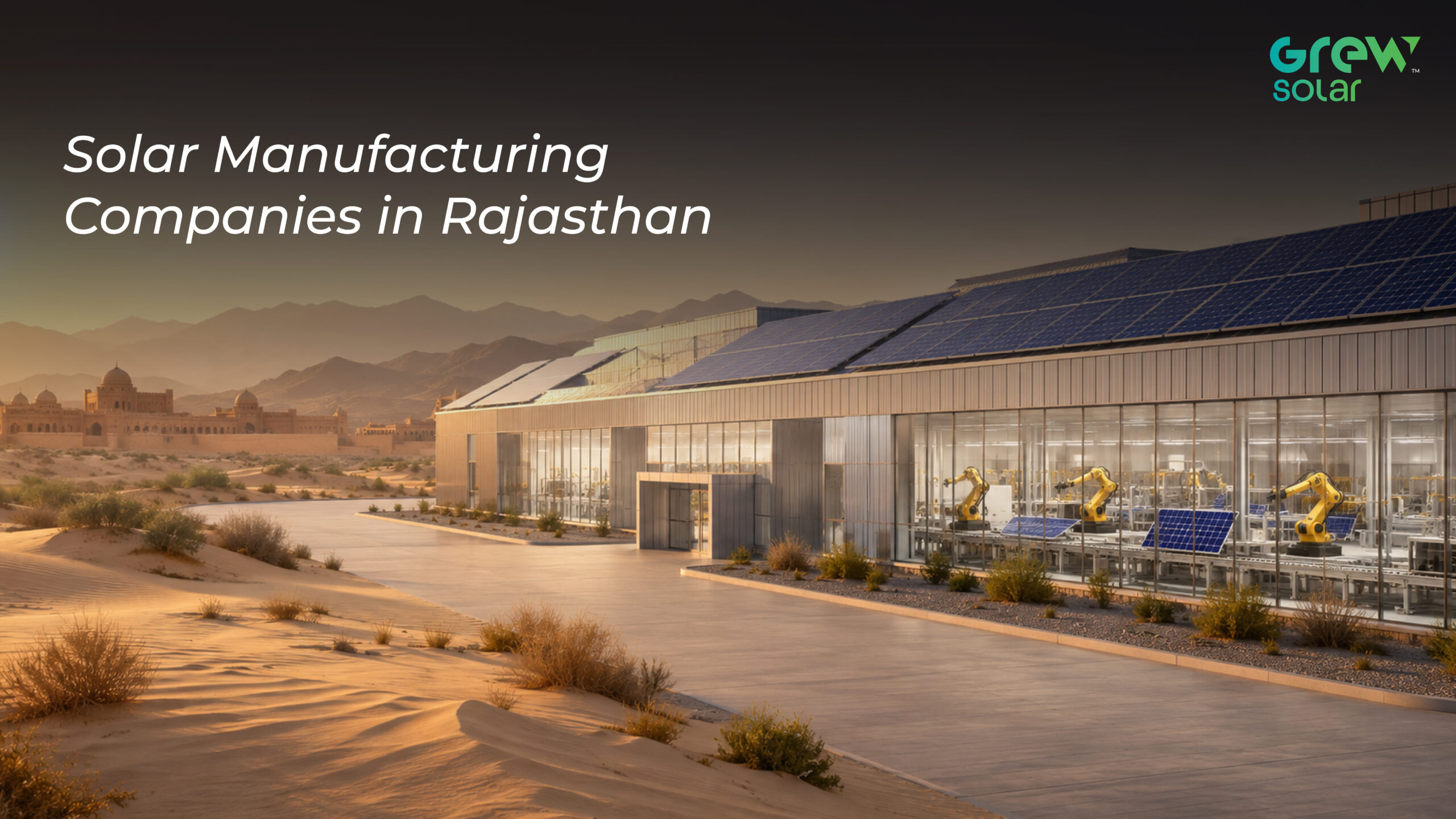
Solar Manufacturing Companies in Rajasthan

Everyone knows Rajasthan for its solar parks, Bhadla, the Thar Desert, and 325-plus sunny days a year. What gets less attention is what’s been building alongside all of that, a manufacturing base that didn’t really exist five years ago.

Rajasthan now holds around 10% of India’s total solar module manufacturing capacity, per Mercom India. Third nationally, behind Gujarat and Tamil Nadu. The companies responsible for that share aren’t fringe players, many are among the most seriously capitalised manufacturers in the country. Here are five with confirmed, operational facilities in the state.

1. GREW Solar

Location: Dudu, Jaipur District Module Manufacturing Capacity: 6.5 GW (expanding to 11 GW in 2026)

The 6.5 GW facility is expanding to 11.0 GW in 2026, and its modules are ALMM certified, a requirement for supplying government-backed solar projects in India. But capacity numbers alone don’t tell the full story. GREW Solar is one of only 11 companies in India to have received a PLI allocation for fully integrated solar manufacturing, not just modules, but the supply chain behind them.

That supply chain ambition is already taking shape. The 3.5 GW solar PV cell manufacturing facility in Narmadapuram, Madhya Pradesh is set to expand to 8.0 GW in 2026. It is the first step in a deliberate long-term backward integration strategy. Cells today, with further upstream integration to follow.

The company was named Solar Energy Manufacturer of the Year in 2025. Three years old, and already setting the pace.

2. INA Solar (Insolation Energy)

Location: Three facilities across Jaipur (including Sawarda, Delhi-Ajmer Expressway) Module Manufacturing Capacity: 5.5 GW combined

INA Solar started in 2015 with 80 MW of capacity. Today it runs three facilities in Jaipur with a combined 5.5 GW and plans on the table to reach 7.0 GW of modules and 4.5 GW of solar cells across Rajasthan and Madhya Pradesh.

The newest facility, at Sawarda on the Delhi-Ajmer Expressway, is worth singling out. 600,000 sq ft, AI and robotics-driven production lines, manufacturing M10R TOPCon modules with minimal manual intervention. It’s a different kind of facility to what India’s solar manufacturing sector looked like even three years ago.

INA Solar is BSE SME listed, ALMM listed, and its panels supply government programmes including PM-Kusum and PM Surya Ghar. One of Rajasthan’s most established manufacturing names.

3. ReNew Photovoltaics

Location: Mahindra World City, Jaipur Module Manufacturing Capacity: 3.55 GW

ReNew Photovoltaics is the manufacturing arm of ReNew Power, one of India’s largest renewable energy companies. Its Jaipur plant sits on 22 acres at Mahindra World City, producing around 15,000 modules a day. The March 2026 ALMM List-I update confirms 3.55 GW of enlisted capacity.

The reason for being in Rajasthan isn’t complicated. ReNew Power has a large project pipeline here. Manufacturing locally cuts procurement risk and logistics costs, and keeps the company competitive for government tenders that require ALMM-listed domestic supply.

It’s a model more developers are moving toward, own your generation, own part of your supply chain. For any solar panel company thinking about vertical integration, ReNew’s approach in Rajasthan is worth watching.

4. SAEL Industries

Location: Rajasthan Module Manufacturing Capacity: 3.2 GW TOPCon module assembly

SAEL is best known as a solar IPP with over 6.7 GW of solar assets across India, operational and under construction. Manufacturing came later, as a backward integration play. Rather than sourcing modules from the open market, the company built the capacity to supply its own projects.

The Rajasthan facility runs 3.2 GW of bifacial N-type TOPCon module assembly, with a 300 MW unit in Punjab alongside it. The technology choice reflects where utility-scale solar is heading, i.e., towards higher efficiency, better low-light performance, longer useful life.

SAEL has announced a larger integrated plant in Greater Noida, suggesting the Rajasthan operation is a step in a longer manufacturing build-out rather than a standalone move.

5. Acme Group (Acme Renewable Equipment Manufacturing)

Location: Jaipur Module Manufacturing Capacity: 1.2 GW

Acme Group invested roughly ₹230 crore to commission a 1.2 GW module manufacturing plant in Jaipur. It’s operational, ALMM listed, and employs over 700 people. The manufacturing entity, Acme Renewable Equipment Manufacturing, is a dedicated vertical within the group, not a side project.

The numbers Acme is targeting give a sense of intent. ₹10,000 crore in revenue from the manufacturing business by 2030. The Jaipur plant is the starting point for that ambition, with cell manufacturing capacity in the pipeline as the company moves toward backward integration.

At 1.2 GW, it’s the smallest facility on this list but Acme isn’t a small company and the trajectory here points firmly upwards.

The Bigger Picture

Gujarat still dominates around 45% of India’s module manufacturing capacity as of December 2025, per Mercom India. Rajasthan is not catching up to that overnight.

But the five companies here have a combined module capacity exceeding 17.5 GW, and most of them are actively expanding. More importantly, they chose Rajasthan for reasons that haven’t changed: land, sunlight, proximity to the country’s most active solar project market, and a state government that has made investment incentives a consistent part of its pitch.

The manufacturing story here is younger than the generation story. It’s also moving faster than most people realise.

Categories
Grew Solar Rajasthan Solar

India’s Growing Role in Global Solar Manufacturing

The global solar industry has a concentration problem. As of 2024, China accounted for more than 80% of global polysilicon, wafer, cell, and module manufacturing capacity, according to BloombergNEF’s Energy Transition Supply Chains 2025 report. One country, one supply chain and the rest of the world has spent the last several years trying to work out what to do about it.


India’s answer has been to build.

Where India Stands in the Global Picture

The scale of China’s manufacturing lead puts India’s position in context. Global PV module production reached 726 GW in 2024, with total manufacturing capacity at 1,405 GW per year, 83% of it located in China, per the IEA PVPS Trends in Photovoltaic Applications 2025 report. India, by comparison, held approximately 3% of global module production capacity as recently as 2023.

What matters, though, is the trajectory. India overtook Japan in 2024 to rank fourth globally in cumulative installed solar capacity at 124.6 GW, per IEA PVPS data. Its domestic manufacturing base is expanding at a pace that few anticipated even three years ago. 

The country is not yet a dominant force in global solar manufacturing but the direction of travel is clear, and the policy machinery driving it is substantial.

The Policy Framework Behind the Growth

India’s manufacturing push is not market-driven in isolation. It is the result of deliberate, layered policy designed to reduce import dependency and build domestic industrial capacity.

The centrepiece is the Production Linked Incentive (PLI) scheme for high-efficiency solar PV modules, administered by the Ministry of New and Renewable Energy with an outlay of ₹24,000 crore. The scheme targets GW-scale domestic manufacturing and is designed specifically for manufacturers willing to commit to fully integrated production.

Running alongside it is the Approved List of Models and Manufacturers (ALMM) mandate, reimposed in April 2024, which limits government-backed solar projects to domestically listed modules and manufacturers. The effect is a protected, captive demand base for Indian producers that directly incentivises capacity expansion.

The results are visible. India added 25.3 GW of solar modules and 11.6 GW of solar cell manufacturing capacity in 2024 alone, per Mercom India’s State of Solar PV Manufacturing in India 2025 report. In the first half of 2025, a further 42.2 GW of module capacity and 7.5 GW of cell capacity were added. MNRE data showed India’s total solar module manufacturing capacity was 74 GW and cell capacity stood at 25 GW as of March 2025.

These are not incremental gains. They represent a structural shift in India’s manufacturing footprint.

The Export Opportunity and Its Limits

India’s growing manufacturing base has opened an export lane that did not meaningfully exist five years ago.

PV module exports grew from $83 million in FY2021-22 to $1.97 billion in FY2023-24, per statements made by India’s Minister of State for New and Renewable Energy to parliament, as reported by PV Magazine. In Q2 2025, India exported solar cells and modules worth $549 million which is a 105.1% quarter-on-quarter increase with the United States accounting for 96.2% of total export volume, per Mercom India.

The US opportunity is largely a consequence of trade policy. High tariffs on solar imports from Vietnam, Cambodia, China and other Southeast Asian suppliers are prompting American developers to look for alternatives. India has picked up some of the slack, with its share of US solar module imports rising to 9% in 2023 from 2.2% in 2021.

However, over-reliance on a single export market, particularly one that may introduce new trade barriers, is a vulnerability that Indian manufacturers will need to manage carefully.

The more fundamental challenge remains upstream. India currently has no commercial production of silicon ingots or wafers, with China accounting for 97% of both globally, per ORF America. Without closing this gap, Indian module manufacturers remain dependent on Chinese components which is a structural dependency that limits the depth of India’s role in the global supply chain.

The Companies Building India’s Manufacturing Future

India’s manufacturing expansion is being led by a growing cohort of domestic producers. IBEF says that Waaree Energies, Adani Solar and Vikram Solar exported more than 50% of their annual production in FY2024, whereas companies like Grew Energy, ReNew Power and Saatvik Energy are expanding their global presence.

One of the manufacturers shaping India’s solar future is GREW Solar. Backed by the Chiripal Group’s 52-year manufacturing legacy, it stands out for the scale and integration of its operations. 

Established in 2022, the company operates a solar PV module manufacturing facility in Dudu, Rajasthan, with 6.5 GW of installed capacity and an ongoing expansion to 11.0 GW in 2026. Complementing this is a 3.5 GW solar PV cell manufacturing facility in Narmadapuram, Madhya Pradesh, set to expand to 8 GW in 2026, a footprint that reflects a deliberate move toward deeper supply chain integration rather than module assembly alone.

GREW Solar is one of only 11 companies in India to receive a PLI allocation for fully integrated solar manufacturing, a distinction that reflects both the ambition and the credibility of its industrial model.

For any solar panel company operating at this level of integration, India’s policy environment, growing domestic demand, and expanding export footprint represent a significant long-term opportunity. The upstream gaps are real, and the global competitive landscape is unforgiving. But the foundation being built in manufacturing capacity, policy support, and industrial expertise positions India as a serious and growing participant in the global solar supply chain.

The distance between “growing role” and “global force” will be determined by how consistently that foundation is built upon.

Categories
solar home Grew Solar

Why Rajasthan is India’s Solar Energy Hub

India has committed to reaching 500 GW of non-fossil fuel capacity by 2030, one of the most ambitious clean energy targets in the world. Achieving it will need ground level execution besides policy initiatives. It demands the right geography, the right scale, and consistent execution. On all three counts, one state stands apart more than any other, i.e., Rajasthan.

The Geography Makes the Case

Solar energy is, at its core, a geography-driven industry. Rajasthan’s natural conditions are perfect for it.

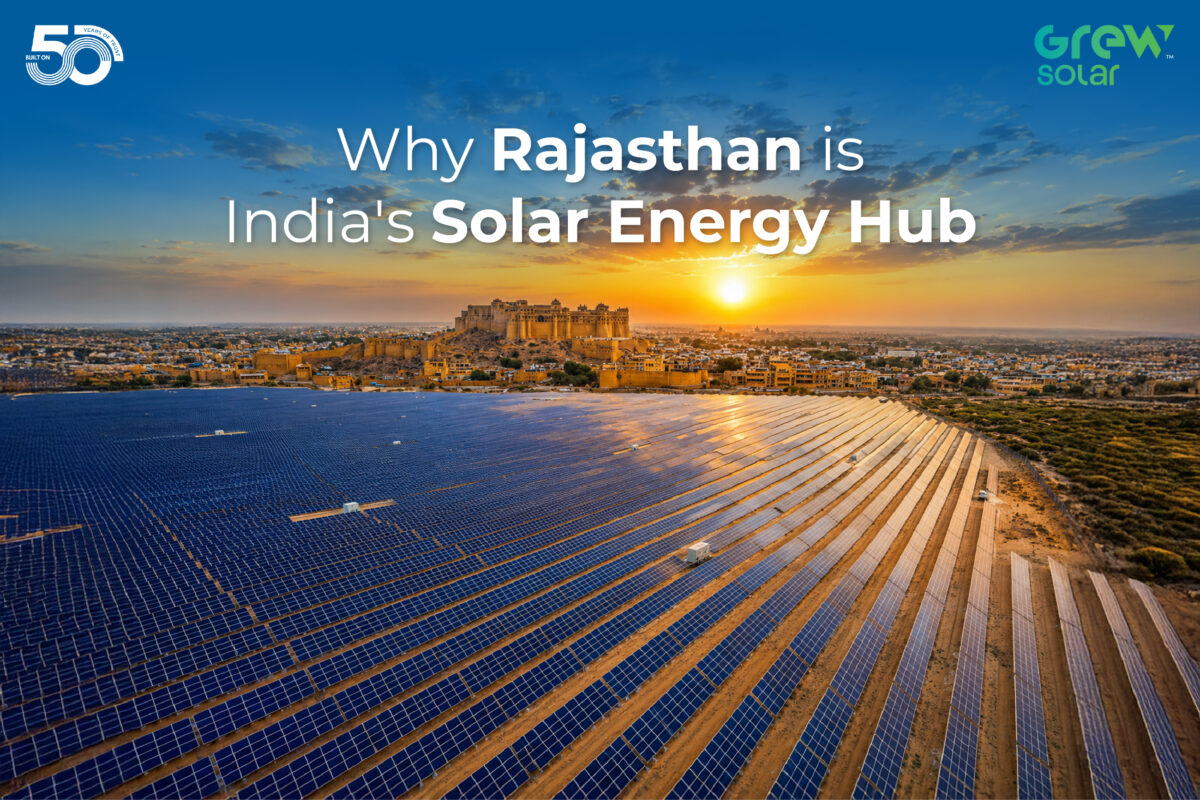
The state receives 6 to 7 kWh of solar radiation per square metre each day, with over 325 sunny days annually. In the western areas of the Thar Desert, rainfall occurs on as few as 10 to 20 days per year. Rajasthan has the highest total solar generation potential among all Indian states, assessed at 142 GW by the Ministry of New and Renewable Energy (MNRE).

Other than the sunlight factor, the state also has a significant land advantage. The Thar Desert covers nearly two-thirds of Rajasthan, offering vast stretches of flat, largely uninhabited terrain with barely any agricultural or urban use. For utility-scale solar infrastructure, this means fewer land conflicts, lower acquisition costs, and faster project clearances; most Indian states cannot match these conditions.

Together, these two factors, i.e., high solar irradiation and abundant usable land form the foundation on which everything else in Rajasthan’s solar story is built.

The Scale of What’s Already in Place

Rajasthan’s solar credentials are already well-established.

The state is home to the Bhadla Solar Park in Jodhpur which spans over 14,000 acres and has 2,245 MW of installed capacity. It is the world’s largest fully operational solar park. Bhadla is an example of how seriously Rajasthan has translated their solar potential into reality.

There are other numbers that reinforce this. According to data from the Global Energy Monitor, Rajasthan accounted for around 31% of India’s non-hydro renewable energy installations between 2020 and March 2024. In Q1 2025, Rajasthan generated 13.1 billion units of solar power, outpacing all other states and registering an 11.1% growth over the last quarter, as per Mercom India’s analysis of data from the Central Electricity Authority (CEA) and Ministry of New and Renewable Energy (MNRE).

Rajasthan has also crossed a milestone that no other Indian state has reached, i.e., more than 50% of its total installed power capacity is solar. This reflects where the state stands today.

A Policy Environment Built for Investment

Rajasthan’s solar scale has been consistently backed by its natural advantages with structured, long-term policy.

The Rajasthan Renewable Energy Policy 2023 had a target of 90 GW renewable energy by 2030, out of which 65 GW was to be solar. The following year, the Integrated Clean Energy Policy 2024 upped the target to 125 GW renewable energy by 2029-30, of which 90 GW was to be solar.

To attract private capital, the Rajasthan Investment Promotion Programme 2024 provides 100 per cent exemption on electricity duty for seven years for renewable energy projects, and big waivers on stamp duty and land conversion charges. For capital-intensive projects where tariff margins are closely managed, these incentives have a huge impact on project economics.

The response from industry has been equally significant. GREW Solar, backed by the Chiripal Group’s 52-year manufacturing legacy and established in 2022 chose Dudu, Rajasthan as the location for its solar PV module manufacturing facility. The plant is now one of India’s largest, with 6.5 GW of operational capacity and an ongoing expansion to 11.0 GW in 2026. 

The decision by a solar panel company of this scale to root itself in Rajasthan reflects what the state’s policy environment has made possible across the full solar value chain.

What the Next Phase Needs to Solve

Rajasthan’s scale is real and so is the infrastructure work required to sustain it.

Solar generation capacity in the state has grown faster than the grid’s ability to move that power. An 18-month delay in a critical transmission strengthening programme created evacuation bottlenecks for 8.1 GW of renewable capacity, as documented in Grid-India’s official Operational Feedback on Transmission Constraints report for April-June 2025. 

Between March and August 2025, curtailment rates climbed from 8.5% to 51.5% during peak solar hours. The Central Transmission Utility of India has identified connectivity challenges for approximately 60 GW of renewable capacity in the state. These are problems that come with moving fast and Rajasthan is moving to address them. 

A 1,000 MW/2,000 MWh battery energy storage project is currently underway, with an additional 4,000 MWh allocated under the PSDF scheme. Demand-side flexibility regulations are set to take effect from April 2026 to better integrate variable solar generation into the grid.

The investment in storage and transmission infrastructure is what will allow Rajasthan to convert its generation capacity into delivered, usable power at the scale the state is clearly capable of.

The Bigger Picture

No other Indian state brings together Rajasthan’s combination of solar irradiation, land availability, installed capacity, and policy infrastructure. That ecosystem is now attracting not just project developers, but manufacturers and the broader solar value chain.

For any solar panel company looking to grow within India’s energy transition, Rajasthan is not to be overlooked. The foundations are proven, the ambition is clear, the only thing that remains is closing the gap between what the state can generate and what its grid can carry.

That is the defining challenge and opportunity of Rajasthan’s next phase.

Categories
solar home Grew Solar

GREW Solar at RenewX 2026: Industry Conversations, Manufacturing Insights, and Market Direction

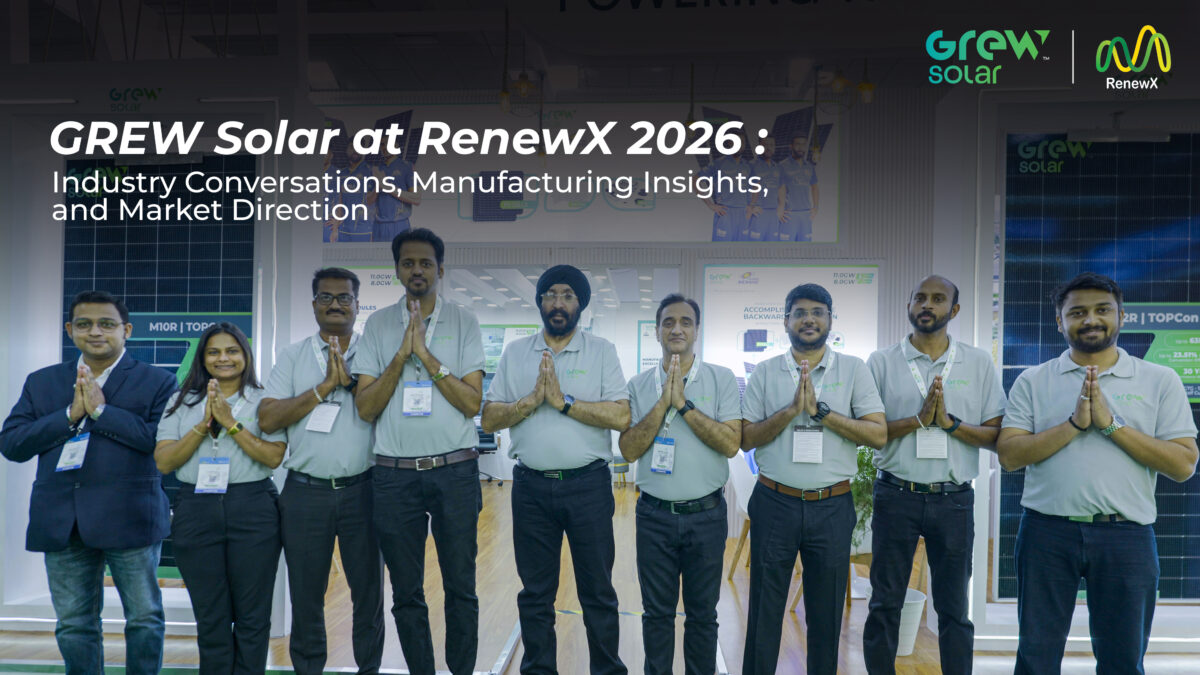
RenewX’s10th edition under the theme “A Decade of Impact – A Future of Abundance” was a three-day event that brought together over 8,000 industry professionals, 200+ leading brands, and more than 50 speakers across solar, energy storage, bioenergy, and emerging clean technologies. 

For manufacturers, the event offered a direct view of how market expectations are evolving. Conversations at booths and sessions reflected a clear shift in procurement priorities, with greater emphasis on manufacturing quality, system integration, and long-term performance rather than upfront cost alone.  

GREW Solar at RenewX 2026 

GREW Solar exhibited its G12R and M10R solar PV modules designed for utility-scale and commercial applications.

Engagement at the booth extended beyond product specifications. Conversations with EPCs, developers, channel partners, and project financiers reflected a shift in how modules are being evaluated today. 

Questions focused on performance consistency across batches, degradation behavior under high ambient temperatures, long-term reliability, and manufacturing traceability. These discussions pointed to a broader industry trend where modules are assessed as long-term performance assets rather than standalone procurement items.

Members of the GREW Solar team also participated in conference sessions addressing critical industry challenges, including the transition to hybrid projects, energy storage deployment, manufacturing quality, and export readiness.

Key Industry Conversations at RenewX 2026

Discussions across the event indicated a gradual shift from standalone solar projects to more integrated energy systems. Hybrid configurations that combine solar, wind, and storage are becoming more common, with a stronger focus on delivering firm and dispatchable power.

Energy storage was a recurring theme, particularly in the context of managing variability and supporting grid requirements. At the same time, there was continued attention on domestic manufacturing and supply chain depth, especially as India increases its installed capacity. 

Another noticeable shift was in evaluation criteria. While cost remains relevant, there is more consistent focus on performance, degradation, and long-term reliability.

Manufacturing and Scale: Insights from Leadership

One of the key discussions at RenewX 2026 focused on how Indian manufacturers can position themselves in global markets. As part of a BloombergNEF-powered panel on unlocking global opportunities through strategic alliances, Hardip Singh, COO at GREW Solar, shared perspectives on the practical realities of scaling solar manufacturing in India.

A central point was the importance of execution. Experience across different states has shown that policy intent alone is not sufficient. Infrastructure readiness, logistics, and access to supply chains have a direct impact on how effectively manufacturing can be set up and scaled. 

There has also been a clear shift in how product quality is perceived. With advancements in technology and stronger regulatory frameworks, discussions are now focused on consistency of performance and the ability to deliver at scale rather than comparisons with global benchmarks. 

Manufacturing discipline, including process control and integration across the value chain, is becoming a more relevant factor in how manufacturers are evaluated in both domestic and export markets. 

Evolving Market Dynamics and Demand Patterns

Market dynamics were also discussed in the context of changing project structures and emerging technologies. In a CRISIL-powered session focused on the evolution of energy storage demand across utility-scale, commercial and industrial, and residential segments, Ankur Baranwal, National Sales Head – KAM at GREW Solar, highlighted how these shifts are influencing solar demand.

The move toward hybrid tenders is changing how solar PV modules are evaluated. Instead of being assessed primarily on cost, modules are now part of a larger system where performance, reliability, and generation profile directly impact project outcomes.

This transition is also leading to more structured demand patterns. As projects are designed to meet defined output requirements, there is less emphasis on short-term pricing and more focus on long-term performance.

At the same time, energy storage deployment is expected to be more closely aligned with demand centres and grid requirements, rather than following the same geographic patterns as solar generation.

Preparing for Export Markets

Sessions exploring India’s readiness for global markets drew lessons from sectors like textiles and chemicals. Three takeaways stood out: consistency beats cost, integration matters for controlling quality, and export markets require patience to build long-term relationships.

India has built domestic manufacturing capacity through PLI, ALMM, and basic customs duty. The next phase should focus on export-linked incentives, trade access through bilateral agreements, support for upstream manufacturing, and competitive financing to enable Indian manufacturers to plug into global supply chains.

What This Means for Solar Manufacturing

RenewX 2026 reflected a sector maturing in its expectations. The focus is shifting from volume addition to system performance, integration, and long-term reliability. Modules are no longer evaluated only on upfront cost but on how they perform within larger systems over time.

This increases the importance of manufacturing quality, process control, and backward integration. As domestic capacity expands, consistency and reliability are becoming more important than incremental cost differences.

For GREW Solar, participation in the event provided valuable insights into how developers, EPCs, and financiers are evaluating manufacturers today. These conversations will continue to inform our approach to capacity expansion and product development as we work toward 11.0 GW of module manufacturing capacity and 8.0 GW of cell manufacturing capacity in 2026.

We thank everyone who visited our booth and engaged with our team during the event.