Categories
Uncategorized

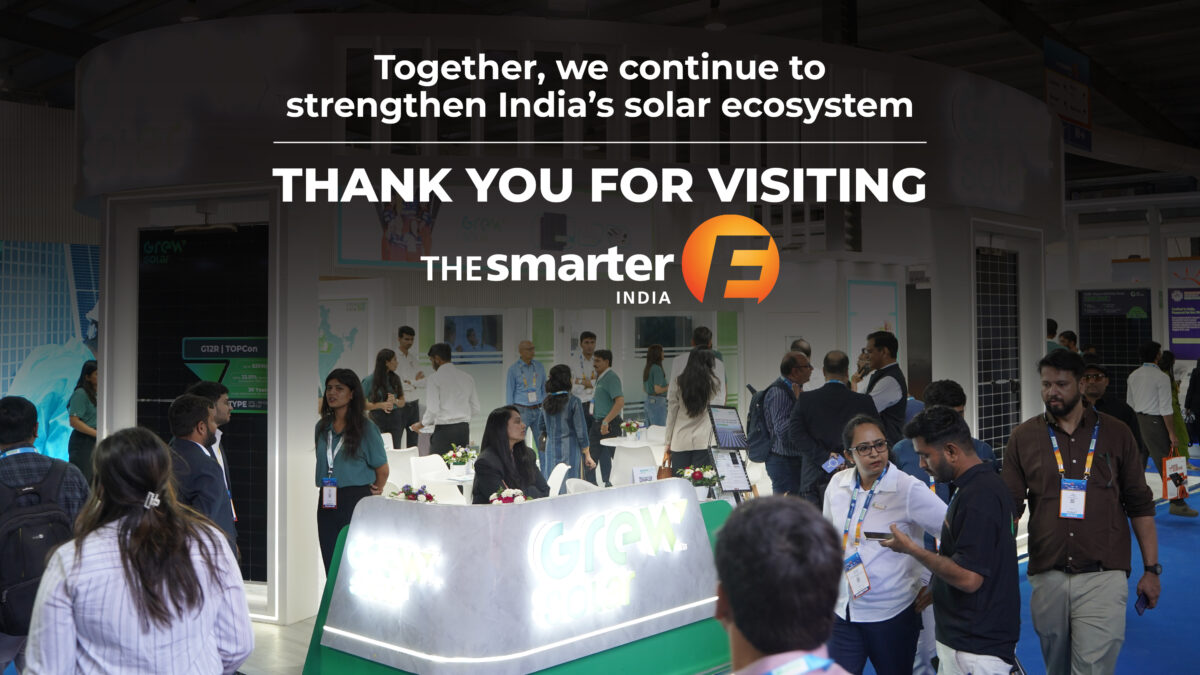
GREW Solar at The Smarter E India 2026: Demonstrating Scale, Technology, and Industry Engagement

The Smarter E India 2026 brought together manufacturers, developers, policymakers, and technology leaders at a time when India’s solar sector is expanding rapidly. As domestic capacity grows and expectations around quality and reliability continue to rise, industry platforms like this serve as important checkpoints. They are spaces where scale, technology, and long-term intent are evaluated closely.


At this year’s edition, GREW Solar presented not only its expanding product portfolio, but also its broader manufacturing roadmap and approach to industry engagement.


Showcasing the Complete Product Portfolio


At the expo, GREW Solar showcased its full range of solar PV modules, including the G12R series, the M10 series, and the All Black module. Each product reflects a specific application focus, from utility-scale installations to commercial and residential deployments.


The G12R solar PV module, with its rectangular wafer design and higher conversion efficiency, represent a step forward in power density and logistics optimisation. The M10 solar PV module continues to offer reliable performance backed by advanced cell technology and strong efficiency benchmarks. The All Black solar PV module offers a solution where aesthetics and energy generation must work together.


Together, the portfolio demonstrates product variety along with manufacturing capability across formats and performance categories. Conversations at the booth centred on efficiency, long-term degradation rates, logistics advantages, and installation flexibility, highlighting the growing demand for both technical strength and practical deployment benefits.


Manufacturing Scale and Integrated Capability


Other than the product display, manufacturing scale also formed a key part of the dialogue. GREW Solar’s expansion roadmap outlines 11.0 GW of solar PV module manufacturing capacity and 8.0 GW of solar PV cell manufacturing capacity. This roadmap reflects a deliberate effort to strengthen domestic manufacturing capability and reduce reliance on external supply chains.


The company’s approach is rooted in integrated manufacturing, with a clear focus on backward integration across modules and cells. As India accelerates toward greater energy independence, building resilient domestic capacity becomes critical. Discussions at The Smarter E India 2026 frequently returned to this theme, particularly around how Indian manufacturers are positioning themselves in the global clean energy landscape.


Scale, however, is only meaningful when supported by quality systems. GREW Solar’s in-house testing infrastructure and quality assurance processes continue to play a central role in ensuring consistency across output. At a time when module efficiency and durability are under constant scrutiny, disciplined manufacturing remains the foundation.


Leadership Dialogue and Policy Conversations


An important highlight during the event was Hardip Singh, COO at GREW Solar, being featured on Voice of India’s Energy Leaders by Energetica India during Intersolar India 2026. The live podcast explored the realities behind scaling solar manufacturing in India, the evolution of module technologies, and the broader implications of domestic capacity expansion.


In addition to the podcast, Hardip Singh engaged with multiple media representatives and participated in interviews that addressed supply chain stability, technology shifts, and the importance of quality control in high-capacity manufacturing environments. These conversations reinforced GREW Solar’s perspective on building scale responsibly while maintaining performance standards.


Industry dialogue extended beyond media engagement. Divyanshu Parmar, National Head – MID Market & Distribution at GREW Solar, participated in an exclusive roundtable on Global Solar Industrial Policy: India’s Views and Role, held during Intersolar India 2026.


The session brought together senior industry representatives to examine how coordinated industrial strategies can support supply chain resilience and strengthen India’s contribution to the global solar ecosystem. Participation in such discussions reflects GREW Solar’s active involvement in policy-oriented conversations shaping the future of domestic solar manufacturing.


Together, these engagements highlighted GREW Solar’s role not only as a manufacturer, but as a contributor to broader industry and policy discourse.


Champions Quiz: Encouraging Industry Engagement


In addition to product and leadership engagement, GREW Solar introduced an interactive element at the booth through the “Champions Quiz.” Visitors were invited to scan a QR code and answer ten questions, many of which focused on GREW Solar’s manufacturing processes, product features, and expansion roadmap. Participants who answered eight or more questions correctly received a prize.


The initiative served a dual purpose. It encouraged deeper interaction with the brand while reinforcing technical awareness. Rather than limiting engagement to brochures and product sheets, the quiz created an opportunity for visitors to test their understanding of manufacturing scale, technology advancements, and integrated capabilities.


This approach reflected a broader intent of building industry familiarity not only through display, but through informed conversation.


Strengthening India’s Clean Energy Ecosystem


The Smarter E India 2026 highlighted how quickly India’s solar ecosystem is maturing. With rising domestic demand, policy support, and technological advancement, expectations from solar manufacturers are higher than ever.


For GREW Solar, participation in the event was aligned with a clear direction to expand responsibly, innovate consistently, and contribute meaningfully to India’s clean energy transition. The 11.0 GW solar PV module manufacturing and 8.0 GW solar PV cell manufacturing capacity roadmap, combined with a diverse product portfolio and integrated manufacturing strategy, reflects a commitment to long-term capacity building.


Industry exhibitions serve as important milestones in this journey. They offer a space to assess progress, exchange ideas, and reinforce partnerships across the value chain. At The Smarter E India 2026, GREW Solar’s presence highlighted its continued focus on performance, scale, and sustainable growth.

Categories
Uncategorized

GREW Solar at RenewX 2026: Advancing Solar Manufacturing for India’s Next Phase of Growth

India’s renewable energy sector continues to expand at scale, with the country now being the world’s third largest renewable energy installation capacity holder. A significant share of this growth is being driven by solar, with installed capacity reaching 150.26 GW and continuing to rise alongside policy support, increasing project sizes, and a growing focus on domestic manufacturing.

Platforms like RenewX bring these developments into a more practical context. While the event has a strong presence from South India, the conversations extend to national priorities around manufacturing, technology, and energy transition. 

As demand continues to evolve across both utility and commercial segments, these interactions offer a clearer view of how the next phase of solar growth is being shaped.

GREW Solar at RenewX 2026

GREW Solar will be participating in RenewX 2026 as part of its ongoing engagement with India’s renewable energy ecosystem. The event offers an opportunity to interact with EPC companies, developers, distributors, and industry professionals who are directly involved in project execution and deployment.

For GREW Solar, one of the key reasons for participation is to understand how market requirements are changing across regions and how manufacturing needs to adapt to support that shift.

What We’re Showcasing

At RenewX 2026, GREW Solar will be showcasing its G12R and M10R solar PV modules, both designed to support different project requirements across utility and commercial applications.

The G12R series focuses on higher power output and improved system efficiency, particularly for large-scale installations where optimization of balance of system costs plays an important role. The M10R series offers stable and reliable performance across a wide range of project types, making it suitable for distributed and commercial use cases.

Both module formats are ALMM certified, aligning with current regulatory requirements while supporting consistent performance across installations.

Manufacturing Scale and Capability

Manufacturing scale continues to be an important part of how solar projects are evaluated today. GREW Solar’s roadmap of 11.0 GW in solar PV module manufacturing and 8.0 GW in solar PV cell manufacturing reflects a focus on building capacity alongside process consistency.

This approach is supported by integrated manufacturing and in-house quality systems that help maintain uniformity across production. 

Testing infrastructure and process control play a key role in ensuring that modules perform reliably under different operating conditions. As demand increases, consistency at scale becomes just as important as capacity itself.

Industry Conversations at RenewX 2026

The conference sessions at RenewX 2026 reflect the range of topics currently shaping the solar and broader renewable energy sector. 

A significant part of the discussion is expected to focus on energy storage and its role in supporting renewable integration, including the shift towards long-duration storage solutions and the growing relevance of energy storage systems in solar projects.

There is also a clear emphasis on supply chain resilience and manufacturing. Conversations around reducing dependency, strengthening domestic capability, and scaling production are likely to remain central, especially as India continues to expand its renewable capacity.

Another area of focus is global opportunity. Sessions exploring international trade and the role of Indian suppliers highlight how domestic manufacturing is increasingly linked to global markets.

Technology and innovation remain consistent themes across sessions, with attention on materials, system integration, and service models that can improve efficiency and long-term performance.

Why These Conversations Matter?

These discussions point to a shift in how solar projects are being approached. It is no longer only about adding capacity, but about improving how that capacity performs, integrates with other technologies, and sustains output over time.

For manufacturers, this means aligning production, technology, and system-level thinking. As storage becomes more relevant and project requirements become more complex, the role of manufacturing extends beyond supply to supporting performance across the lifecycle of a system.

Event Details

RenewX 2026 will take place on 27, 28 & 29 April 2026 at the Chennai Trade Centre, Chennai, across Halls 1, 2, 3 & Hangar.

Conclusion

RenewX continues to serve as a space where regional demand and national priorities come together. It brings practical market perspectives alongside broader industry discussions, creating an environment where both current challenges and future directions are examined.

GREW Solar’s participation in RenewX 2026 reflects a continued focus on manufacturing scale, product reliability, and engagement with the evolving needs of the solar industry.

Join us at booth no. B353, hall no. 3, and see how we’re redefining performance and quality in solar PV modules.

Book an appointment info@grewsolar.com 

Categories
Grew Solar Industrial Solar Solutions Rajasthan Solar

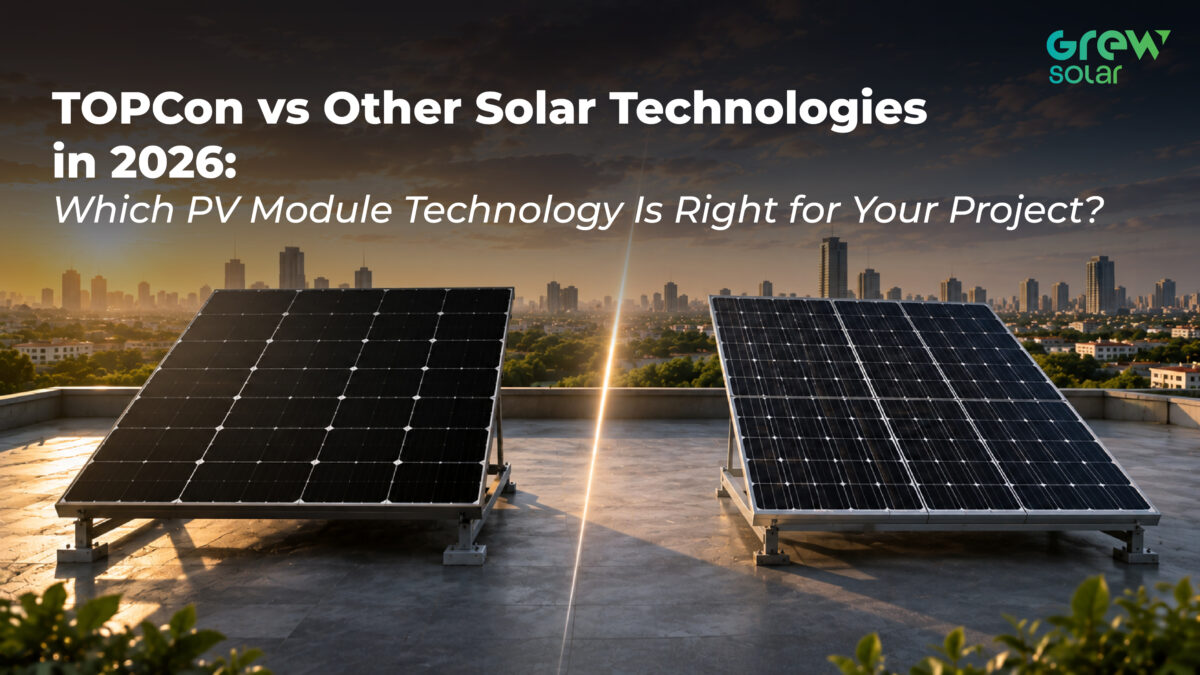
TOPCon vs Other Solar Technologies in 2026: Which PV Module Technology Is Right for Your Project?

Module technology used to be a footnote in most solar proposals, a spec sheet line most buyers skipped past. That has changed. In 2026, the gap between TOPCon, HJT, PERC, and back-contact cells is wide enough to genuinely affect yield, roof-space efficiency, and 25-year returns, not just marketing copy. For anyone specifying or buying modules this year, the following is what actually separates these technologies, and which one fits which kind of project.

The 2026 Technology Landscape

TOPCon is no longer merely the leading technology; it has become close to the industry default. According to PV Tech, citing CRU’s Solar Module Tracker, TOPCon accounted for almost 85% of global module production as of early 2026, while mono PERC had fallen below 5%. The same tracker places leading TOPCon module efficiencies above 24.5%, with median module efficiencies around 23%. HJT occupies a smaller, premium niche built around specific performance advantages rather than volume. Back-contact technology remains constrained by manufacturing complexity and cost, making it a technology to monitor rather than one to specify by default in most 2026 projects.

What Makes TOPCon Different

TOPCon stands for Tunnel Oxide Passivated Contact. It is an n-type cell design that adds a thin tunnel oxide layer plus a doped polysilicon layer at the rear of the cell, reducing electron recombination losses relative to standard p-type PERC cells. TOPCon’s second advantage is manufacturing, not physics alone: the cell architecture is compatible with existing PERC production lines, allowing manufacturers to retrofit rather than rebuild factories from scratch. That compatibility is a primary reason TOPCon scaled to dominant market share faster than any prior cell technology shift, and why module pricing has remained relatively competitive even as efficiency climbed.

TOPCon vs PERC

TOPCon modules operate at meaningfully higher efficiency than standard mono-PERC, with stronger inherent bifaciality, since the n-type structure is better suited to rear-side generation. Degradation is where the gap compounds most significantly: according to NREL’s Fleet Performance Data Initiative, N-type technologies including TOPCon and HJT show annual degradation in the range of 0.3% to 0.4%, against 0.55% to 0.7% for P-type PERC. PERC retains a role for genuinely budget-constrained projects, or where distributors are clearing older stock at a discount, but availability from top-tier manufacturers continues to shrink as production lines convert to TOPCon. For most new residential and commercial projects in 2026, TOPCon has effectively become the default specification rather than a premium upgrade.

TOPCon vs HJT

HJT is engineered to outperform TOPCon on two specific measures: temperature response and long-term degradation. Because the amorphous silicon layers in an HJT cell manage heat differently from TOPCon’s structure, HJT modules retain comparatively more output as ambient temperatures rise, and NREL’s degradation banding places HJT at the stronger end of the N-type range. The trade-off is cost. HJT carries a real price premium over comparable TOPCon modules, one that is most easily justified in genuinely hot climates where the temperature advantage compounds daily, on space-constrained rooftops where every additional watt per square metre carries outsized value, and on projects where the priority is minimising lifetime degradation rather than minimising upfront capital cost.

TOPCon vs Back Contact

Back-contact cells relocate all electrical contacts to the rear of the cell, eliminating the visible front-side grid lines that give conventional panels their striped appearance. This makes BC modules the preferred choice where roof appearance is a priority, and the technology carries the highest theoretical efficiency ceiling of the group. In 2026, however, BC remains constrained by process complexity and manufacturing cost, keeping it a smaller-scale, higher-price option rather than a mainstream one. The development worth monitoring is hybridisation, combining BC’s contact architecture with TOPCon or HJT cell chemistry to reduce cost while retaining the efficiency and aesthetic advantages of each. That combination is not yet the practical default for most Indian projects, but it is where the next meaningful efficiency gains are likely to originate.

Matching Technology to Project Type

The right technology depends less on which option performs best in isolation and more on what a given project is optimising for. Budget-conscious residential installations are generally best served by TOPCon, or by discounted PERC clearance stock where the cost differential is decisive, since TOPCon currently offers the strongest cost-to-efficiency balance at prevailing prices. Space-constrained rooftops warrant HJT or premium high-wattage TOPCon, where maximising output per square metre outweighs the marginal cost difference. Installations in consistently hot climates are a stronger case for HJT specifically, given the temperature coefficient advantage protects summer-season yield most directly. Utility-scale and large ground-mount projects continue to favour TOPCon, on the strength of manufacturing scale, bankability, and the lowest levelised cost of energy at volume. Where aesthetics are the deciding factor in residential projects, BC remains the appropriate choice where budget allows. For long-horizon assets where 25-year yield is the primary financial variable, HJT’s lower annual degradation among mass-produced options makes it the more defensible selection.

Compliance Adds a Second Filter Beyond Technology

Technology choice and compliance now sit on top of each other rather than functioning as separate decisions. For any project tied to subsidies, government tenders, or the PM Surya Ghar scheme, ALMM listing is non-negotiable, and from June 1, 2026, that listing requires both the module and the cells used to build it to meet domestic sourcing rules. Confirming a specific product’s current ALMM status directly is more reliable than relying on a manufacturer’s general claim, since listings are revised periodically. Several major Indian manufacturers now hold ALMM-listed TOPCon products, reflecting how far the domestic supply chain has progressed in step with the underlying technology shift.

GREW Solar’s G12R DCR series illustrates where this compliance layer and the TOPCon technology discussion intersect directly. The module is an N-type bifacial TOPCon design, rated at up to 23.14% efficiency, and carries a 30-year linear performance warranty with 1% first-year degradation followed by 0.4% annually thereafter, consistent with the N-type degradation curve referenced in NREL’s data. It is manufactured under India’s DCR guidelines, placing it within the same ALMM List I and List II framework outlined above.

Where Buyers Are Misled by the Datasheet

Most errors in module selection occur after the technology decision has already been made, not before it. ALMM status is the most common point of oversight, where a buyer confirms the manufacturer’s general listing status rather than the specific product model, and the two are not always identical, which is precisely the gap the List I and List II requirement addresses. The degradation curve is overlooked even more frequently: a headline “25-year warranty” figure describes a duration, not a decay rate, and two modules with identical headline years can retain materially different output by year twenty depending on whether the annual degradation rate is 0.4% or 0.7%. Temperature coefficient should be weighted in direct proportion to climate: a site with regular cell temperatures above 35°C should treat it as a primary consideration, while a site in a temperate zone may reasonably treat it as secondary. Product warranty and performance warranty are also not interchangeable protections, despite frequently being quoted together: one covers manufacturing defects, the other covers output decline, and a module may fail on one measure without the other applying. GREW’s own G12R DCR datasheet distinguishes these explicitly, specifying a 12-year product warranty against a 30-year performance warranty, illustrating the distinction every manufacturer should be asked to clarify rather than assumed from a single headline figure. The final check is the least technical and the most frequently skipped: the length of time a manufacturer has been shipping product at scale, and whether after-sales infrastructure exists beyond the point of sale, since a strong datasheet from a company without an established operating history carries materially different risk than the same datasheet from a manufacturer with years of field data behind it.

The technology decision and the compliance decision were once treated as separate items on a project checklist. In 2026, they function as a single decision, and projects that recognise this early will spend considerably less time re-specifying later.

Categories
Grew Solar Industrial Solar Solutions Rajasthan Solar

PM Surya Ghar Yojana 2026: What Rooftop Solar Installers, Businesses & Homeowners Need to Know

PM Surya Ghar Muft Bijli Yojana remains India’s largest residential rooftop solar programme, and 2026 has been its busiest year yet. According to MNRE data, the scheme had crossed 40 lakh solarised households by May 2026, against a target of one crore homes by FY2026-27 and a central outlay of Rs 75,021 crore. The scheme has moved well past its early rollout phase into a mature, high-volume programme with tighter compliance rules, and it has picked up new guidelines this year that change what installers, businesses, and homeowners each need to check before signing up.

What the Scheme Actually Offers Homeowners

The subsidy is a capital payment tiered by system size, and it does not scale indefinitely with capacity: MNRE’s published slabs run Rs 30,000 for a 1 kW system, Rs 60,000 for 2 kW, and a Rs 78,000 cap for anything 3 kW or larger. To qualify, the applicant needs a residential electricity connection with a sanctioned load of 10 kW or below, and the installed equipment must be ALMM-listed. One detail that catches many homeowners off guard: the subsidy is not an upfront discount. It is credited as a direct bank transfer within roughly 30 days of the DISCOM commissioning the system, which means the full cost has to be funded first, out of pocket or through a solar loan. End to end, from application on the national portal to subsidy credit, MNRE’s own process timeline runs 45 to 90 days, covering feasibility approval, installation by a registered vendor, net meter installation, and final inspection.

What Changed in 2026 That Homeowners Should Know

Two MNRE updates this year are worth knowing before finalising a vendor. From June 1, 2026, eligible modules must appear on ALMM List I and be manufactured using solar cells from ALMM List II, meaning the cells themselves, not just final module assembly, have to be domestically produced. A narrow set of net-metering and open-access projects has since received exemption windows, but subsidised PM Surya Ghar installations are not among them, so this applies directly to homeowners claiming the central subsidy. Separately, MNRE issued an Office Memorandum on July 30, 2026 introducing standard branding guidelines for rooftop solar installations, requiring registered vendors, manufacturers, and DISCOMs to follow uniform identification and visibility standards across both the CAPEX model and the newer Utility Led Aggregation mode. Practically, this gives homeowners a way to visually confirm they are dealing with a registered installation rather than an unregistered contractor claiming scheme eligibility.

Where Businesses Fit In, and Where They Don’t

Commercial and industrial consumers are not eligible for the PM Surya Ghar subsidy. The scheme is built around residential connections with a sanctioned load capped at 10 kW, and the subsidy only applies to the CAPEX model where the homeowner owns the system outright. RESCO and PPA arrangements, where a third party owns and finances the installation, do not qualify even when installed at a residential address. For genuine commercial and industrial rooftops, offices, retail spaces, warehouses, factories, the subsidy route simply does not apply. That doesn’t mean solar is unviable for businesses; the commercial economics run through a different set of levers entirely: net or gross metering policies that vary by state and DISCOM, accelerated depreciation benefits under the Income Tax Act, open access solar for larger loads, and RESCO or PPA structures for businesses that want zero-capex adoption at a fixed per-unit tariff. None of these run through the PM Surya Ghar national portal, and the numbers differ meaningfully by state, so any business evaluating rooftop solar needs a state-specific proposal rather than the residential scheme’s figures. One edge case is worth flagging: home-based businesses or mixed-use properties may still qualify for the residential subsidy if the electricity connection itself is registered as residential and stays within the 10 kW load. It is the connection category that decides eligibility, not how the space is used.

The Compliance Burden Now Sits With the Installer

Vendor registration on the national portal is free and requires a GST certificate, business registration documents, an electrical contractor licence, bank account details, and at least one commissioned solar project as a reference. Two 2026 compliance points now sit on top of that base requirement. Branding compliance under the July memorandum applies across both CAPEX and ULA project modes, so installers working through aggregators are not exempt. And ALMM List I plus List II compliance needs checking at the sourcing stage, before committing to a project timeline or price. A module that was compliant last quarter isn’t guaranteed to still be on the list, and committing to non-compliant stock risks the customer’s subsidy eligibility, not just the installer’s margin. There is also a practical reason to tighten documentation discipline: since the subsidy is disbursed within about 30 days of commissioning, any delay in net-metering paperwork or inspection sign-off delays the homeowner’s payout directly, and in a scheme where vendor reputation travels by word of mouth, that turnaround time has become a genuine differentiator.

The Rule Rewards a Different Kind of Manufacturer

The List-II requirement changes what domestic manufacturing means for a module supplier’s compliance risk. A manufacturer that only assembles panels domestically while importing cells is now exposed every time the approved list is revised, since a change in cell sourcing can strand inventory or de-list a product overnight. One that produces its own cells carries none of that exposure, because the compliance boundary sits entirely within its own supply chain.

GREW Solar is built on that backward-integrated model: cell manufacturing in Narmadapuram feeding directly into module production in Dudu, rather than sourcing cells externally. GREW is one of 11 companies to win a PLI allocation covering PV modules, cells, and wafers/ingot manufacturing, under the same backward-integration approach this year’s rule is now asking the rest of the industry to move toward.

That shift, more than the subsidy slabs or the branding stickers, is the part of 2026’s changes likely to decide which manufacturers stay compliant without scrambling every time MNRE revises a list.

Categories
Grew Solar Industrial Solar Solutions Rajasthan Solar

India’s Solar Manufacturing Boom in 2026: Why Domestic PV Module Manufacturing Matters

India’s solar module manufacturing capacity has expanded sharply over the past two years, driven by a policy push that began with the Production-Linked Incentive scheme and has since tightened through successive rounds of the Approved List of Models and Manufacturers framework. According to Mercom India’s 2026 industry report, the country added approximately 119 GW of new module manufacturing capacity through 2025, bringing cumulative capacity to roughly 210 GW by December 2025. Cell manufacturing capacity has not kept pace, and the resulting gap is now shaping procurement and compliance decisions across the sector.

The Capacity Numbers Behind the Headlines

MNRE has structured its PLI scheme solar manufacturing support with a ₹24,000 crore outlay covering more than 48 GW of fully or partially integrated manufacturing capacity, allocated across three categories: polysilicon-to-module, ingot-wafer-to-module, and cells-plus-modules. A manufacturer awarded under the poly-to-module category carries no obligation to build cell capacity, while one awarded under cells-plus-modules does, and the scheme’s early years saw considerably more capacity allocated to the former. That imbalance is part of why domestic solar manufacturing India has scaled unevenly across the value chain rather than growing in step from raw material to finished module. Manufacturers including Waaree, Vikram Solar, Premier Energies, and GREW Solar, whose Dudu facility in Rajasthan operates at 6.5 GW with an announced expansion to 11 GW, have each contributed to the module-side capacity that now defines India’s manufacturing base. That module figure is accurate and verifiable. It does not indicate what those modules are built from.

The Backward Integration Shift

Cell manufacturing is where the supply chain gap is most significant. Per CEEW, ALMM List-I enlisted module manufacturing capacity reached 119.8 GW as of October 2025, while cumulative cell manufacturing capacity, including capacity still coming online under PLI support, is estimated at 60.34 GW, a shortfall of approximately 59.66 GW. That gap is why the ALMM List-II mandate, requiring List-I modules to use List-II certified cells from June 1, 2026, functions as an operational constraint rather than a compliance formality. Backward integration, manufacturing cells rather than sourcing them externally, has accordingly moved from a competitive differentiator to a structural requirement for manufacturers operating at scale. SAEL Industries built cell manufacturing into its strategy specifically to reduce procurement dependency for its own project pipeline. INA Solar has announced plans to add 4.5 GW of cell capacity alongside its existing module lines. GREW Solar took this route earlier than most, operating a cell manufacturing facility in Narmadapuram, Madhya Pradesh, that feeds directly into its Dudu module line, and its inclusion among 11 companies to receive PLI allocation covering modules, cells, and wafers reflects the same three-category structure MNRE built the scheme around.

Why the Gap Exists in the First Place

Module and cell manufacturing are not comparable undertakings, and that difference explains much of the imbalance. Assembling modules involves stringing, laminating, and framing cells that have already been manufactured elsewhere, a process that can be set up and commissioned in a relatively short timeframe. Manufacturing cells requires diffusion furnaces, PECVD deposition equipment, and precision screen printing lines, each carrying significantly higher capital cost, longer equipment lead times, and process expertise most module-only manufacturers had no prior need to develop. Commissioning a new cell line typically takes considerably longer than commissioning a module line of comparable capacity. Lower barrier to entry, more than incentive value alone, is why the PLI scheme’s earlier allocations skewed toward module manufacturing even where cell manufacturing carried the stronger incentive weighting.

Where the Constraint Actually Bites

CEEW’s analysis notes that without additional cell capacity beyond current projections, nearly half of India’s enlisted module manufacturing capacity could become ineligible for domestic deployment starting June 2026, outside specific exempted categories such as net-metering and open-access projects commissioned before that date. A developer working entirely within an exempted category faces a materially different sourcing environment than one procuring for a subsidised residential or utility-scale project under the mandate directly. A PLI allocation on paper is not equivalent to operational cell output today, and that distance is creating near-term sourcing pressure for module manufacturers that have not yet moved on cell integration. Module manufacturing capacity has expanded as reported; the upstream capacity it depends on has not expanded at the same rate, and the two figures should not be read as a single trend.

The Procurement Question This Creates

For EPCs and developers, the gap is not only a manufacturing-sector statistic, it changes what due diligence needs to check. A manufacturer’s overall scale or ALMM List-I status no longer guarantees consistent access to List-II compliant cells, since that access now depends on whether the manufacturer holds its own cell supply or is competing for the same constrained external pool as everyone else. Cell sourcing traceability has become a standard verification step rather than an unusual request as a direct result, and manufacturers with in-house cell capacity carry a structurally different supply reliability profile than those without it, independent of how large their module operation is. For a developer evaluating vendors against a fixed project timeline, that distinction now carries more practical weight than it did before the List-II mandate took effect.

Where This Goes Next

GREW Solar, founded in 2022 and built on the Chiripal Group’s manufacturing base, structured its cell manufacturing as an early step in its integration roadmap rather than a later addition, ahead of the compliance deadline that has since tightened sourcing across the sector. Manufacturers who made that same sequencing choice early are now working from a materially different starting position than those approaching cell integration as a response to the mandate rather than preparation for it. The next phase of India’s manufacturing build-out will be shaped by how quickly the remaining gap closes, not by how large module capacity announcements continue to get.

Categories
Grew Solar Industrial Solar Solutions Rajasthan Solar

Solar Panel Performance in Monsoon 2026: What the Season Revealed for Generation Planning

India’s solar sector posted strong growth through the 2026 monsoon period. Per Saur Energy’s reporting of Central Electricity Authority data, national solar generation rose 57.1% year-on-year in June 2026 to 20,307.54 million units, and climbed 45.9% for the April-June quarter to 62,791.14 million units. That growth reflects installed capacity reaching 162.15 GW by June 2026, up from 116.25 GW a year earlier, an addition of nearly 46 GW in twelve months. The monsoon itself, meanwhile, ran below normal: IMD’s seasonal forecast placed June-September rainfall at roughly 90% of the long-period average, and July rainfall came in close to 19% below normal nationally, with Northeast India, Central India, and the South Peninsula all trailing their respective normals. Two things were true about the same season, and neither cancels the other out.

The National Number Doesn’t Show What a Single Plant Experienced

A headline generation increase driven primarily by new capacity tells an EPC or developer almost nothing about how an individual plant’s output-per-installed-MW held up through the season. Capacity growth at this scale, nearly 46 GW added in a year, is large enough to mask a real seasonal drag entirely at the national aggregate level, even where that drag was material at a specific site. This is the gap most generation planning misses: a national or even state-level number moving upward says nothing about whether a given plant underperformed its own baseline during the exact weeks cloud cover was heaviest over its specific location. The relevant comparison for planning purposes isn’t this year’s national total against last year’s, it’s a plant’s actual monsoon-period output against its own pre-monsoon baseline, adjusted for the capacity it had at the time.

What the Season Actually Did to Output at the Plant Level

Below-normal, unevenly distributed rainfall changes the generation trade-off in a specific way. Sustained cloud cover increases the share of diffuse irradiance reaching a module relative to direct beam radiation, and diffuse-heavy conditions typically reduce output more than an equivalent amount of rainfall does on its own. Rainfall itself cuts the other way: it periodically clears dust and particulate buildup from a module’s surface, so a season with fewer rainfall days doesn’t only mean less cloud-driven loss, it also means fewer natural cleaning events, allowing soiling to accumulate over longer stretches between rains. A below-normal season like 2026 produced less diffuse-irradiance loss in the driest regions, offset to some degree by heavier soiling accumulation than a normal season would have allowed. Humidity moved independently of rainfall volume through the season. Even in regions where rainfall ran below normal, ambient humidity remained high enough to affect cell temperature behavior and elevate hot-spot risk at junction points, since humidity levels and rainfall totals track different atmospheric conditions rather than moving together.

Where Module Design Held Up or Didn’t

Module architecture responded to these conditions unevenly. Bifacial modules captured measurably more of the diffuse and ground-reflected light dominating the sky during overcast stretches than mono-facial modules did, since bifacial rear-side generation is suited specifically to the low-direct, high-diffuse conditions a below-normal but still cloud-heavy monsoon produces. Moisture ingress risk tracked with humidity exposure rather than rainfall totals, which meant junction box sealing and encapsulant integrity mattered across the full season regardless of how much rain fell in a given region. Modules built to IP68 junction box standards, rated for continuous submersion resistance rather than incidental splash protection, held a measurable advantage through sustained humidity exposure that persisted even in the drier parts of the country.

Why a Flat Seasonal Number Fails at the Plant Level

Solar generation monsoon 2026 forecasting built on a single national assumption will keep missing the variability that actually determines site-level output. A model that treats “monsoon reduces output by X%” as a flat national figure overlooks the regional divergence IMD’s own data showed this season, and a forecast that treats diffuse-irradiance loss and soiling accumulation as offsetting factors risks understating both, since they don’t necessarily move in opposite directions at the same site. Wet-dry cycling, the repeated expansion and contraction a module undergoes moving between saturated humidity and drier stretches, is a degradation factor worth tracking across the full season rather than only during the heaviest rainfall weeks. Post-monsoon inspection should be tied to a season’s actual regional rainfall pattern rather than a fixed calendar date, since a below-normal season with concentrated dry stretches leaves a different soiling and moisture profile on a module than a heavy, evenly distributed one would.

Where This Points for Next Season

Regional, month-by-month data of the kind IMD already publishes gives a more useful planning baseline than a single seasonal average, particularly given how much a below-normal headline figure masked at the plant level in 2026. Solar panel performance rainy season planning should start from that plant-level baseline, not the national growth figure. GREW Solar’s All Black Module, built with an IP68-rated junction box and bifacial cell architecture, reflects design choices suited to this kind of variable exposure rather than an assumption of uniform monsoon conditions. This season’s national generation growth came from capacity additions. The monsoon’s effect on individual plant output ran independently of that number, and that is the distinction worth carrying into next year’s planning cycle.

Categories
Grew Solar Industrial Solar Solutions Rajasthan Solar

What Makes a Solar PV Module Bankable for Large Projects?

A lender financing a large solar project is not actually evaluating a module. They are evaluating a bet on manufacturing discipline that has to hold for twenty-five years, made using only what can be verified today. Wattage and price per watt are the two numbers procurement sheets lead with, and they are also the two numbers that say the least about whether that bet is sound. A 600W or 635W module can look identical to a competitor’s on paper while sitting behind a completely different level of production consistency, warranty support, and long-term reliability, and once thousands of modules are installed across a site, that gap stops being theoretical.

What Lenders Are Actually Trying to Answer

Bankability exists as a category because a financial institution cannot directly observe twenty-five years of future module performance, so it evaluates something it can observe: whether the manufacturer behind the module has the systems, track record, and financial standing to make that future performance plausible. Financing for a large plant is typically structured around expected generation over the project’s operating life, so if modules underperform, degrade faster than specified, or develop widespread quality issues, the financial model built around them is what actually breaks.

The Manufacturer Question Comes Before the Module Question

For a large project, the first real question is rarely about the module itself. It is about the company producing it. Supplying modules at the volume a utility-scale project requires, often into the tens or hundreds of thousands of units, demands production capacity, quality systems, and operational stability that a smaller or newer manufacturer may not yet have built. A developer evaluating a solar PV module manufacturer in India for this kind of order is effectively asking whether the company can maintain consistent output, honor warranty obligations years after delivery, and still be operationally intact if a claim needs to be resolved a decade into the project. That question extends past the warranty document itself: a manufacturer’s ability to provide technical assistance after installation, troubleshooting a performance issue on-site, supporting an inspection, answering an EPC’s question mid-project, is a separate capability from simply honoring a warranty claim on paper, and it is one large buyers increasingly weigh as part of the same due diligence. A manufacturer with an established production facility, documented quality processes, and a real after-sales function gives a project stakeholder something to verify. A manufacturer without those is asking to be trusted on reputation alone.

Technology Sets a Ceiling, Manufacturing Discipline Sets the Floor

Module technology still matters, but it answers a narrower question than most procurement conversations treat it as answering. N-type TOPCon has become a standard choice for high-efficiency projects because of its efficiency ceiling and long-term performance characteristics relative to older cell architectures. But two manufacturers can build modules on the same TOPCon platform and still produce meaningfully different products, because the technology sets what is possible, not what is actually delivered. The manufacturing quality behind that technology, testing rigor, defect detection, and process consistency, determines how close a given batch comes to that ceiling. The practical question for a developer is therefore not only which technology a module uses, but how consistently the manufacturer behind it can reproduce that technology’s stated performance across a full production run.

Certification and Testing Are a Separate Question From Technology

Choosing the right cell technology and verifying that a specific manufacturer’s modules actually meet durability standards are two different due-diligence steps, and treating them as one is where procurement decisions go wrong. Large projects need evidence that modules have been tested against relevant mechanical, environmental, and electrical performance requirements, not just a technology label. This matters because problems not caught during production become considerably more expensive once modules are installed in the field, at which point a defect is no longer a factory-floor fix but a site visit, a warranty claim, or in the worst case a generation shortfall the project has to absorb. GREW Solar’s approach illustrates what that discipline looks like in practice: its manufacturing facility runs 100% string-level electroluminescence testing with triple-stage inspection, alongside in-house laboratory checks at multiple production stages, and its modules are certified to IEC 61215, a standard that itself requires mechanical load and hail-impact testing rather than leaving durability claims to be taken on faith.

Warranty Numbers Mean Nothing Without the Distinction Behind Them

A 25- or 30-year performance warranty sounds reassuring precisely because it is a large, round, reassuring-sounding number, which is exactly why the number alone is not useful. Product warranty and performance warranty cover entirely different failure modes: the first addresses manufacturing defects in the physical module, the second addresses whether the module maintains its specified power output over time, and a warranty document that blends the two into a single headline figure is hiding the more important information rather than simplifying it. The degradation rate specified underneath that warranty is where the real financial exposure sits. Per NREL’s Fleet Performance Data Initiative, N-type technologies including TOPCon show annual degradation in the 0.3% to 0.4% range, against 0.55% to 0.7% for older P-type PERC architecture, a gap that looks small in isolation but compounds meaningfully across a large module count and a multi-decade holding period. For a utility-scale project, the difference between those two degradation bands can move a generation forecast by a margin that matters to the project’s actual economics, not just its marketing sheet.

The Parts of Bankability That Don’t Show Up on a Spec Sheet

A module performing well under laboratory conditions says little about whether a manufacturer can reproduce that performance across the tens or hundreds of thousands of units a large plant actually requires, which is why automated production controls, batch-level EL testing, and traceability from finished module back to production batch matter more at scale than a single strong test result. Supply reliability sits alongside that concern rather than separate from it: solar projects run on fixed construction and commissioning schedules, and a manufacturer that cannot deliver the required volume within that window creates delays that ripple through EPC timelines regardless of how well the module itself performs once installed.

What This Actually Looks Like in a Procurement Decision

Put together, this reframes what price-per-watt is actually for in this evaluation. It still belongs in the comparison. It stops being the factor the rest of the decision gets built around, and becomes one input weighed against manufacturer track record, testing depth, warranty structure, and after-sales capability rather than the number a procurement sheet defaults to first.

Why This Changes What “Best Module” Actually Means

None of this reduces to a single specification that makes a module bankable. A module can carry high efficiency with weak warranty backing. Another can sit behind an established manufacturer while running older technology. A third can be priced competitively while lacking the production scale a large order requires. Bankability sits at the intersection of technology, manufacturing quality, testing rigor, warranty structure, company stability, and supply capability, and no single factor on that list substitutes for the others. This is also why India’s shift toward larger, more integrated manufacturing capacity changes the underlying conversation for anyone sourcing a bankable solar module today: a manufacturer building cells and modules under one roof, with documented testing at every stage, is offering something closer to what a lender is actually trying to verify than a manufacturer offering the same nameplate wattage from a thinner production base. GREW Solar’s own product range, including modules reaching up to 635Wp at 23.51% efficiency, sits inside that broader shift, not apart from it.

Bankability, in the end, is a question about who is still standing behind the module when the warranty document actually gets tested.

Categories
Grew Solar Industrial Solar Solutions Rajasthan Solar

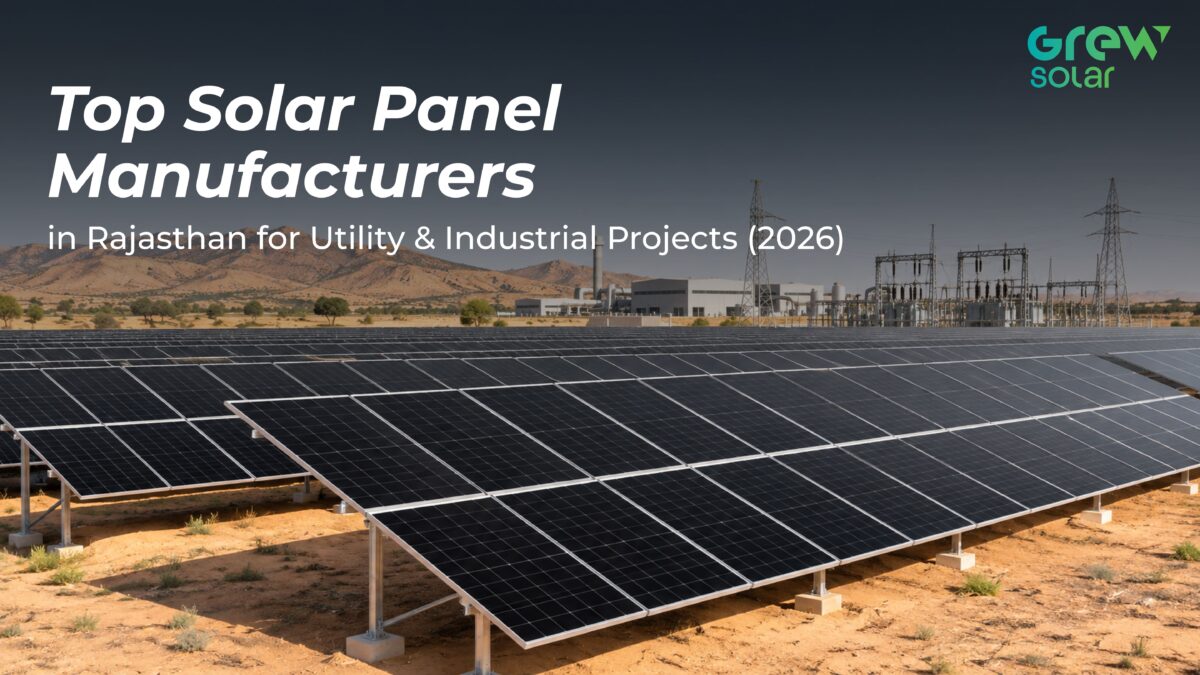
Top Solar Panel Manufacturers in Rajasthan for Utility & Industrial Projects (2026)

Rajasthan’s solar story has two chapters. The first is for its record-breaking installed capacity, the Bhadla Solar Park, and more sunny days per year than almost anywhere else in India. The second is newer, and growing faster than most people realise.

Alongside its position as India’s largest solar power-producing state, Rajasthan has quietly become one of the country’s more significant solar manufacturing destinations. Several large-scale manufacturers have established production facilities here over the past few years, drawn by the state’s industrial infrastructure, proximity to major project pipelines, and policy environment. Their presence is reshaping what Rajasthan means for India’s solar supply chain as a place where the technology behind it is built.

For project developers and EPC contractors evaluating module suppliers for utility-scale and industrial projects, the field in Rajasthan is wider than it was even two years ago. What follows is a look at five manufacturers with confirmed, operational facilities in the state, along with what developers should be evaluating before making a procurement decision.

Top Solar Panel Manufacturers in Rajasthan for Utility & Industrial Projects

1. GREW Solar

Manufacturing Facility: Dudu, Jaipur District, Rajasthan

GREW Solar was founded in 2022 and has scaled at a pace that few manufacturers manage in their first few years. The company operates a 6.5 GW solar PV module manufacturing plant in Dudu, Jaipur district with an expansion plan to 11 GW in the works. It is backed by the Chiripal Group’s 52-year manufacturing legacy that has shaped the operational discipline behind its production processes. 

What distinguishes GREW Solar from many peers is the depth of its integration strategy. Rather than focusing solely on module assembly, the company has established a 3.5 GW solar PV cell manufacturing facility in Narmadapuram, Madhya Pradesh planned to expand to 8 GW as the first step in a deliberate backward integration roadmap. 

Cells manufactured in-house feed into modules produced in Rajasthan, giving the company tighter control over quality and supply chain consistency than manufacturers dependent on externally sourced components.

GREW Solar is one of only 11 companies in India to have received a PLI allocation for fully integrated solar manufacturing. Its modules include high-efficiency N-type TOPCon solar PV modules are ALMM certified and designed for the performance demands of utility-scale and large commercial installations.

2. INA Solar (Insolation Energy)

Manufacturing Facility: Three facilities across Jaipur, Rajasthan

INA Solar is one of Rajasthan’s oldest module manufacturers. Established in 2015 with 80 MW of initial capacity, the company now has three manufacturing facilities across Jaipur with a total module manufacturing capacity of 5.5 GW. This scale-up is a reflection of both the growth in domestic solar demand and INA’s steady investment in manufacturing infrastructure. 

Its latest facility at Sawarda, on the Delhi-Ajmer Expressway, is spread over 600,000 sq ft and uses AI and robotics-driven manufacturing lines to produce M10R TOPCon modules. The degree of automation at this facility is notably high for the Indian market, with production processes designed to minimise variability across large batch runs. 

INA Solar is BSE SME listed and ALMM listed, with its modules supplying government programmes including PM-Kusum and PM Surya Ghar. Expansion plans on the table include 7 GW of module capacity and 4.5 GW of solar cell capacity across Rajasthan and Madhya Pradesh.

3. ReNew Photovoltaics

Manufacturing Facility: Mahindra World City, Jaipur

ReNew Photovoltaics is the manufacturing arm of ReNew Power, one of India’s largest renewable energy companies. The Jaipur facility is spread across 22 acres at Mahindra World City and manufactures around 15,000 modules per day. The ALMM List-I update of March 2026 lists 3.55 GW of enlisted capacity.

The strategic logic for manufacturing in Rajasthan is simple for a company like ReNew Power, with its project pipeline in the state. Manufacturing modules close to where they will be deployed shortens procurement lead times, improves logistics and ensures that product specifications are aligned with the practical needs of the projects they supply. For utility-scale procurement, that alignment matters.

4. SAEL Industries

Manufacturing Facility: Rajasthan

SAEL Industries came to manufacturing through a different route than most. The company is primarily a solar independent power producer, with over 6.7 GW of solar IPP assets across India. Manufacturing entered its strategy as a backward integration move building supply chain capability to reduce procurement dependency for its own growing project pipeline.

The Rajasthan facility runs 3.2 GW of bifacial N-type TOPCon module assembly, with a 300 MW unit in Punjab alongside it. The shift to TOPCon reflects the same direction utility procurement specifications are moving across the sector. SAEL has announced a larger integrated plant in Greater Noida as the next step in its manufacturing build-out, suggesting the Rajasthan operation is part of a longer strategic arc rather than a standalone move.

5. ACME Renewable Equipment Manufacturing

Manufacturing Facility: Jaipur, Rajasthan

ACME Renewable Equipment Manufacturing is a dedicated manufacturing entity within the ACME Group, a Gurgaon-based renewable energy conglomerate. The company operates a 1.2 GW ALMM-listed solar module manufacturing facility in Jaipur, commissioned with an investment of approximately ₹230 crore and currently employing over 700 people.

The scale of intent behind this facility is worth noting. ACME has set a target of ₹10,000 crore in revenue from its manufacturing business by 2030 positioning this as a core vertical within the group’s long-term strategy. Cell manufacturing capacity is in the pipeline as the company moves toward greater upstream integration.

What Developers Should Evaluate Before Choosing a Solar Manufacturer?

For utility-scale and industrial projects expected to operate for more than two decades, the choice of module manufacturer is a decision that will influence project performance long after installation is complete. Before shortlisting, developers should evaluate manufacturers across four areas:

  • ALMM Certification: Modules from non-listed manufacturers are ineligible for government-supported projects and open access schemes. Besides the listing itself, the more important questions are about what sits behind it and how much of the supply chain does the manufacturer actually control, and how consistent is output quality across large production batches?
  • Supply Chain Integration: Manufacturers who produce their own cells rather than sourcing them externally maintain tighter oversight of the most performance-critical component in the module. For developers procuring at scale, that consistency reduces the risk of underperforming batches showing up in a system that needs to deliver reliable generation for 25 years.
  • Technology: The shift toward N-type TOPCon across Rajasthan’s leading manufacturers reflects where utility procurement specifications are moving towards lower degradation, better thermal performance, and stronger long-term output retention. For projects where total lifetime generation is the financial variable that matters most, module technology is not a secondary consideration.
  • Warranty and Stability: A 25-year performance warranty is only meaningful if the company issuing it is built to last. Warranty terms, after-sales infrastructure, and the manufacturer’s operational track record all factor into this.
Categories
Grew Solar Industrial Solar Solutions Rajasthan Solar

How to Choose the Best Solar Panel Manufacturer in Gujarat for Commercial Projects (2026)

When a commercial solar project underperforms, the reason is rarely the sunlight.

It’s usually the modules and more specifically, the decision made about who manufactured them. A system built to run for 25 years will either justify or undermine that decision every year it operates. Getting it right at the start matters more than most buyers initially appreciate.

Across Gujarat, commercial solar adoption has accelerated. Manufacturing facilities in Ahmedabad, textile units in Surat, logistics parks near Vadodara, businesses across sectors are investing in solar infrastructure designed to run for decades. The size and ambition of these projects has grown, so has the cost of choosing the wrong manufacturer.

Price Is the Wrong Place to Start

Two modules with near-identical specifications on paper can deliver very different results after ten or fifteen years of operation. The difference isn’t visible on a quotation. It shows up in degradation curves, production consistency, and how the modules actually perform under the conditions they’re installed in, and not just under standard test conditions in a lab.

Gujarat’s climate makes this particularly relevant. High temperatures for much of the year mean thermal performance isn’t a secondary consideration. A module’s temperature coefficient i.e., how much efficiency it loses as heat rises directly affects real-world annual generation. A slightly higher-quality module from a manufacturer with tighter process control can generate meaningfully more electricity over its lifetime than a lower-priced alternative that looks equivalent on the datasheet.

For any serious commercial solar installation Gujarat project, the starting point for manufacturer evaluation shouldn’t be price. It should be what’s behind the price and the manufacturing process, the technology, and the quality infrastructure that determines whether the module performs as specified over a 25-year asset life.

What Integration Actually Means for Quality

There’s a meaningful difference between a company that assembles solar modules and one that manufactures them.

Many suppliers in the market source cells from third parties, often imported, and assemble finished modules locally. That model isn’t necessarily unreliable, but it introduces a variable that an integrated manufacturer controls and an assembler doesn’t, i.e., what goes inside the panel.

Manufacturers that produce both cells and modules under controlled production environments have direct oversight of the most performance-critical component. They can maintain tighter consistency across large production batches, trace quality issues back to their source, and reduce exposure to supply chain disruptions. For a commercial buyer procuring modules for a multi-megawatt installation, that consistency matters. 

Integration also relates to technology. Most serious manufacturers have moved, or are moving, toward N-type TOPCon cell technology rather than Mono PERC. TOPCon modules offer lower annual degradation rates, better performance in high-temperature and low-light conditions, and stronger output retention over time. For commercial projects where total generation over 25 years drives the financial case, the technology inside the module is also a financial variable.

Verify Certifications Before You Buy

Before shortlisting any manufacturer, two certifications should be non-negotiable: BIS certification and ALMM listing.

BIS certification is issued by the Bureau of Indian Standards which confirms the module meets India’s specified safety and performance standards, largely aligned with international IEC testing requirements. ALMM listing, maintained by the Ministry of New and Renewable Energy, requires a physical inspection of the manufacturing facility by the National Institute of Solar Energy, along with detailed documentation of production capacity and quality control processes. ALMM-listed modules are the only ones eligible for government-supported projects, open access schemes, and net metering benefits.

These certifications establish that a manufacturer meets the minimum standard to operate in the Indian solar market. They are the entry requirement. The right manufacturers demonstrate quality well above what certification requires, through in-house testing infrastructure and documented reliability systems.

Questions Worth Asking Before You Commit

When evaluating a solar company in Gujarat for a commercial project, the conversation should go beyond brochures and datasheets. A few questions that tend to surface the answers that matter:

Does the manufacturer produce its own cells, or does it source them externally? What technology is the current production line built around, and what’s the roadmap? How is quality managed across large production volumes, what testing happens at the module level before dispatch? What do the warranty terms actually commit to, and does the manufacturer have the operational stability to honour them over a 25-year period?

Any manufacturer worth choosing should be able to answer these questions clearly.

Gujarat’s Growing Manufacturing Ecosystem

Gujarat has become one of India’s strongest manufacturing hubs for renewable energy due to its industrial infrastructure, policy environment, and the concentration of commercial and industrial demand within the state. Businesses planning commercial projects in Gujarat now have access to manufacturers operating at significant scale, with the capacity to supply both large rooftop installations and utility-scale developments without procurement delays.

Among the manufacturers building at that scale is GREW Solar. Headquartered in Ahmedabad, GREW Solar operates a 6.5 GW solar PV module manufacturing facility in Dudu, Rajasthan which is expanding to 11.0 GW, and a 3.5 GW solar PV cell manufacturing facility in Narmadapuram, Madhya Pradesh, set to scale to 8.0 GW in 2026. As one of only 11 companies in India to hold a PLI allocation for fully integrated solar manufacturing, and with ALMM-certified modules across its product range, the company is among the more credible options for commercial buyers evaluating a solar panel manufacturer in Gujarat with a serious integration strategy behind it.

The Decision That Shapes 25 Years

Choosing a manufacturer for a commercial solar project is not a procurement decision in the conventional sense. It’s a decision that will influence energy generation, operational costs, and project reliability for the entire life of the system.

The manufacturers worth choosing are the ones who can demonstrate that their production process, technology, and quality systems are built to support that kind of long-term commitment. In Gujarat’s growing solar market, those manufacturers exist. Finding them requires asking the right questions, not just comparing the right prices.

Categories
Grew Solar Industrial Solar Solutions Rajasthan Solar

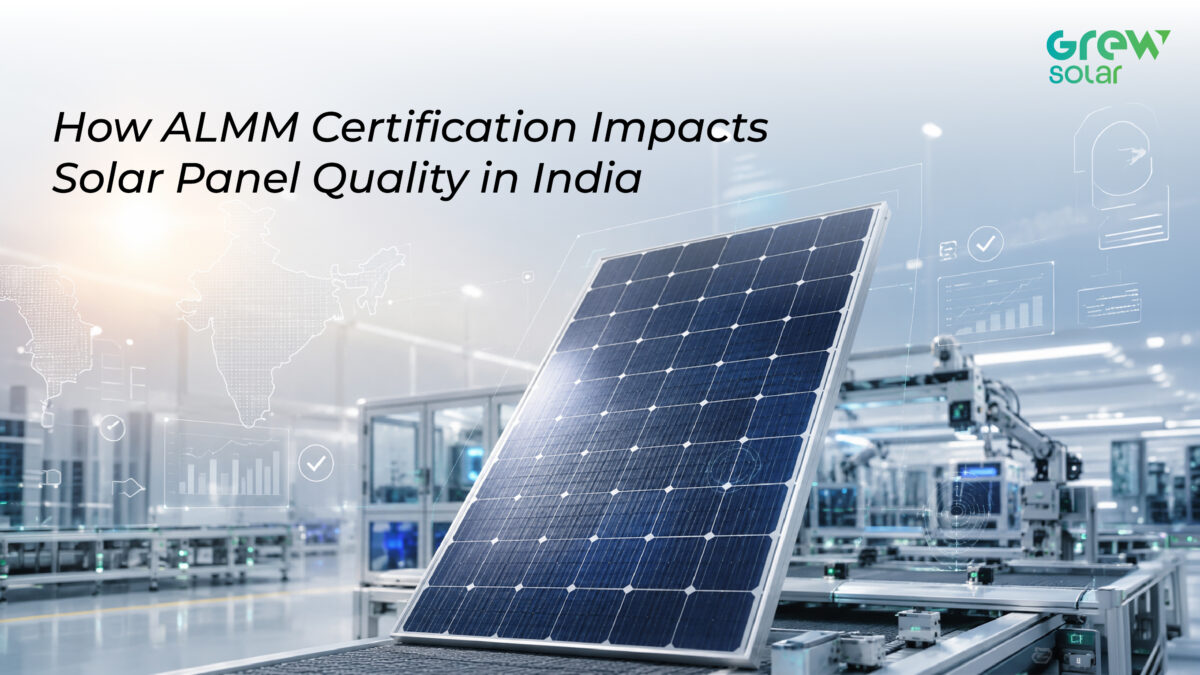
How ALMM Certification Impacts Solar Panel Quality in India

India’s solar sector has grown quickly but rapid growth in any industry tends to surface a familiar problem that not all products in the market are equal, and not all suppliers are accountable. The ALMM was the government’s answer to that problem.

Understanding what it actually does, and what it means in practice for buyers and developers, is more useful than treating it as just another compliance checkbox.

What Is ALMM?

The Approved List of Models and Manufacturers (ALMM) is a mandatory registration framework maintained by the Ministry of New and Renewable Energy. Introduced under the Approved Models and Manufacturers of Solar Photovoltaic Modules Order, 2019, and first issued on March 10, 2021, it functions as an official quality gate for the Indian solar market.

The list has two parts. List-I covers finished solar PV modules. List-II, introduced in September 2025 and enforced from June 1, 2026, covers the solar cells that go inside those modules. In plain terms: List-I is the approval for the panel, and List-II is the approval for what’s inside it.

Only modules and cells from ALMM-listed manufacturers are permitted in government-owned projects, government-assisted projects, and projects operating under schemes that provide regulatory benefits like net metering or open access. As of 2025, over 80 module manufacturers are listed under List-I, per MNRE data. List-II currently covers approximately 30 GW of approved domestic cell manufacturing capacity, per the seventh revision published in April 2026.

What Getting Listed Actually Requires

Getting onto the ALMM list isn’t straightforward, which is precisely the point.

Modules must meet certain safety and performance requirements, largely aligned with international IEC standards, for BIS certification. This is the minimum and a manufacturer can move to the next stage only after passing this.

The MNRE application requires extensive documentation, including company registration, financial details, comprehensive facility specifications, production capacity details and a complete outline of quality control procedures.Once submitted, the National Institute of Solar Energy, an autonomous body under the MNRE, conducts a physical inspection of the manufacturing facility. 

If the inspection clears, the manufacturer and its specific module models are added to the list. That listing is valid for two years, after which a renewal and re-inspection is required. Listing a new module model requires a fresh application for that specific model.

The entire process from documentation to approval is designed to be thorough enough that manufacturers can’t treat it as a formality.

What It Means for Buyers and Procurement Teams

For anyone procuring solar modules, the ALMM list does something simple but important. It removes a category of risk that’s otherwise difficult to manage: the risk of buying from a manufacturer with no verifiable quality infrastructure behind it.

A module appearing on ALMM List-I means it has cleared BIS certification, passed a NISE facility inspection, and is backed by documented quality processes. That’s a reliable minimum standard that non-listed products haven’t been required to demonstrate.

There are practical implications here that go beyond quality assurance. Modules sourced from non-listed manufacturers disqualify a project from government subsidies, scheme benefits, and regulatory advantages like net metering. For residential buyers, this includes schemes like PM Surya Ghar, which offers significant subsidies that simply don’t apply if the installed modules aren’t ALMM-listed.

The question of solar panel price in India often comes up here. ALMM-listed modules can carry a higher upfront cost than uncertified alternatives available in the market. But the relevant comparison isn’t the upfront price, it’s the total value over a 25-year module lifecycle. 

A lower-cost module with no quality verification behind it creates performance risk, maintenance exposure, and project ineligibility that erodes that apparent saving quickly. Certification isn’t a premium. It’s the cost of accountability.

What It Means for Developers and EPC Companies

For developers and EPC contractors, ALMM compliance is the entry requirement for any project with government linkage.

Under the ALMM mandate, any project seeking government support, participating in competitive bidding, or operating under open access or net-metering frameworks must procure from ALMM-listed suppliers. Using non-listed modules on a qualifying project doesn’t just create risks disqualifying the project from its regulatory framework entirely.

The extension of ALMM to cells under List-II adds a further layer from June 1, 2026. Module manufacturers on List-I must now source their cells exclusively from List-II-approved domestic suppliers. 

For EPC companies and developers evaluating suppliers, this means it’s no longer sufficient to verify module-level ALMM listing alone. The cells inside those modules now carry their own compliance requirement and the responsibility to verify this sits with the procurement team, not just the manufacturer.

What to Look for Beyond the List

ALMM certification is a baseline. It confirms that a manufacturer has met the minimum standard required to operate in the Indian solar market. It doesn’t differentiate between manufacturers who just clear that bar and those who build significantly above it.

For buyers and developers making procurement decisions that will sit on a project’s balance sheet for 25 years, the question worth asking isn’t only “is this manufacturer ALMM-listed?” It’s also, “what does their quality infrastructure look like beyond the listing requirements?”

Gujarat has become one of India’s most active states for solar manufacturing investment, and several serious players have based their operations there. Any credible solar panel manufacturer in Gujarat worth evaluating for a major project should be able to demonstrate not just ALMM listing, but the manufacturing depth and quality systems that explain why their modules perform the way they do over time. 

GREW Solar, headquartered in Ahmedabad and operating a 6.5 GW module manufacturing facility in Dudu, Rajasthan, alongside a 3.5 GW cell manufacturing facility in Narmadapuram, Madhya Pradesh, is one example of a manufacturer building toward that level of integration with ALMM certification as the foundation.

The ALMM is a meaningful quality standard but it works best when treated as the starting point of a procurement evaluation, not the end of it.